BrokerHiveXBrokerHiveXBrokerHiveX
Summary:Ho Chi Minh Stock Exchange (HOSE) Review: Is Vietnam's largest securities market reliable? A comprehensive analysis of regulatory compliance, market size, foreign investment restrictions, product diversity, and growth potential reveals the opportunities and risks of investing in the Vietnamese stock market.
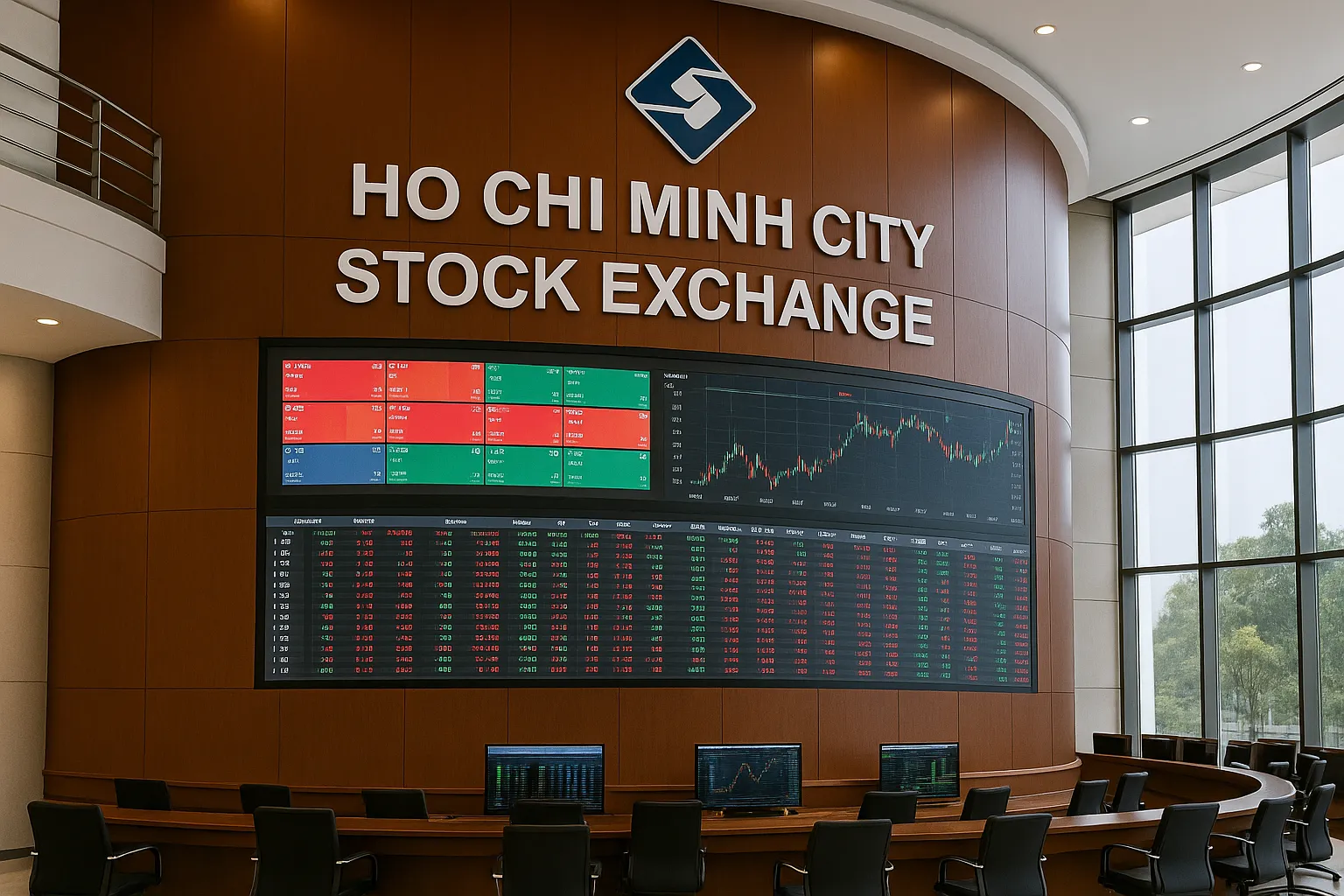
The Ho Chi Minh City Stock Exchange ( HOSE ), established in 2000, is Vietnam's first stock exchange. Initially featuring only two listed companies, it has grown into Vietnam's largest capital market, with a market capitalization exceeding US$200 billion . In 2020, HOSE merged with the Hanoi Stock Exchange (HNX) to form the Vietnam Stock Exchange (VNX) , but HOSE still maintains its core stock market functions.
The growth of HOSE is closely related to Vietnam’s economic reforms, especially after the “Đổi Mới” policy, when the capital market became an important channel to attract international investment and promote financing for domestic enterprises.
Unlike other Southeast Asian exchanges, HOSE's trading accounts are mainly dominated by local investors. Although the proportion of foreign shareholding has been gradually liberalized, there is still a policy restriction of a 30% foreign shareholding cap .
Trading hours : 9:00 – 15:00 daily (lunch break).
Market segments : Main Board (large and medium-sized enterprises), UPCoM (unlisted companies transition market), derivatives market (managed by HNX).
Investment groups : By 2024, the number of retail investors in Vietnam will exceed 7 million , while the proportion of institutional investors is still relatively low.
HOSE is regulated by the Ministry of Finance (MOF) and the State Securities Commission (SSC) of Vietnam, and all trading activities comply with the Securities Law.
Regulator : Vietnam State Securities Commission (SSC).
Legal basis : Vietnam Securities Law (last revised version 2019).
Compliance mechanism : including information disclosure system, mandatory financial audit, market monitoring system, etc.
Although the regulatory framework is gradually maturing, HOSE still has gaps in transparency and enforcement compared with places like Singapore and Malaysia.
Number of listed companies : approximately 400 (2024).
Market capitalization : approximately USD 200–220 billion.
Main indices : VN-Index (core composite index), VN30 (blue chip index).
Product types : Stocks, ETFs, bonds (primarily on HNX), the derivatives market is still in its early stages of development.
In 2021, HOSE experienced system downtime due to a surge in trading volume, forcing the Korea Exchange (KRX) to assist in providing a new generation of trading platform.
Currently, HOSE's technical infrastructure has been greatly improved, and the transaction matching speed has increased, but it still lags behind SGX and IDX in terms of high-frequency trading and cross-border access.
Degree of internationalization : Still positioned as a "frontier market".
Foreign investment restrictions : The upper limit of foreign shareholding affects liquidity and foreign investment participation.
Cross-border products : Some ETFs and offshore derivatives are listed in Singapore and Hong Kong, but on a limited scale.
This means that HOSE has limited appeal to international institutional investors, but still has considerable appeal to regional funds and local investors.
Language support : The official website supports Vietnamese and some English, but the English version has a significant data lag.
Investor Relations : Provide downloads of listed company announcements and financial reports.
Customer service channels : Mainly telephone and email, but compared to exchanges such as SGX, their professionalism is limited.
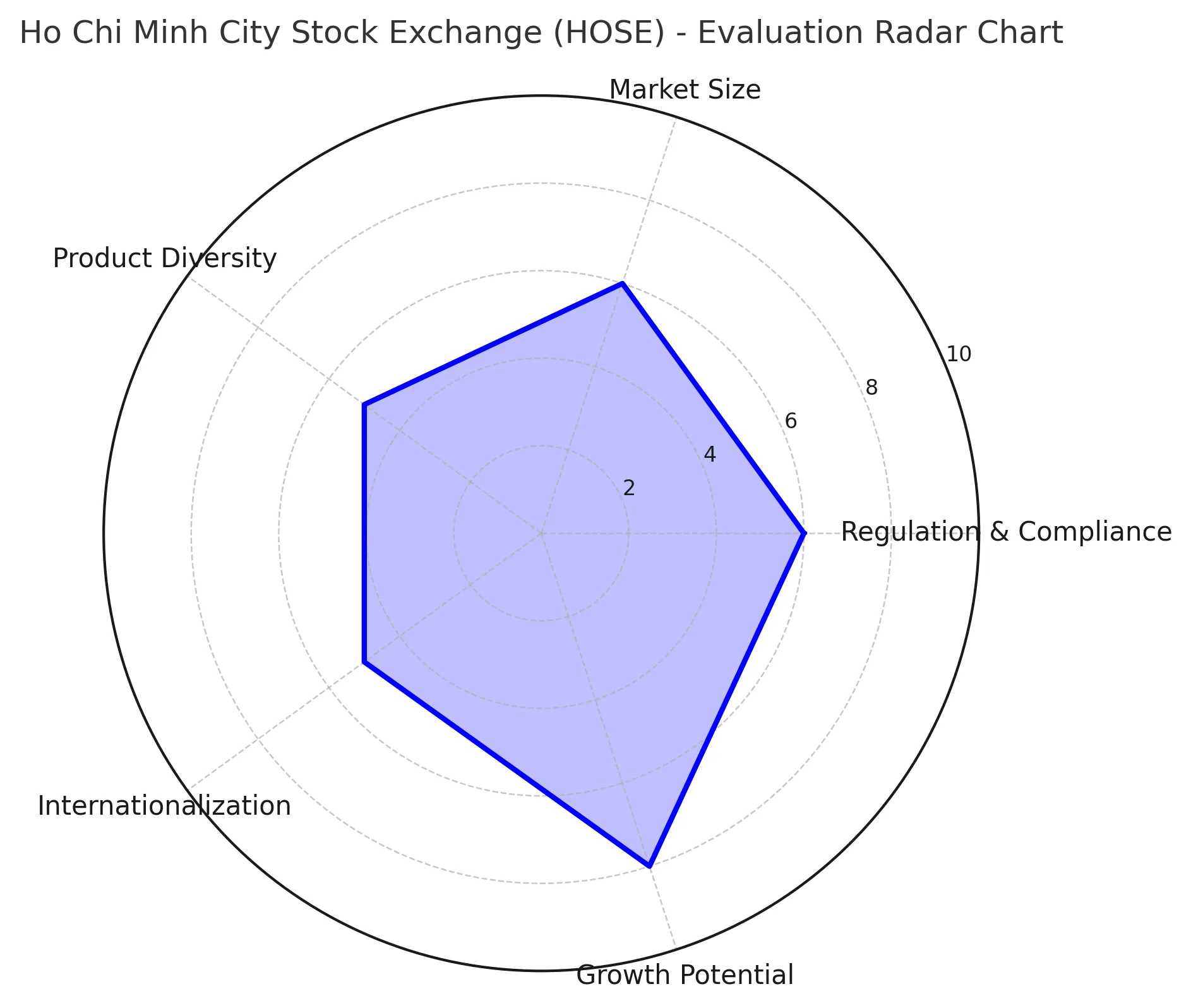
Regulation and Compliance : 7 / 10 — Basic framework in place, but transparency around enforcement needs to be improved.
Market size : 6 / 10 — Growing rapidly, but still lags behind regional leaders (SGX, IDX).
Product Diversity : 5 / 10 — Primarily stocks, with derivatives and bond markets still underdeveloped.
Degree of Internationalization : 4 / 10 — Foreign investment restrictions and market positioning limit its internationalization level.
Growth Potential : 9 / 10 — Vietnam's rapid economic growth has created strong momentum for capital market expansion.
📊Overall rating: 6.2/10
HOSE is still a developing capital market and is attractive to investors who are optimistic about the Vietnamese economy in the long term, but there are institutional and technical risks in the short term.
High market volatility : Vietnam's stock market is often affected by policies and capital flows and is subject to sharp fluctuations.
Liquidity risk : Some small and mid-cap stocks have low trading volumes and wide bid-ask spreads.
Foreign investment policy risks : The upper limit of foreign shareholding may be adjusted at any time, affecting investment expectations.
Systemic risk : Although the stability of the technical platform has improved, it still requires attention.
The Ho Chi Minh Stock Exchange (HOSE) is the core of Vietnam's capital market, offering both rapid growth potential and institutional challenges . For investors focused on Southeast Asian markets, HOSE provides a window into Vietnam's economic growth. However, investors should be mindful of risk factors such as regulatory transparency, technical implementation, and foreign investment policies.
BrokerHivex is a financial media platform that displays information from the public internet or user-uploaded content. BrokerHivex does not support any trading platform or instrument. We are not responsible for any trading disputes or losses arising from the use of this information. Please note that the information displayed on the platform may be delayed, and users should independently verify its accuracy.