BrokerHiveXBrokerHiveXBrokerHiveX
Summary:How is the Toronto Stock Exchange (TSX)? Is it reputable and secure? This review covers its regulatory compliance, global rankings, energy and mining strengths, internationalization, green finance, and future potential, providing investors with a comprehensive understanding.
Background : TSX was founded in 1852 and is one of the earliest organized securities exchanges in North America.
Current Status : In 2025, the TSX's market capitalization was approximately $3.2 trillion , ranking ninth globally and third in North America, behind only the NYSE and NASDAQ.
Strategic Role : The TSX is a core pillar of Canada's financial system, accounting for approximately 40% of the country's GDP and a source of financing . It is a global leader in the mining, energy and financial sectors.
The TSX's regulatory compliance system is considered one of the most transparent and robust in the world:
Main regulatory body : The Ontario Securities Commission (OSC) is at the core, and the Canadian Securities Administrators (CSA) achieves national coordination.
Legal basis : Ontario Securities Act, Canada Business Corporations Act.
Investor protection : The Canadian Investor Protection Fund (CIPF) provides compensation of up to CAD$1 million.
Cross-border law enforcement cooperation : TSX maintains cross-border information sharing with the SEC (US), FCA (UK), and HKEX (Hong Kong Exchanges and Clearing Limited).
Authoritative case : The proposed merger with the London Stock Exchange in 2011 was aborted due to regulatory and political resistance, demonstrating the independence and prudence of Canada's financial supervision.
By 2025:
Number of listed companies : Approximately 1,640, of which mining and energy companies account for more than 40% .
Market capitalization structure : Finance (32%), Energy (20%), Technology (14%), Healthcare and Consumption (34%).
ETF size : TSX is the second largest ETF listing market in the world, with a size of over C$400 billion .
Average daily trading volume : approximately 600 million shares, with a turnover of 6 billion Canadian dollars .
New share financing capacity : The scale of IPO financing in 2024 will be C$32 billion , ranking among the top ten in the world.
Stocks : Blue-chip companies are concentrated, dominated by financial, energy and mining giants.
ETFs and Funds : Canada is the birthplace of the ETF market, with products covering stocks, bonds, commodities and cryptocurrency-related ETFs.
Fixed Income : Government and corporate bonds have a mature secondary market on the TSX.
Derivatives Market : Options, interest rate and energy futures are traded centrally through the Montreal Exchange (MX).
REITs and Alternative Assets : TSX is the world's leading listing venue for real estate investment trusts (REITs).
Cross-border listings : TSX attracts companies from the United States, Latin America, and Asia, especially mining and new energy companies.
International comparison :
Compared with NYSE/NASDAQ : It has a smaller market capitalization, but has exclusive advantages in mining and resource companies.
Compared with LSE : There is fierce competition between the two in mining companies, and TSX has a clear lead in North American resource IPOs.
Compared with HKEX : TSX is more inclined towards resources and ETFs, while HKEX is more inclined towards new economy and Chinese companies.
Global investor participation : No foreign exchange restrictions, support for direct entry of overseas investors.
Trading engine : TSX Quantum XA system, capable of processing millions of orders per second .
Clearing and delivery : Services are provided by CDS Clearing , with a T+2 delivery system.
Risk management : real-time margin monitoring, circuit breaker mechanism, and automatic suspension system.
Market transparency : mandatory information disclosure, financial reports and major events must be made public through **SEDAR (Canadian Electronic Disclosure System**).
CIPF Compensation : Up to CAD$1 million in investor protection.
Typical case : During the 2008 financial crisis, TSX did not experience systemic defaults, demonstrating its liquidation and risk prevention and control capabilities.
Controversial events : Some small mining companies have been suspended or delisted due to insufficient information disclosure, indicating that supervision is strictly enforced.
Green and Sustainable Finance : Canada is a global leader in carbon emissions trading and green bonds, and the TSX is promoting ESG indices.
Technological innovation : The number of companies listed on the stock market related to AI, blockchain, and clean energy is growing rapidly.
Cross-border cooperation : In the future, TSX is expected to strengthen its cooperation with the capital markets in Asia (especially Singapore, Tokyo and Hong Kong).
Digital transformation : Introducing more electronic IPO processes and blockchain clearing technology.
Regulation and Compliance: 9.5/10
Market size: 8.5/10
Product diversity: 9.0/10
Internationalization: 8.5/10
Technology and Risk Management: 9.0/10
Future Potential: 9.0/10
Overall rating: 8.9/10
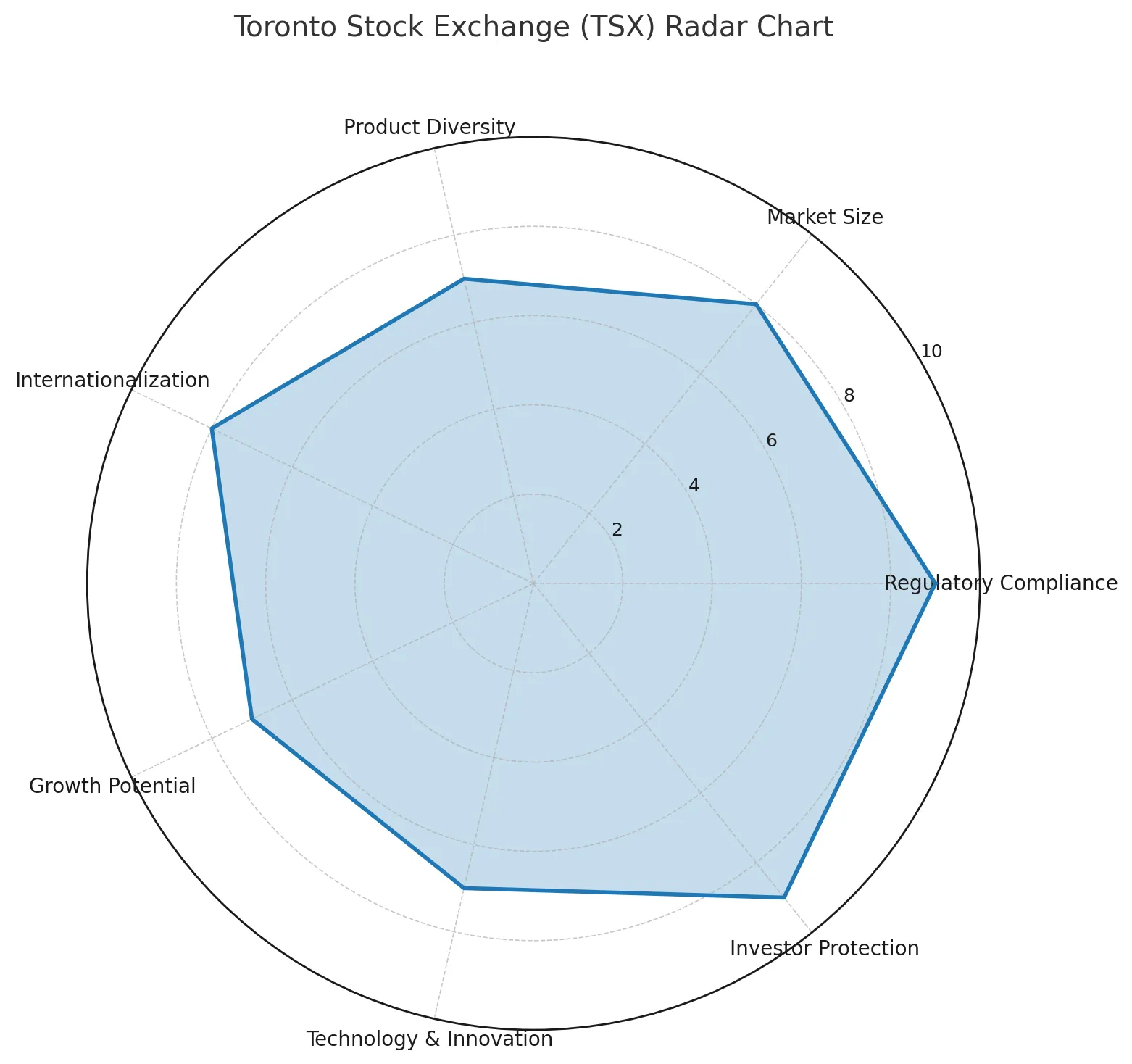
The TSX is a highly authoritative, secure, and stable financing center of choice for global resource-based companies . Its strengths lie in transparent regulation, a strong resource and financial sector, and leading green finance and ETF markets. However, its industry concentration is high (due to its reliance on energy and mining), and further breakthroughs are needed in technology and international expansion.
BrokerHivex is a financial media platform that displays information from the public internet or user-uploaded content. BrokerHivex does not support any trading platform or instrument. We are not responsible for any trading disputes or losses arising from the use of this information. Please note that the information displayed on the platform may be delayed, and users should independently verify its accuracy.