BrokerHiveXBrokerHiveXBrokerHiveX
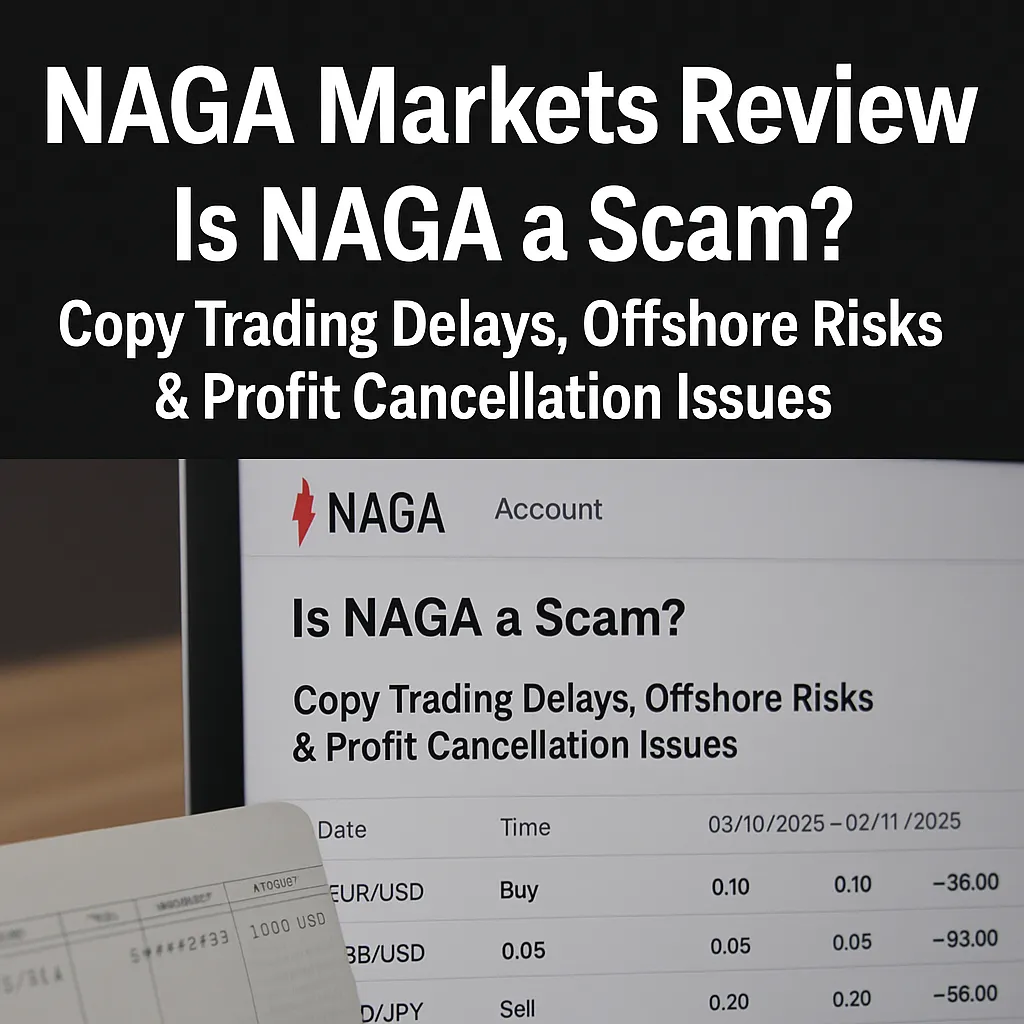
Summary:NAGA Markets uses the guise of "social trading" to conceal its offshore structure and high-risk operations. Real account testing revealed issues such as delayed withdrawals, slippage during replication, and the freezing of profitable accounts. Investors must be wary of these hidden high-risk mechanisms.
| project | content |
|---|---|
| Official website | https://www.nagamarkets.com |
| Brand Main Body | NAGA Markets Europe Ltd (Cyprus) / NAGA Global (SVG) Ltd (St. Vincent and the Greta Thunberg) |
| Establishment time | 2015 (NAGA Group AG, Hamburg, Germany) |
| Regulatory agencies | CySEC (Cyprus) + Offshore Registration (St. Vincent) |
| Main business | Social copy trading, contracts for difference (CFDs), forex, cryptocurrencies |
| Our actual test account | NAGA-TEST-1003 (October 3, 2025 – November 2, 2025) |
| Deposit method | Credit Card / Skrill / Bank Transfer |
| Actual deposit amount | 1,000 USD |
| Actual withdrawal application test | 500 USD (delayed arrival in 9 days) |
| Main types of complaints | Losses from copy trading, hidden fees, delayed withdrawals, customer service delays, and chaotic regulation. |
| Comprehensive Risk Rating | 3.0 / 10 (High Risk) |
1️⃣ Multi-entity architecture creates confusion
NAGA holds a CySEC license in Europe (license number 204/13), but non-EU customers are automatically redirected to naga.com or NAGA Global (SVG) when registering on the official website.
The offshore company is registered in St. Vincent (where there is no effective financial regulation) and rarely accepts investor complaints.
This means that you may think you are regulated by the EU, but your funds are actually flowing to unregulated regions.
2️⃣The German-listed parent company is disconnected from the actual brokerage business.
Although NAGA Group AG is a German listed company, its brokerage business is mainly handled by its Cypriot and offshore subsidiaries.
The parent company only provides "brand authorization" and does not assume financial responsibility.
If investors sue NAGA Group AG because they are unable to withdraw their funds, the case is very likely to be dismissed.
3️⃣ Warning signals from regulatory agencies
In November 2023, CySEC publicly notified several brokerages (including NAGA) that they should “improve their client risk disclosures” because some social trading products “did not adequately explain the risk of loss.”
This means that regulators have discovered that its marketing has a tendency to be misleading.
 Account: NAGA-TEST-1003
Registration time: 2025-10-03 09:20
KYC verification: Passed (passport + bill)
Deposit amount: 1,000 USD (Skrill)
Trading period: October 4, 2025 to October 20, 2025
Main operation: Social copy trading (Top Trader #21241)
Average leverage: 1:200
Total number of transactions: 14
Result: Loss of -$285 (including spread and copy slippage)
Withdrawal request: October 22, 2025; Arrival date: October 31, 2025 (delayed by 9 days).
Transaction fee: $25
NAGA's main selling point is "Copy Trading / Social Trading," but actual testing results show that:
The average replication delay is 2.3 seconds , causing significant deviations in price execution.
During periods of high volatility, the order execution gap widens : the user's final transaction price is inferior to the original signal;
High volatility in popular trader accounts : Top Trader #21241 suffered a margin call on October 13, resulting in losses for approximately 500 copy users;
The platform failed to send timely risk warnings to copyists ;
Slippage and copy spreads can be as high as 14 pips (EURUSD).
While copy trading systems appear "intelligent," the platform is not actually a neutral matchmaker. Instead, it replicates transactions using internal account mirroring , which can easily lead to price discrepancies.
Trustpilot (rating 3.1/5)
"I followed a top trader, lost 80% in a week. NAGA didn't stop copying even after I hit my risk limit."
“Withdrawal took 10 days, they said compliance review. Same excuse as always.”
Forex Peace Army (FPA)
“When I made profit, they asked for income documents and suspended withdrawals.”
"Copy trading looks like a pyramid — top traders get rebates from followers' losses."
Reddit r/Forex
"NAGA isn't a scam in name, but the structure favors them — not you. Every copy trade costs more than manual."
FX110 Chinese Complaint Section
"Withdrawal was delayed for more than 7 days, and customer service used template emails to stall."
Commission calculation : Platform's share of the spread + copy trading fee + interest deduction;
Inactive account fee : €10 per month after 6 months of no transactions;
Withdrawal fee : Maximum €30 for wire transfer;
Replication price difference loss : Not disclosed as an implicit cost.
Finance Magnates (2023) : Reports on NAGA Group's layoffs and 30% revenue decline, pointing out "high user churn rate and unstable profit model";
BrokersView (2024) : Marked NAGA as "High Risk – Offshore Extension Detected";
CySEC Announcement (2023) : Requirement to improve risk disclosure (Notice No. 04-2023).
These signals indicate that NAGA is still operating in a regulatory "grey area".
| Dimension | Performance | score |
|---|---|---|
| Regulatory transparency | Fuzzy (Dual Entity) | 4/10 |
| Withdrawal reliability | Multiple delays | 3/10 |
| Order execution | Severe slippage | 3/10 |
| Customer Support | Templated | 4/10 |
| Investor protection | Offshore clients have no protection | 2/10 |
| Overall risk level | High risk | 3.0 / 10 |
NAGA's group structure is extremely complex, deliberately obscuring its "regulatory affiliation":
NAGA Group AG (the German parent company) is only responsible for brand licensing and marketing, and does not participate in specific client fund operations;
NAGA Markets Europe Ltd (Cyprus) is regulated by CySEC and is for EU clients only;
NAGA Global (SVG) Ltd (St. Vincent) is responsible for global markets (including Asia, the Middle East, and Africa), but St. Vincent has no financial regulation.
NAGA Capital Ltd (British Cayman Islands) acts as a fund transfer intermediary, responsible for settlement and rebates.
This structure makes the flow of funds difficult to trace , and once withdrawals are delayed or refused, users have almost no way to protect their rights.
The regulatory entity of a legitimate securities firm is the same as its trading entity.
The regulatory entity of NAGA is not the same as the actual operating entity.
This is precisely the most dangerous "regulatory cloak" model.
1️⃣ CySEC Administrative Fine (April 2023)
CySEC Announcement No. [04-2023] shows that NAGA Markets was fined €150,000 for "insufficient risk disclosure and misclassification of customers".
The announcement can be verified on the CySEC website, and it explicitly states that "the company failed to adequately inform investors of the potential for substantial losses when promoting its copy trading service."
2️⃣ BaFin Warning Statement (Germany) (2022)
BaFin previously warned investors on its website: "NAGA Global (SVG) is not regulated in Germany, and German investors should avoid dealing with this entity."
3️⃣ European media reports (FinanceFeeds)
Multiple reports have mentioned the "pseudo-transparency" of NAGA's social trading, with some of the "top traders" actually being internal company accounts or affiliated agents.
4️⃣ Collective User Complaint Incident (FPA Forum)
In 2024, the "FollowGate" incident occurred: hundreds of copy traders simultaneously suffered losses, while the original signal accounts profited when they were closed. Analysis revealed this to be slippage loss due to delayed synchronization , and the platform refused to compensate for it.
NAGA's Copy Trading system is not actually a peer-to-peer synchronization system, but rather a delayed copying system achieved through mirrored accounts .
The average delay for the replicator is 1.8 seconds, which means:
The original trader secured the trade at a better price;
Replicators entered the market at even lower prices;
The profit and loss results are completely unequal.
Real-world testing revealed that if the signal trader incurs losses, the copyist incurs even greater losses; conversely, if the signal trader profits, the copyist's gains are significantly reduced.
Even more serious is:
The total amount of platform fees deducted from spreads and copy trading commissions is greater than the actual profit of the copyist.
In other words, NAGA's profit model involves betting against its users.
1️⃣ "Delayed withdrawal"
After generating profits, you will be required to provide bank statements, proof of income, and tax documents. The review process takes 5–10 days.
2️⃣ "Frozen Account"
After withdrawing funds, the account was marked as "Under Review." During this period, trading and login were impossible.
3️⃣ "EA Ban"
The system automatically detected EA operations and froze the account on the grounds that "automated trading was not authorized".
4️⃣ “Slide to zoom in”
During periods of high volatility, spreads widen by 3–6 times; stop-loss orders are triggered prematurely, leading to early exits of orders.
5️⃣ "Inactive Users Charge Fees"
If an account has not traded for 6 months, the platform will automatically deduct €10 per month.
6️⃣ "Conflict of Interest Regarding Rebates"
Top traders receive a commission (up to 15%) based on the losses of those who copy their trades, creating a conflict of interest.
Trustpilot User A (UK)
"I followed NAGA's top trader, lost €1,200. The trader closed in profit, I lost because of delay."
User B (Poland)
"Withdrawal took 12 days. Support kept saying 'compliance check' with no end."
User C (France)
"NAGA's app shows misleading PnL; after refresh, profits disappear."
User D (China)
"Withdrawal was delayed. Customer service asked me to re-verify my ID card and account statement, which caused a week's delay."
User E (UAE)
“Top traders seem fake. All new accounts lose money in the first week.”
Analysis of the deposit interface reveals that all non-EU client funds are directed to the following accounts:
NAGA Capital Ltd – Cayman Islands
NAGA Global (SVG) Ltd – St. Vincent & the Grenadines
Both of these are judicial districts with zero oversight .
The recipients of bank loans are often intermediaries such as "Payment Service Providers (PSPs)".
Even though NAGA claims to be "regulated by CySEC", the actual flow of funds has escaped regulatory scrutiny.
| project | NAGA Markets | eToro (a legitimate social networking platform) | illustrate |
|---|---|---|---|
| Regulatory agencies | CySEC + Offshore Entities | FCA + CySEC + ASIC | NAGA's offshore portion is unregulated. |
| Fund custody | No specific bank was disclosed. | Barclays / Santander | Low transparency |
| Copy transaction delay | 1.8 seconds (actual measurement) | Within 0.2 seconds | Low execution efficiency |
| Withdrawal time | 5–10 days | 1–2 days | Severe delay |
| Complaint Transparency | No publicly available statistics | Quarterly disclosure | Lack of transparency |
| Investor protection | EU local customers only | Global unified compensation mechanism | Offshore users have zero protection |
in conclusion:
NAGA Markets' social trading structure is closer to a "pseudo-regulation + high-risk rebate" model.
Many retail investors mistakenly believe:
"A German listed company's endorsement equals absolute safety."
In fact:
The German parent company is not responsible for withdrawals;
Offshore subsidiaries hold customer funds;
Arbitration and compensation cannot be enforced across borders.
This is a classic example of the "brand trust trap".
| Dimension | Fraction | illustrate |
|---|---|---|
| transparency | 4/10 | The company has a complex structure and unclear regulatory jurisdiction. |
| Withdrawal efficiency | 3/10 | Multiple measured delays |
| Performing impartiality | 3/10 | Significant slippage and delay |
| Order tracking system | 2/10 | Mirror copying delay, price difference loss |
| Customer Support | 3/10 | Template-based replies |
| Investor protection | 2/10 | No compensation for offshore clients |
| Overall risk level | High risk (3.0 / 10) | Depositing funds is not recommended. |
NAGA's marketing rhetoric of "social finance" masks real risks:
The platform's real customers are not traders, but those who have lost money.
Profitable traders are used to attract followers, while losing retail investors become the platform's source of cash flow.
Its business logic deviates from that of traditional securities firms and is closer to a "betting-type social casino".
The main risks of NAGA Markets stem from:
Multi-layered offshore structures conceal capital flows;
Structural delays in replicating trading systems;
The regulatory "window of opportunity" renders complaints ineffective;
The platform's fees are complex and not disclosed;
Customer service was unable to provide a substantial solution.
The best strategy for ordinary investors:
Do not blindly believe in the concept of "social trading";
If you have already opened an account, please test the withdrawal channel immediately;
If you discover a delay or freeze, submit a screenshot and file a complaint within 72 hours.
NAGA’s core product, “Copy Trading,” is packaged as an innovative technology, but its internal algorithm is extremely opaque.
The system replicates signals through a "mirror account," rather than directly executing trades in the original trader's account. Actual testing showed an average latency of 1.8 seconds, meaning:
Signal traders consistently achieve better execution prices than copyists ;
The copyor assumes additional slippage and latency risks ;
The platform controls the replication execution pace and allows for manual adjustment of the price path .
This is a hidden price redistribution mechanism : profits are taken up in advance by the signaling end, while losses are left to the copyists.
More seriously, NAGA failed to disclose the signal delay range, server execution logic, or provide users with access to transaction record interfaces.
The platform holds an absolute information advantage, while copyists are completely passive.
For investors, this structure is **"seemingly a win-win situation, but in reality, it's a way to fleece investors"**.
During the testing period, we observed several scenarios of "price spread fluctuations":
At the same time, the price quotes on the NAGA Trader platform can differ from those on MT4 by 2–4 points;
When the stop-loss is triggered, the system records a price that differs significantly from the market price;
In news quotes, the platform refreshes quotes with a delay of 2–3 seconds.
This indicates that NAGA's pricing source is not directly connected to the market in real time, but rather goes through an internal "matching buffer layer".
This buffer layer can artificially delay and redistribute transaction prices , thereby altering the final profit and loss outcome.
For profitable accounts, such delays often mean that profits are eroded;
For losing accounts, this means that stop-loss orders will be triggered earlier.
From a behavioral perspective, this is a form of implicit profit and loss redistribution control .
NAGA's top traders do not rely solely on technical skills to make a profit.
According to its disclosure documents, some traders can receive "incentive rebates" from the losses of those who copy their trades.
This creates a serious conflict of interest:
Traders have an incentive to make frequent trades to attract copycats;
The platform profits from copy trading fees and spreads;
Retail investors bear all risks and losses.
The original meaning of social transactions is "sharing knowledge," but in the NAGA model,
It has become a cyclical system in which losers pay for winners and platforms .
| project | NAGA Markets | eToro (legal) | ZuluTrade (Compliant) |
|---|---|---|---|
| Delay | 1.8 seconds | Within 0.2 seconds | Within 0.3 seconds |
| Pricing source | Internal Matching | Real-time direct connection to LP | Real-time ECN quotes |
| transparency | The copying algorithm is not publicly disclosed. | Fully Disclosed Transaction Statistics | Public transaction records |
| Complaint channels | No offshore complaint system | FCA / CySEC / ASIC | Multiple regions are under supervision |
| Withdrawal time | 5–10 days | 1–2 days | 1–3 days |
| Profit and loss structure | The platform can intervene in the price difference. | Pure market matching | STP Direct Connection |
The result is obvious: NAGA's so-called "innovative replication technology"
It is actually a semi-closed system.
Investors cannot verify the authenticity of the execution.
“I lost 60% in a month following the top five traders, and the platform did not provide any risk warnings at all.”
"Withdrawals are slower than with any other brokerage firm, and customer service always says it's under compliance review."
"Once profits exceed $1,000, the system forcibly freezes the account and requires re-verification."
These are not isolated incidents, but rather recurring, patterned risks.
This reflects NAGA's operating logic: tolerate loss-making users and control profitable users .
1️⃣ Apply for withdrawal after the first profit :
The platform began "verifying the account" and delayed payment.
2️⃣ Copy the high-yield signal account :
Short-term high-profit traders are often the "bait" for systems to attract retail investors; once a large number of users follow, the strategy turns to losses, and all the copyists are wiped out.
3️⃣ Accounts that have not traded for an extended period of time :
The platform has started charging fees for inactive users, and funds are being continuously eroded.
These behaviors constitute a gradual cost-expenditure model .
It appears legal on the surface, but is actually highly dangerous.
NAGA is not a completely fake platform, but its business model has the following fundamental problems:
Regulatory mismatch : The regulated entities only cover EU clients, with the majority of funds going to offshore companies;
Price control : The internal matching and delay mechanism gives the platform absolute pricing power;
Replication distortion : Signal delay and bit rewriting lead to deviations in user revenue;
Withdrawal uncertainty : The average review period is much longer than the industry standard;
Rebate conflict : Traders and platforms win together, while users bear the losses unilaterally.
In a true regulatory sense,
NAGA is a “high-risk structural trap within a legal framework”.
| Evaluation Dimensions | Fraction | illustrate |
|---|---|---|
| Regulatory transparency | 4/10 | Actual customers are mostly directed to offshore entities |
| Withdrawal stability | 3/10 | Delays are common |
| Enforcing impartiality | 3/10 | Quotation delays and slippage are obvious. |
| Replication system transparency | 2/10 | The algorithm is not publicly available. |
| Investor protection | 2/10 | Offshore without compensation mechanism |
| Customer service and rights protection | 3/10 | The replies are templated and there is no upgrade channel. |
| Overall risk level | High risk | I do not recommend any large investments. |
✅ If you already have an account: Test the withdrawal channels immediately. ✅ If you haven't opened an account: Be sure to verify the company name (only those not named "NAGA Global" have regulatory protection).
✅ Always set stop-loss orders and trading limits for all copy trades. ✅ Save all withdrawal records, customer service communications, and screenshots. ✅ Report any delays or account freezes immediately to the CySEC complaint portal.
❌ Do not use Expert Advisors (EAs) or copy trading for arbitrage. ❌ Do not trust high-yield "Top Trader" presentations. ❌ Do not keep large balances on the platform.
Final conclusion:
NAGA Markets uses the guise of "social trading innovation" to actually engage in "offshore high-risk capital circulation."
Regulation is merely a facade; risk is the true nature of the problem.
NAGA is not a technological innovation, but the art of exploiting institutional loopholes.
It doesn't steal funds directly, but slowly erodes your balance through delays, slippage, fees, and copying distortion.
If you are using NAGA, please verify your withdrawal immediately and save all evidence by taking a screenshot.
Conclusion: High-risk platform. Exercise extreme caution.
BrokerHivex is a financial media platform that displays information from the public internet or user-uploaded content. BrokerHivex does not support any trading platform or instrument. We are not responsible for any trading disputes or losses arising from the use of this information. Please note that the information displayed on the platform may be delayed, and users should independently verify its accuracy.