BrokerHiveXBrokerHiveXBrokerHiveX
Summary:Comprehensively analyze the differences and connections between options and futures, exploring the application of financial derivatives in investment, hedging, and risk management. Interpret the latest market trends and strategies to help investors understand the practical value of options and futures.
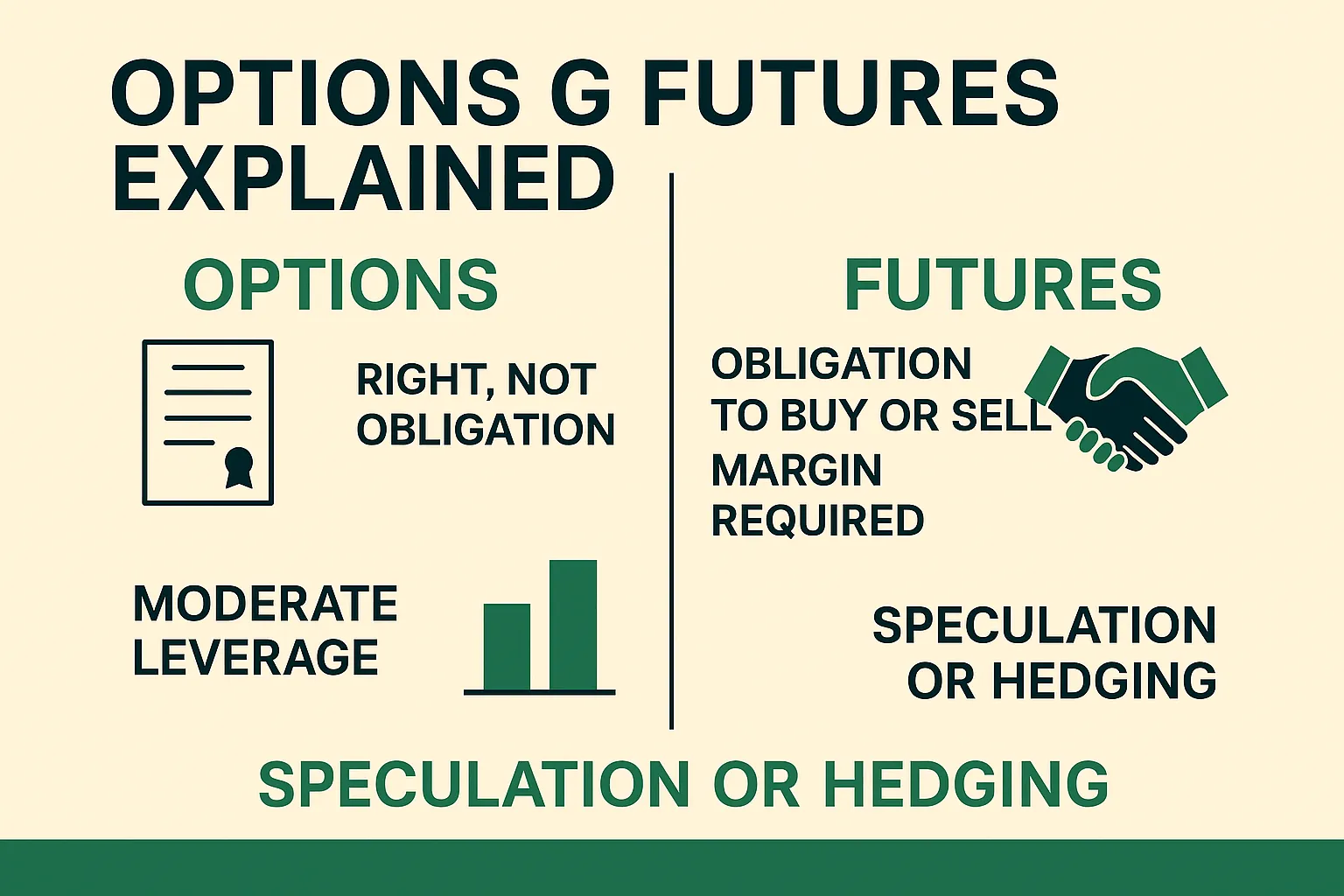
Financial derivatives are contracts based on underlying assets (such as stocks, foreign exchange, commodities, and indices), whose value depends on price fluctuations. The most common derivatives include options and futures , which are widely used in global financial markets, fulfilling functions such as price discovery, risk hedging, and speculative profit.
Definition : An option is a contract that gives the holder the right, but not the obligation, to buy or sell an underlying asset at an agreed price at a specific time in the future.
Types : Call and Put.
Common strategies :
Covered Call: Holding the underlying asset and selling a call option.
Protective Put : Hold the stock and buy a put option for protection.
Straddle : Simultaneously buying call and put options of the same expiration date to protect against large fluctuations.
Risk and reward : The maximum loss of an option is the option premium, while the potential gain is theoretically unlimited.
Definition : A futures contract is a contract that requires two parties to buy or sell an underlying asset at an agreed price on a specific date in the future.
Application scenarios :
Commodity trading (such as crude oil, gold, wheat)
Stock index futures (hedging systemic risk)
Foreign exchange futures (managing exchange rate fluctuation risk)
Leverage and Risk : Futures margin trading can magnify returns, but it also magnifies risks and can easily lead to margin calls.
| Dimensions | Options | Futures |
|---|---|---|
| Rights and obligations | The buyer has rights but no obligations; the seller has obligations | Both parties have an obligation to fulfill their contract |
| Maximum loss | The buyer only loses the premium | Unlimited losses possible |
| Leverage Effect | Medium (controlled by option premium) | High leverage, margin trading |
| Common Uses | Speculation, volatility trading, protective hedging | Commodity trading, systemic risk hedging |
Risk Control Recommendations
Options investors should beware of "time value loss"
Futures trading requires setting stop-loss and margin management
International Regulatory Developments
The CFTC (U.S. Commodity Futures Trading Commission) regulates the futures market
The SEC (U.S. Securities and Exchange Commission) regulates the options market
Major European and Asian markets have also strengthened compliance requirements for derivatives trading.
Options and futures, as key representatives of financial derivatives, have become indispensable tools in the global capital market. Options are suitable for volatility trading and protective hedging, while futures play a prominent role in commodity and systemic risk management. For investors, understanding their mechanisms, applying appropriate strategies, and rigorous risk management are key to sound investment practices.
BrokerHivex is a financial media platform that displays information from the public internet or user-uploaded content. BrokerHivex does not support any trading platform or instrument. We are not responsible for any trading disputes or losses arising from the use of this information. Please note that the information displayed on the platform may be delayed, and users should independently verify its accuracy.