BrokerHiveXBrokerHiveXBrokerHiveX
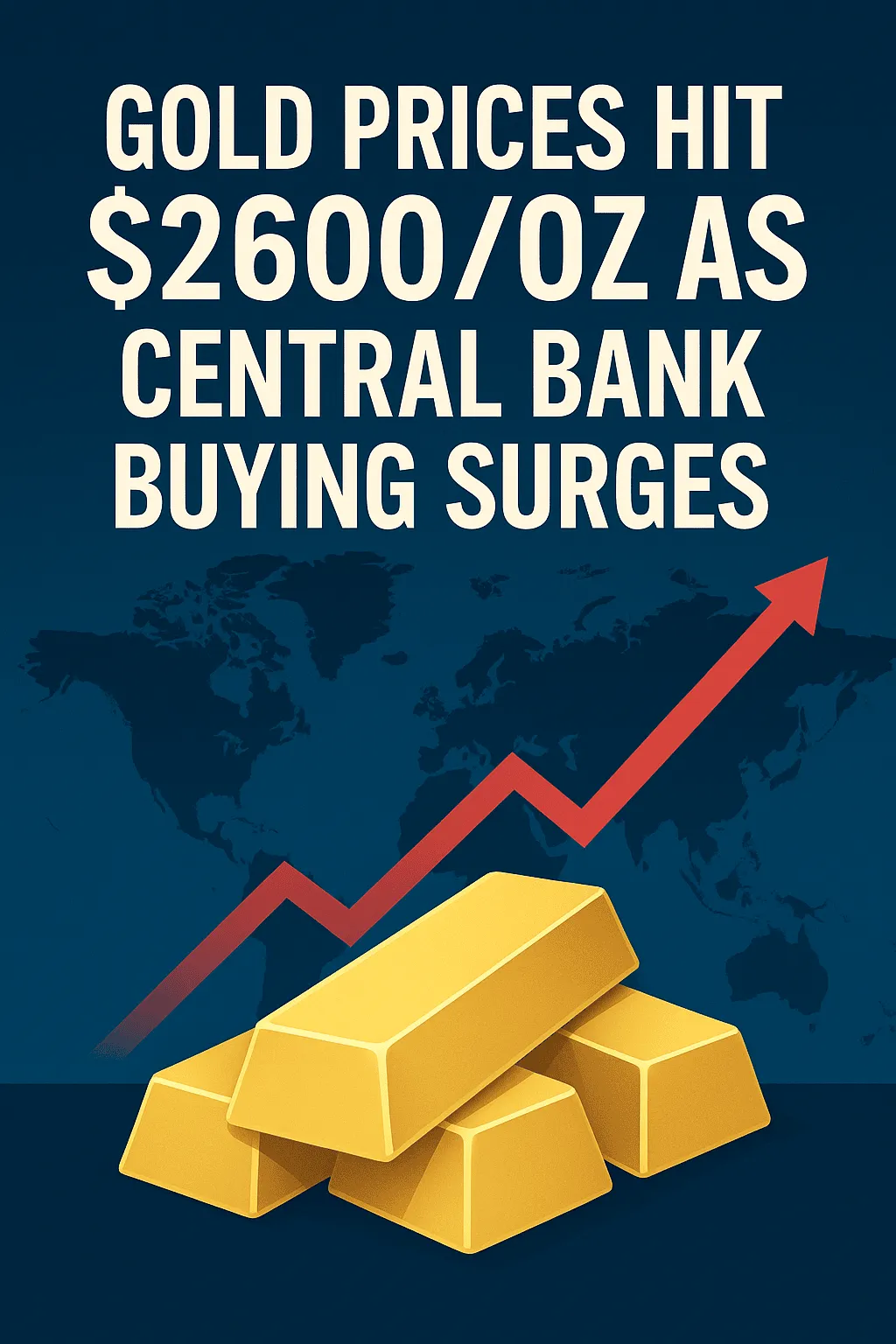
Summary:In July 2025, the latest quarterly report of the World Gold Council (WGC) showed that the global central bank's new gold reserves reached 1,300 tons, the highest level since records began in 1994. Safe-haven demand, de-dollarization and geopolitical concerns pushed the gold price above $2,600 per ounce. Industry insiders predict that with the downward trend in policy interest rates and loose liquidity, gold may enter a new round of "super bull market", but the risk of short-term volatility cannot be ignored.
Evelyn Carter , Lead Reporter, Commodities & Macro Hedge
According to statistics from the World Gold Council (WGC), in the first half of 2025, global central banks purchased 1,300 tons of gold, a year-on-year increase of 28%. On the surface, it seems to be "balance sheet rebalancing", but in fact there are three deep drivers:
De-dollarization and diversification of foreign reserves - After the Russia-Ukraine conflict, nearly 40% of central banks in emerging economies emphasized "reducing sensitivity to sanctions", and gold became the first choice because it has no sovereign credit risk.
Monetary policy hedging - the U.S. and European central banks have entered the "pause rate hike" window since mid-year, real interest rates have fallen, and the opportunity cost of holding zero-interest gold has decreased, which is in sharp contrast to the Fed's rapid interest rate hike period in 2022.
Demand for currency stability - High-inflation countries such as Turkey, Egypt, and Argentina use gold-buying signals to boost confidence in their own currencies, while also reserving "last-resort guarantee assets" for potential exchange rate depreciation.
Since breaking through $2,400 at the end of April, global gold ETFs have seen net subscriptions for eight consecutive weeks for the first time in three years, attracting a total of $11 billion. CME quotes show that COMEX gold futures positions have increased to 790,000 lots, and long positions have doubled since the beginning of the year. At the same time, the gold mining stock ETF (GDX) has risen 48% this year, outperforming the S&P 500's 17% and Nasdaq's 23%.
Institutional behavior : Pension funds and sovereign funds return to gold ETFs to lock in inflation uncertainty.
Retail investor sentiment : The number of precious metals trading accounts on the Robinhood platform increased by 35% compared to last year, becoming an important amplifier of gold price momentum.
Historical data shows that when the real interest rate (nominal government bond yield minus inflation) is below 1%, the excess return of gold relative to the S&P 500 rises significantly. In July this year, the real yield of the US 10-year TIPS fell below 0.85%, hitting a 14-month low; the eurozone is closer to 0%. Under the combination of "low real interest rates + inflation tail risk", gold once again plays the dual role of "quasi-currency" and "fifth reserve asset".
Fed’s path : interest rate futures imply a 50 bp rate cut in Q4 2025; the pace of the Fed’s balance sheet reduction has slowed, and liquidity has eased marginally.
Inflation tail : The surge in Middle East freight rates and fluctuations in food prices have made the market wary of re-inflation, and the demand for gold hedging continues.
The world's top ten gold mining companies account for more than 46% of the output; South Africa and West Africa account for about 22% of the world's new resources, and political unrest and power shortages in the two places have caused supply bottlenecks. The copper-gold price ratio shows that the strengthening of copper prices has pushed up the cost of associated gold and compressed the return on investment in new production capacity. Although Canadian and Australian miners are actively expanding production, it takes an average of 5-7 years from feasibility study to production of new projects, making it difficult to fill the gap in the short term.
Tactical configuration : After the gold price quickly broke through $2,600, it was technically overbought, with RSI > 75. It is recommended to hedge the risk of high-level pullback through options, or configure gold/silver spread trading.
Structural preference : Prioritize low-cost North American mining companies with abundant cash flow, as well as medium-sized miners with potential for resource expansion; while paying attention to sustainable mining ESG ratings.
Currency diversification : Gold ETFs denominated in RMB and Euro are affected by the appreciation and depreciation rhythm of the local currency and are suitable for hedging exchange rate exposure.
If the US dollar index breaks through 106 due to safe-haven flows, it will suppress the gold price denominated in US dollars;
The pace of gold purchases by central banks may suddenly slow down as fiscal pressures change, causing a demand gap;
Derivative leverage : Gold futures longs account for 74% of open contracts. In the event of forced liquidation or increased regulation, it may lead to sharp short-term fluctuations.
Louise Street, senior strategist at WGC, predicts that if the Fed's real interest rate remains below 1% and the central bank's gold purchases remain at 300 tons per quarter, the gold price may reach $2,800 within 12 months. However, UBS believes that if a soft landing is achieved and the US dollar rebounds, the gold price may fall back to the range of 2,350-2,400.
Evelyn Carter concluded: "Gold is at the intersection of loose macro liquidity, diversified central bank reserves and supply-side bottlenecks. Investors need to find a balance between emotional climax and fundamental support, and use dynamic hedging and portfolio diversification to smooth out fluctuations in order to truly enjoy the dividends brought by the 'central bank bull market'."
BrokerHivex is a financial media platform that displays information from the public internet or user-uploaded content. BrokerHivex does not support any trading platform or instrument. We are not responsible for any trading disputes or losses arising from the use of this information. Please note that the information displayed on the platform may be delayed, and users should independently verify its accuracy.