BrokerHiveXBrokerHiveXBrokerHiveX
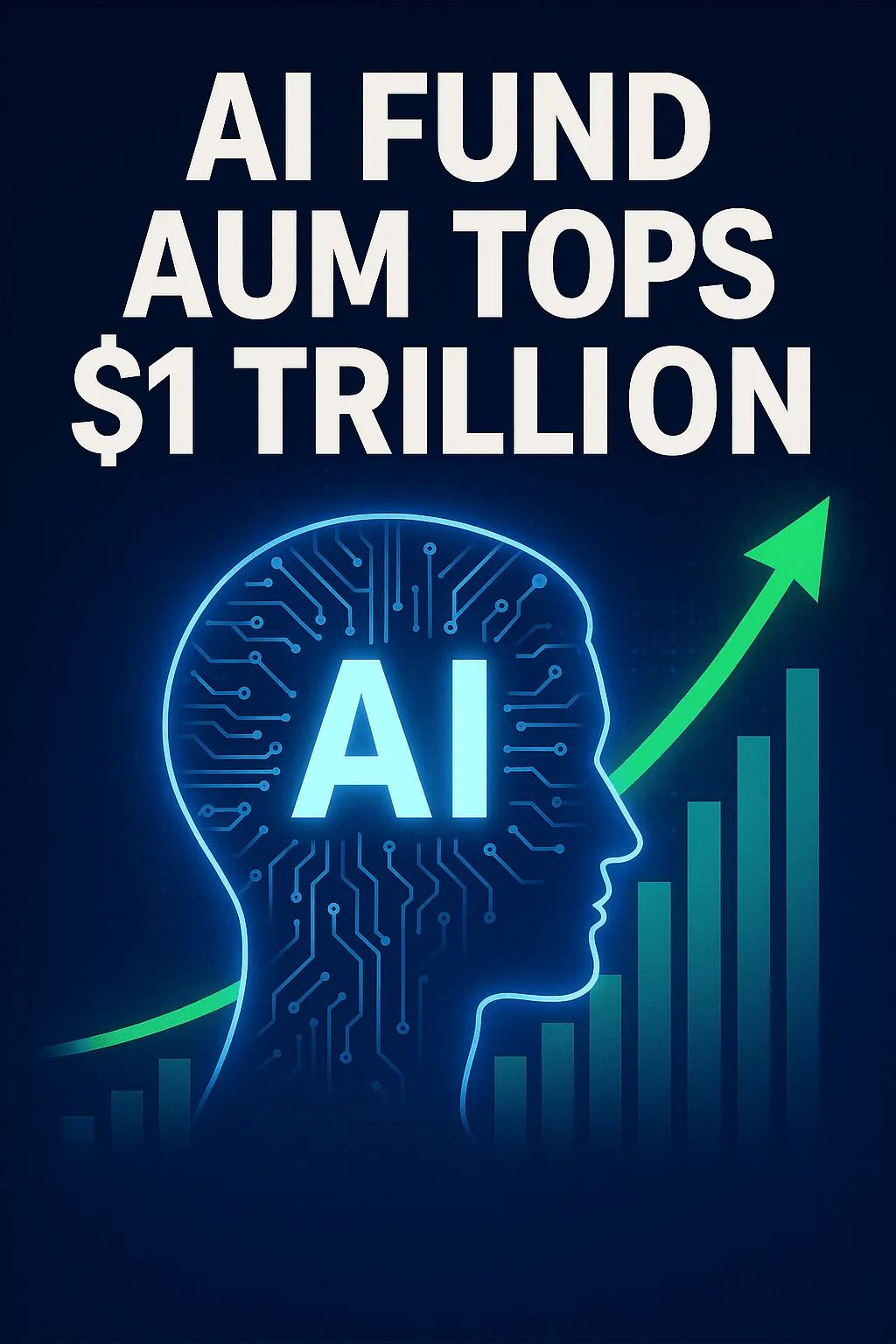
Summary:The latest statistics from global index agency MSCI show that as of July 2025, the total management scale (AUM) of active and passive funds incorporating AI themes will exceed US$1 trillion for the first time. This figure has increased by more than 60% from the end of 2024, reflecting the continued pursuit of generative AI, large model chips, automation software and data center REITs by global investors. Industry analysts believe that policy support and corporate profit resonance are the main drivers, but valuation and bubble risks are also increasing.
 Contributor
Andrew Li , Senior Reporter, Technology and Capital Markets
In the first half of 2025, global AI-themed funds attracted a total of $378 billion, pushing the total scale to over $1 trillion. In terms of subdivision, passive index products (ETFs and index-enhanced funds) contributed 55% of the increase, and active hedge funds and private equity funds contributed the remaining 45%. In terms of geographical distribution, North American institutions are still the main force, accounting for 48% of positions; European, British and Nordic pension funds account for 24%; Asia (including Middle Eastern sovereign funds and Singapore family offices) accounts for 22%, and the remaining 6% comes from insurance and mutual funds in Latin America and Oceania. It is worth noting that Asia has the fastest growth rate of funds, with a net inflow of $82 billion in the first half of the year, a year-on-year increase of 98%, reflecting the dual-wheel drive of "local computing power construction + generative AI landing".
Since ChatGPT detonated generative AI in 2023, investors have gradually shifted from simply chasing model companies to full-stack value chain layout. In terms of upstream hardware, the revenue growth rate of GPU, ASIC, HBM, high-end switching chips and optical modules generally exceeds 50%; at the same time, advanced packaging capacity such as TSMC, ASE, and Samsung is hard to find. The midstream computing power infrastructure has entered the "GPU super node" era, and the capital expenditure guidance of the six major cloud vendors in North America in 2025 has been raised to US$270 billion, an increase of 32% year-on-year. Downstream applications show a "three-wave diffusion"-after the large text model matures, pictures, videos and multimodal models enter commercialization; in addition, RAG (retrieval enhanced generation) and Agent frameworks have significantly improved the retention rate of AI SaaS customers. Investors gradually shifted the valuation anchor from "parameter scale" to "unit computing power efficiency" and "gross profit margin realization."
United States : The Biden administration’s second phase of the Chips and Science Act added $25 billion in incentives, focusing on subsidizing GPU packaging, chiplet interconnection, and silicon photonics integration; at the same time, it expanded the IT investment tax deduction ratio of the Inflation Reduction Act, and AWS, Microsoft, and Google’s parent company Alphabet all received additional deductions.
China : The Ministry of Industry and Information Technology and the Ministry of Finance jointly set up a 200 billion yuan "Special Re-loan for Large Model Computing Power", with an interest rate as low as 1.75%, and multiple places simultaneously started the construction of "1000P FLOPS-level Intelligent Computing Center". Focus on supporting domestic GPUs, AI servers and basic large model ecology.
EU : The AI Act was formally passed, and a 30 billion euro "Trustworthy AI" fund was set up to accelerate European capital investment in large models and computing networks that are safe and controllable; Germany, France and Italy agreed to extend marginal electricity discounts to 2030 to reduce data center operating costs. The competition among countries for subsidies has brought about a "policy amplifier", making AI infrastructure a new hot spot for public capital expenditure.
In the past 24 months, the dynamic price-to-earnings ratio of the top GPU manufacturers has risen from 35 times to 70 times, which is above the valuation center of semiconductor leaders during the Internet bubble period. The median price-to-sales ratio of the AI broad index (including hardware, cloud, and applications) is 14 times, which is also 2 standard deviations higher than the historical mean. At the same time, the shortage of advanced packaging, high-bandwidth memory, and gallium nitride power devices makes capacity expansion uncertain; if geopolitical escalation leads to restrictions on equipment exports, capacity realization may be lower than expected. In terms of supervision, the EU's "AI Act" requires "high-risk models" to disclose training data and energy consumption, potentially increasing compliance costs; US lawmakers are also promoting the "SAFE AI Act", which intends to implement compulsory licensing for large models with more than 500 billion parameters. The triple pressure of policy, capacity, and valuation determines that AI-themed funds may experience a high-volatility "spike-like" market.
β configuration : For long-term funds that hope to share in the overall growth of the industry, you can choose global AI hardware ETFs with low costs and good liquidity (such as SMAL, AICI); if you are worried about the valuation decline, you can hedge the 10-15% downside by buying 0.7-0.8 Delta put options.
α Mining : Focus on semiconductor IP and EDA tool suppliers with sustainable gross profit margin improvement and strong bargaining power; or screen cloud vendors that have self-developed GPU/TPU and master vertical scenarios.
Theme diffusion : In the medium term, we will focus on data governance, secure computing power and edge AI modules; in the long term, we will be optimistic about the fields of automation software, industrial large models and AI for Bio (protein folding, molecular design).
Hedging strategy : While holding a high beta position, establish a 20-year U.S. Treasury call/put option combination or hold a cash equivalent stablecoin income strategy to hedge against macro interest rate and liquidity contraction risks.
Conclusion
AI theme funds have reached the trillion-dollar level, which means that the capital market has listed "intelligence" as a long-term structural opportunity. But as Andrew Li emphasized, when policy subsidies, technological iterations and global supply chain risks are intertwined, investors need to remain calm in the optimistic narrative and use layered allocation, dynamic hedging and fundamental screening to cross the potential volatility cycle. Only in this way can we truly capture excess returns in this AI capital feast, rather than being swallowed up by high volatility and valuation drawdowns.
BrokerHivex is a financial media platform that displays information from the public internet or user-uploaded content. BrokerHivex does not support any trading platform or instrument. We are not responsible for any trading disputes or losses arising from the use of this information. Please note that the information displayed on the platform may be delayed, and users should independently verify its accuracy.