BrokerHiveXBrokerHiveXBrokerHiveX
Summary:Introduction: As the global economy enters a new era of digitalization, central bank digital currencies (CBDCs) are moving from conceptual research to large-scale pilots and commercialization, reshaping payment, clearing and financial infrastructure. In June 2025, the European Central Bank and the Bank of England launched a new round of technical testing; by the end of 2024, the People's Bank of China completed the full-link test of digital RMB offline payment and promoted it to the Guangdong-Hong Kong-Macao Greater Bay Area in the first half of 2025. This article will use a series of key data and time nodes to deeply analyze the technical architecture, application scenarios, regulatory framework and market impact of CBDCs in the three major economies.
By James Anderson
Digital Euro Phase 2 Plan
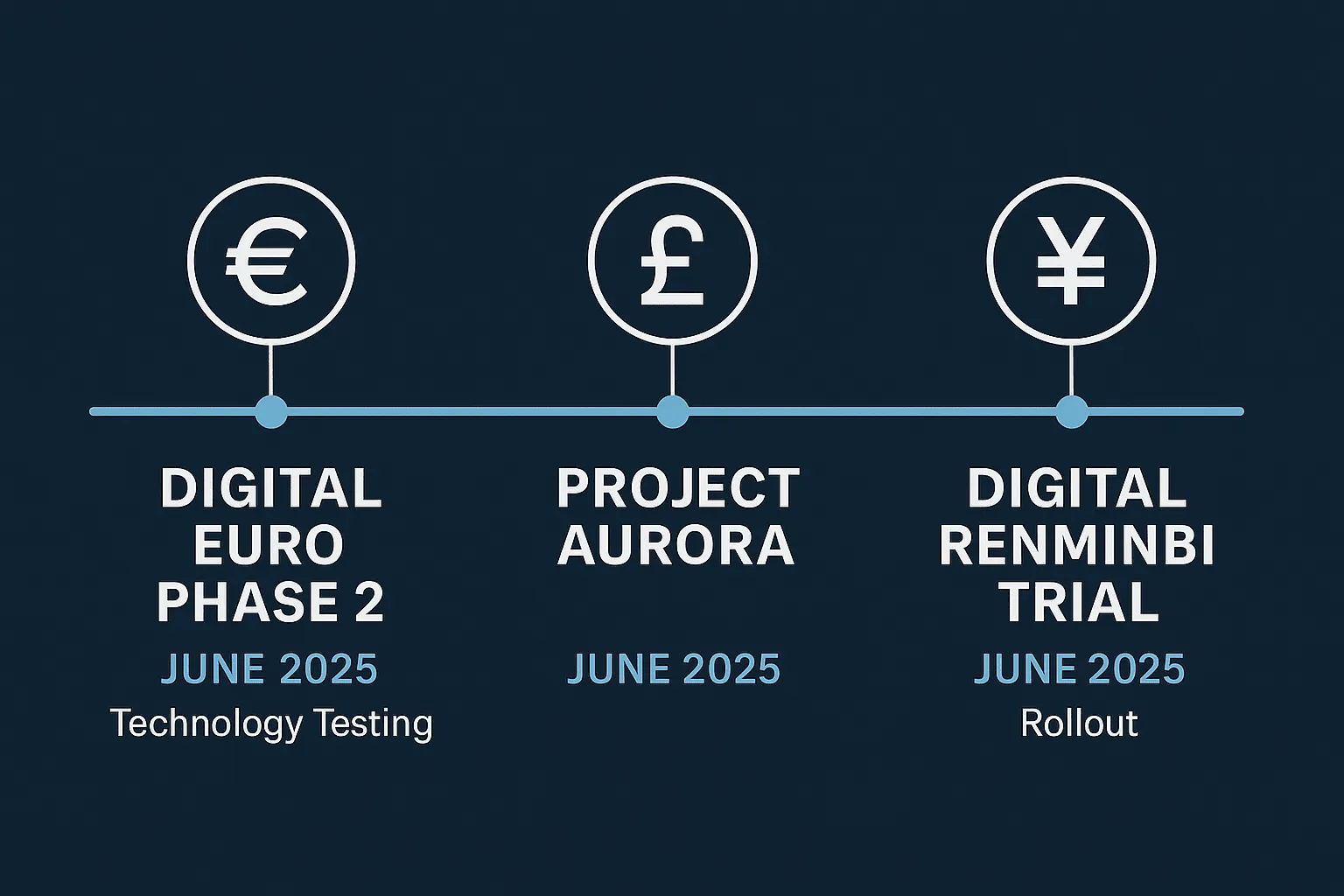
In June 2025, the European Central Bank released a tender document for the "Digital Euro Phase II Technical Proposal", which clearly adopted a hybrid architecture of an account model and a permissioned blockchain, taking into account both scalability and privacy protection.
Multi-party secure computing (MPC) and homomorphic encryption technology are introduced in the solution design to strike a balance between regulatory traceability and user anonymity.
Project Aurora: Digital British Pound Proof of Concept
The Bank of England launched the "Project Aurora" proof of concept (PoC) in June 2025 to test digital pound payments at the retail and wholesale levels, including offline transfers and real-time cross-border settlements.
This PoC places special emphasis on the automatic execution capabilities of smart contracts, aiming to reduce counterparty risks in cross-border trade and improve transaction transparency and efficiency.
Digital RMB Account Model and Offline Payment
The People's Bank of China completed the full-link testing of digital RMB offline payments at the end of 2024, adopting an account model that balances performance and security, and designed a "double signature" anti-replay mechanism in the offline transaction link.
Subsequently, in the first half of 2025, the function will be promoted to more than 100 merchants in the Guangdong-Hong Kong-Macao Greater Bay Area, covering catering, retail, public transportation and other scenarios.
Cross-border real-time settlement
With the help of CBDC and distributed ledger technology, central banks of many countries have achieved 24/7 real-time cross-border payments, significantly reducing the T+2 to T+3 delay of the traditional SWIFT channel to seconds.
The "mBridge" project has completed the first two-way real-time settlement in RMB-Singapore dollar payment, demonstrating the feasibility of multi-CBDC bridging.
Popularization of retail scenarios
As of May 2025, the cumulative transaction volume of digital RMB has exceeded 50 billion yuan, with an average of more than 8 million active users per day.
Europe and the United Kingdom have also launched retail pilots, and some large supermarket chains and transportation operators have launched digital euro and digital pound payment options, providing consumers with a variety of experiences such as scanning codes, NFC card swiping, and offline QR codes.
Enterprise-level applications and programmable payments
Several international logistics and trading companies participated in the wholesale-level PoC, using smart contracts to achieve automatic transfer and conditional delivery of supply chain funds, significantly reducing counterparty risks.
Fintech companies have launched programmable payment APIs based on the CBDC platform, providing one-stop technical services for insurance claims, automatic settlement of dividends, and regular financial product scenarios.
Anti-Money Laundering (AML) and Know Your Customer (KYC)
In the “Digital Finance Package” released by the European Union in April 2025, the digital euro was incorporated into the Payment Services Directive (PSD3) framework, requiring all service providers to implement strict KYC and AML processes.
In its “Project Aurora” sandbox regulatory guidelines, the UK Financial Conduct Authority (FCA) proposed dynamic risk control and real-time monitoring indicators to support innovation while preventing systemic risks.
Data privacy and security assessment
In the CBDC supporting regulations released by China in March 2025, all access institutions are required to complete national-level security assessments, with special reviews of offline payments and cross-border data transmission.
Multi-party secure computing (MPC) and homomorphic encryption technologies are used in cross-border regulatory data sharing to ensure that regulators in various countries can conduct joint reviews without infringing on user privacy.
Standardization and interoperability
The International Organization for Standardization (ISO) is developing a supplementary module for the CBDC message standard ISO 20022 to promote cross-chain interoperability and unified data formats to reduce the technical connection costs between central banks and commercial banks.
The technical white paper led by the Bank for International Settlements (BIS) emphasizes that the introduction of chain hashing and cross-chain verification technology will be a core element of the next-generation cross-border payment network.
Banking System and Liability Structure
The popularity of CBDC may divert some deposits from commercial banks, but it will also give rise to new sources of profit for payment services. Research institutions predict that if digital currency replaces 10% of traditional deposits, the overall liability cost of banks is expected to rise by 20 basis points, while payment business income is expected to increase by more than 30%.
SMEs and cross-border trade
A drop of more than 70% in cross-border payment costs will significantly reduce exchange fees for small and medium-sized enterprises and enhance their bargaining power in the global supply chain.
Real-time settlement capabilities can also help mitigate the risk of supply chain disruptions and improve the resilience of the entire trade network.
Technology companies and emerging markets
The investment bank report pointed out that from 2025 to 2030, the market size of CBDC underlying platform construction, wallet and API services, compliance consulting and other segments is expected to exceed US$100 billion.
Private equity and venture capital firms have increased their investment in this field, focusing on sub-sectors such as programmable wallets, secure hardware, cross-chain gateways, and smart contract security audits.
Technology integration and legacy system integration
The interconnection and interoperability between the central bank system, commercial bank core systems and emerging FinTech platforms still faces the dual challenges of standard differences and security isolation.
The maturity of hybrid cloud architecture, edge computing and blockchain gateway technology will directly affect the cost and risk of large-scale deployment.
Cybersecurity and operational resilience
As the digital currency ecosystem expands, the network attack surface also expands. Building a multi-level security defense and emergency shutdown and security upgrade mechanism will be a compulsory course for central banks and operating institutions in various countries.
Global collaboration and legal adaptation
The cross-border utility of CBDC requires full coordination among countries at the legal level, including data sovereignty, tax attribution and dispute resolution mechanisms.
International organizations need to promote the signing of multilateral agreements before the end of 2025 to provide stable legal protection for the cross-border application of CBDC.
Summarize:
Against the backdrop of accelerating digitalization, CBDC has entered a new stage of pilot verification and commercialization. The second phase of the European Central Bank's tender in June 2025, the BoE's "Project Aurora" PoC, and the People's Bank of China's promotion in the Guangdong-Hong Kong-Macao Greater Bay Area indicate that the world's three largest economies are ushering in a critical turning point in the application of digital currency. Faced with challenges such as technical architecture integration, regulatory coordination, and security protection, financial institutions and technology companies need to speed up their layout, actively participate in standard setting and ecological construction, and jointly create a new era of efficient, transparent and inclusive digital currency.
BrokerHivex is a financial media platform that displays information from the public internet or user-uploaded content. BrokerHivex does not support any trading platform or instrument. We are not responsible for any trading disputes or losses arising from the use of this information. Please note that the information displayed on the platform may be delayed, and users should independently verify its accuracy.