BrokerHiveXBrokerHiveXBrokerHiveX
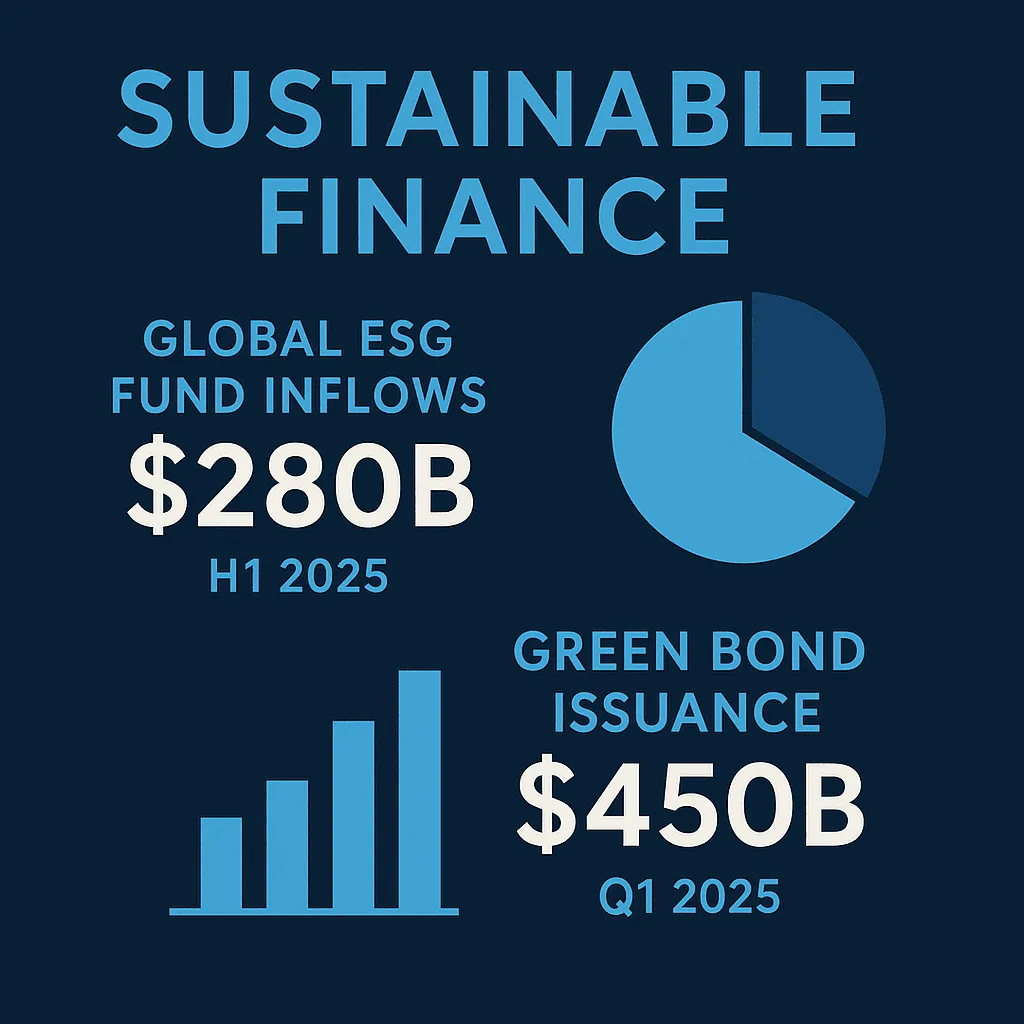
Summary:As global investors pay more and more attention to environmental, social and governance (ESG) factors, the sustainable finance sector continues to maintain strong growth in the first half of 2025. According to the latest data from Morningstar, the total inflow of global ESG funds reached US$280 billion in the first half of 2025, a year-on-year increase of 35%; the issuance of green bonds climbed to US$450 billion in the first quarter of 2025, a year-on-year increase of 22%. This article will provide an in-depth interpretation of the latest developments in sustainable finance from five dimensions: market trends, regulatory frameworks, bond markets, technological innovations and future prospects.
By Sophia Lee
Global ESG fund inflows
During the period from January to June 2025, global ESG funds received cumulative inflows of US$280 billion, a 35% increase from US$207 billion in the same period of 2024.
Europe remains the largest market, contributing 45% of new funds, followed by North America and Asia Pacific, accounting for 30% and 15% respectively.
Green Bond Issuance
Green bond issuance reached $450 billion in the first quarter of 2025, up 22% year-on-year, higher than the average growth rate of 17% over the past five years.
The Asia-Pacific region accounts for 40% of issuance, mainly concentrated in China, Japan and Australia; Europe and North America each account for 30%.
Sustainability Index Performance
The MSCI ESG Leaders Index rose 12.8% in the first half of 2025, outperforming the 8.3% of traditional stock indices.
EU Sustainable Finance Disclosure Regulation (SFDR)
After SFDR Level 2 came into effect in March 2023, the EU issued supplementary technical standards in May 2025, clarifying the definitions of “product classification labeling” and “transition activities” and strengthening the transparency obligations of fund managers.
US SEC climate risk disclosure proposal
In April 2025, the U.S. Securities and Exchange Commission (SEC) proposed the "Climate-Related Financial Risk Disclosure Rules", requiring listed companies to disclose the impact of climate risks on their business, strategy and prospects, and to provide detailed descriptions according to GICS industry classifications.
China's "Carbon Neutrality" Green Finance Policy
The People's Bank of China, the China Securities Regulatory Commission and the China Banking and Insurance Regulatory Commission jointly issued the "Guidelines on Green Bond Support Tools" in February 2025, providing differentiated re-lending rate discounts and risk compensation mechanisms for the issuance of green bonds.
International multilateral cooperation
The Financial Stability Board (FSB) and the International Organization for Standardization (ISO) are promoting the "Uniform Standards for Sustainable Finance Disclosures" and plan to release the first version of the common framework by the end of 2026 to facilitate comparisons and decision-making among cross-border investors.
Social Security Bonds and Sustainable Bonds
The issuance volume of Social Bonds and Sustainability Bonds reached US$120 billion and US$80 billion respectively in the first half of 2025, meeting investors' dual needs between social responsibility and environmental protection.
“Interest-bearing” and “zero-interest” green bonds
"Interest-bearing green bonds" still dominate, accounting for 85% of the issuance volume; at the same time, zero-coupon bonds have attracted many large institutional investors due to their tax incentives and liquidity advantages.
Structured and segmented pricing
Some issuers have introduced structured green bonds with different maturities and returns linked to sustainable performance targets (SDG-Linked Bond). If the project achieves the predetermined emission reduction target, investors will receive additional returns.
Green bond registration on blockchain
Several international banks and technology companies have collaborated to launch a green bond registration system on a blockchain platform to achieve real-time sharing and unalterable recording of issuance, custody and transaction information.
AI-driven ESG assessments
Using artificial intelligence to analyze hundreds of ESG indicators to form an automated scoring model is 50% more efficient than traditional survey methods and can generate detailed ESG reports within hours.
Smart Contracts and Programmable Bonds
Smart contract technology is introduced into the sustainable bond issuance process. When the project reaches key performance indicators (KPIs), the system will automatically trigger interest rate adjustments or principal payments, enhancing transparency and trust.
Investor education and risk control
As the variety of products increases, investors need to strengthen their prevention of "greenwashing" risks and conduct due diligence on third-party certification and standard compliance.
The balance between regulation and self-regulation
Although unified standards are conducive to the healthy development of the industry, excessive regulation may inhibit innovation. Regulators need to work with market players and adopt a "sandbox" mechanism to balance the relationship between the two.
Potential in emerging markets
Latin America, Africa and Southeast Asia have huge demands for green energy and infrastructure construction, and tens of billions of dollars of sustainable investment opportunities are expected to emerge in the next two years.
Technology iteration and ecosystem construction
With the continuous evolution of distributed ledger, artificial intelligence and big data analysis technologies, the sustainable finance ecosystem will become more complete, providing investors and issuers with a safe, efficient and transparent one-stop platform.
Summarize:
In the first half of 2025, the sustainable finance sector has seen multiple positive developments: fund inflows and bond issuance have both hit new highs, the regulatory framework has been continuously improved, and technological innovation has been accelerated. Although the risks of green reshuffles and the challenges of regulatory balance still exist, sustainable finance is moving towards a higher-quality development stage under global cooperation and standardization efforts. For investors, in-depth research on product compliance and performance-linked mechanisms will be the key to seizing future opportunities; for issuers, the use of digital tools and international cooperation will help reduce financing costs, improve project transparency, and contribute to achieving global carbon neutrality goals.
BrokerHivex is a financial media platform that displays information from the public internet or user-uploaded content. BrokerHivex does not support any trading platform or instrument. We are not responsible for any trading disputes or losses arising from the use of this information. Please note that the information displayed on the platform may be delayed, and users should independently verify its accuracy.