BrokerHiveXBrokerHiveXBrokerHiveX
Summary:In the first half of 2025, global stock markets fluctuated under the interweaving of multiple factors. With the stabilization of US inflation data, divergence in the Fed's interest rate path, slowing corporate profit growth, and rising macro risks in emerging markets, investor sentiment experienced multiple fluctuations in May and June. Based on the latest economic and market data, this article deeply analyzes the direction of the Fed's monetary policy, the performance of major stock indexes, the rotation of industry sectors, exchange rates and emerging market dynamics, as well as potential risks and hedging strategies, to provide investors with comprehensive and actionable market insights.
By Oliver Smith
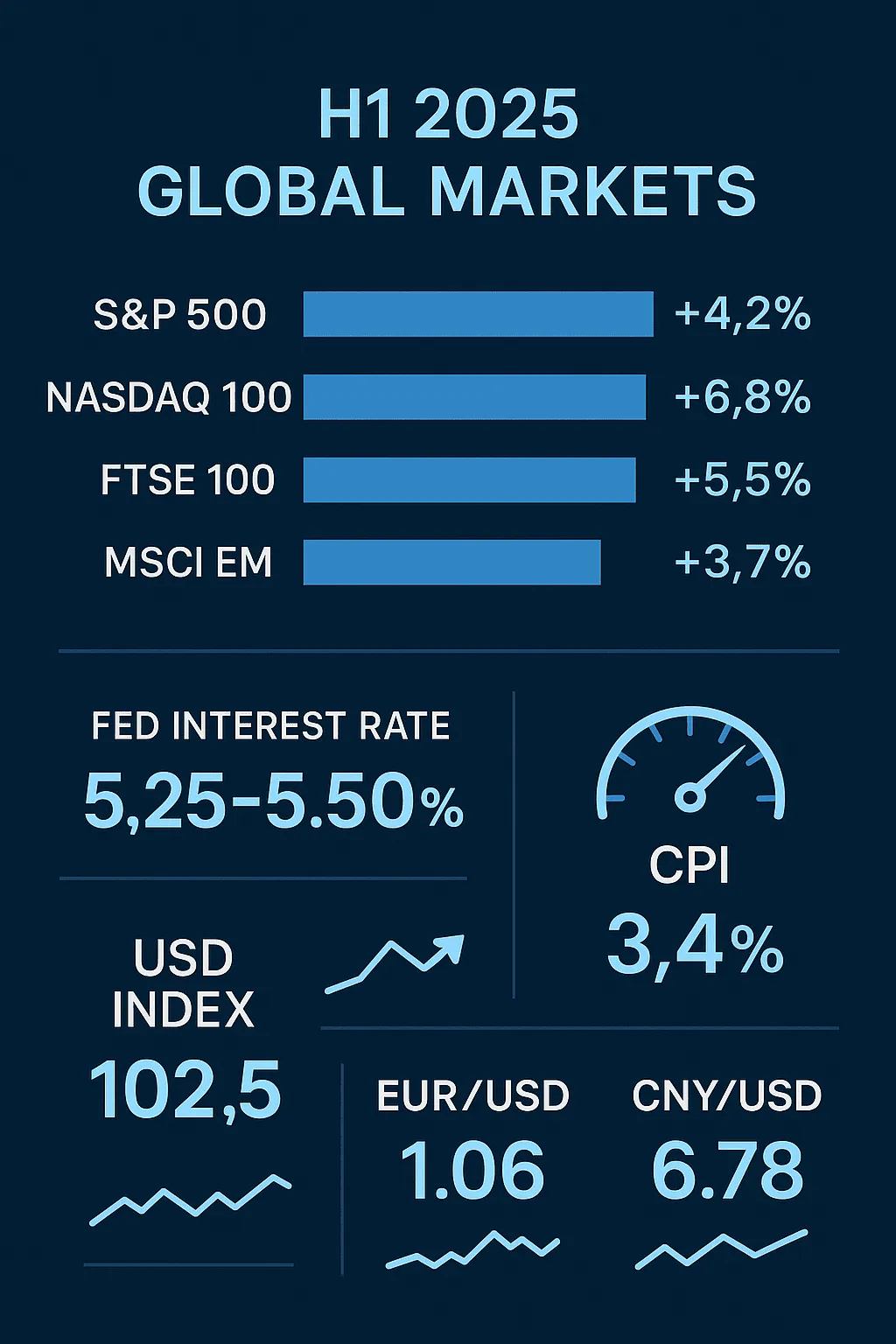
In May 2025, the year-on-year growth rate of the U.S. Consumer Price Index (CPI) fell back to 3.4%, and the core PCE (Personal Consumption Expenditures Price Index) fell modestly by 0.1 percentage point month-on-month, suggesting that inflationary pressures have eased. The FOMC meeting statement on June 17-18 reiterated that it would continue to raise interest rates "gradually", but the dot plot showed that some officials supported pausing interest rate hikes at the July meeting, and the federal funds target rate is expected to remain in the 5.25%-5.50% range for a longer period of time. At the press conference, the chairman of the Federal Reserve emphasized the need to maintain policy flexibility to cope with the complex balance between the labor market and inflation. The market FedWatch tool shows that as of June 20, the market's expectation of keeping interest rates unchanged in July has risen to 62%.
Under the influence of policy expectations, U.S. and European stock markets showed divergent trends:
S&P 500 : Up 4.2% in the first half of 2025, but fell 2.5% in June, driven by adjustments in large technology stocks;
NASDAQ 100 : Affected by the rotation of semiconductor and AI concept stocks, the H1 cumulative increase was 6.8%, but the volatility increased;
UK FTSE 100 : Driven by the raw materials and energy sectors, H1 rose 5.5%, and the weakening of the pound supported overseas earnings;
STOXX 600 : H1 rose slightly by 1.1%, French and German equity performance diverged, investors waited and watched the ECB policy pause;
MSCI Emerging Markets Index (MSCI EM) : Against the backdrop of stable trends in the RMB, rupee and Mexican peso, the H1 rose 3.7%, and overall capital inflows slowed down.
Changes in policies and macroeconomic environment drive sector rotation:
Technology sector : Under the pressure of high valuations, the technology sector (including FAANG) rose by only 2.9% in the first half of 2025, but the AI and cloud computing sub-sectors had a rebound opportunity in June, especially semiconductor equipment manufacturers, which achieved a monthly increase of more than 10% thanks to new process investments.
Energy and commodities : Fluctuations in oil prices triggered differentiation among energy stocks, which rose 8.4% overall in H1. The renewable energy sector performed well, with leading companies in wind power and photovoltaic equipment seeing a cumulative increase of 15%.
Financial sector : Benefiting from rising interest rates and widening interest rate spreads, Bank of America (BAC) and JPMorgan Chase (JPM) saw their share prices rise by 6.2% and 5.8% respectively; large European banks saw limited gains of only 2.3% due to regulatory pressure.
Consumption and healthcare : The daily consumer goods sector is relatively defensive, with an increase of 3.5% in H1; the healthcare sector has seen a cumulative increase of 7.1% due to increased industry concentration and frequent approvals of innovative drugs.
As global capital flows become more cautious, volatility in major currencies and emerging market assets has intensified:
US Dollar Index (DXY) : It fell back to 101.0 from 102.1 at the beginning of the year, but rose again to 102.5 before the June meeting, indicating that the market is still divided on the Fed's suspension of interest rate hikes.
EUR/USD : Against the backdrop of the narrowing of the ECB interest rate spread, H1 fell from 1.08 to 1.06;
RMB (CNY/USD) : Supported by the recovery of foreign trade and cross-border capital inflows, it rose from 6.90 to 6.78 in half a year;
Emerging market sovereign bonds : Under the influence of the weakening of local currencies and the upward trend of US Treasury yields, the overall yield has risen by about 30 basis points, attracting the return of strong US dollar assets;
Capital Flows : According to EPFR data, funds flowing into emerging market equities in June were +US$1.2 billion, a significant rebound from +US$300 million in May, but far lower than +US$2.5 billion in the same period of 2024.
As market uncertainties remain high, investors need to pay attention to the following major risks and take corresponding hedging measures:
Geopolitical risks : The situation in the Middle East and the dynamics in the Taiwan Strait may disrupt energy supply and trade in the Asia-Pacific region - it is recommended to allocate global macro hedge funds or WTI crude oil futures positions.
Economic growth is slowing down : US GDP growth is expected to fall from 2.5% in Q1 to 1.8% in Q2; Europe is facing a shrinking manufacturing industry - portfolio volatility can be reduced through defensive assets such as bond ETFs (such as TLT, IE00B3XXRP09).
Market liquidity risk : The reduction of the Federal Reserve’s balance sheet will compress market liquidity - it is recommended to increase cash equivalents and short-term U.S. Treasuries in existing stock positions to maintain flexibility.
Industry concentration risk : Large technology stocks account for more than 28% of the S&P 500. Any tightening of policies or regulations may trigger valuation adjustments. Consider investing in thematic ETFs (such as ROBO and ARKK) to diversify risks.
Policy expectations : The Federal Reserve is expected to maintain the current interest rate level before September, and the European Central Bank may also suspend interest rate hikes in July; at the end of the year, it will turn to the "repurchase +" tool to ease liquidity pressure.
Asset allocation : We recommend small-cap value stocks in the equity sector, energy and pharmaceutical sub-sectors, and high-grade sovereign bonds; use option strategies (such as buying VIX call options) to hedge tail risks.
Thematic investment : focus on AI and cloud infrastructure, green energy and carbon trading platforms; at the same time, seize the certain opportunities brought by semiconductor process upgrades and biotechnological innovations.
Emerging market opportunities : Amid the global monetary policy divergence, robust growth economies such as India, Mexico and Vietnam are expected to attract industrial chain transfer and capital layout, and potential excess returns can be obtained through relevant ETFs (such as INDA, EWW, VNM).
Summarize:
In the first half of 2025, monetary policy divergence and macro data fluctuations will bring multiple challenges and opportunities to the global market. Investors should pay close attention to the dynamics of the Federal Reserve and the evolution of the labor market and inflation in major economies, flexibly adjust asset allocation, and through diversification and hedging strategies, not only seize thematic opportunities such as technology and energy, but also effectively prevent systemic risks to welcome the new market pattern in the second half of the year.
BrokerHivex is a financial media platform that displays information from the public internet or user-uploaded content. BrokerHivex does not support any trading platform or instrument. We are not responsible for any trading disputes or losses arising from the use of this information. Please note that the information displayed on the platform may be delayed, and users should independently verify its accuracy.