BrokerHiveX
1. Market size and growth drivers
Total size and regional distribution
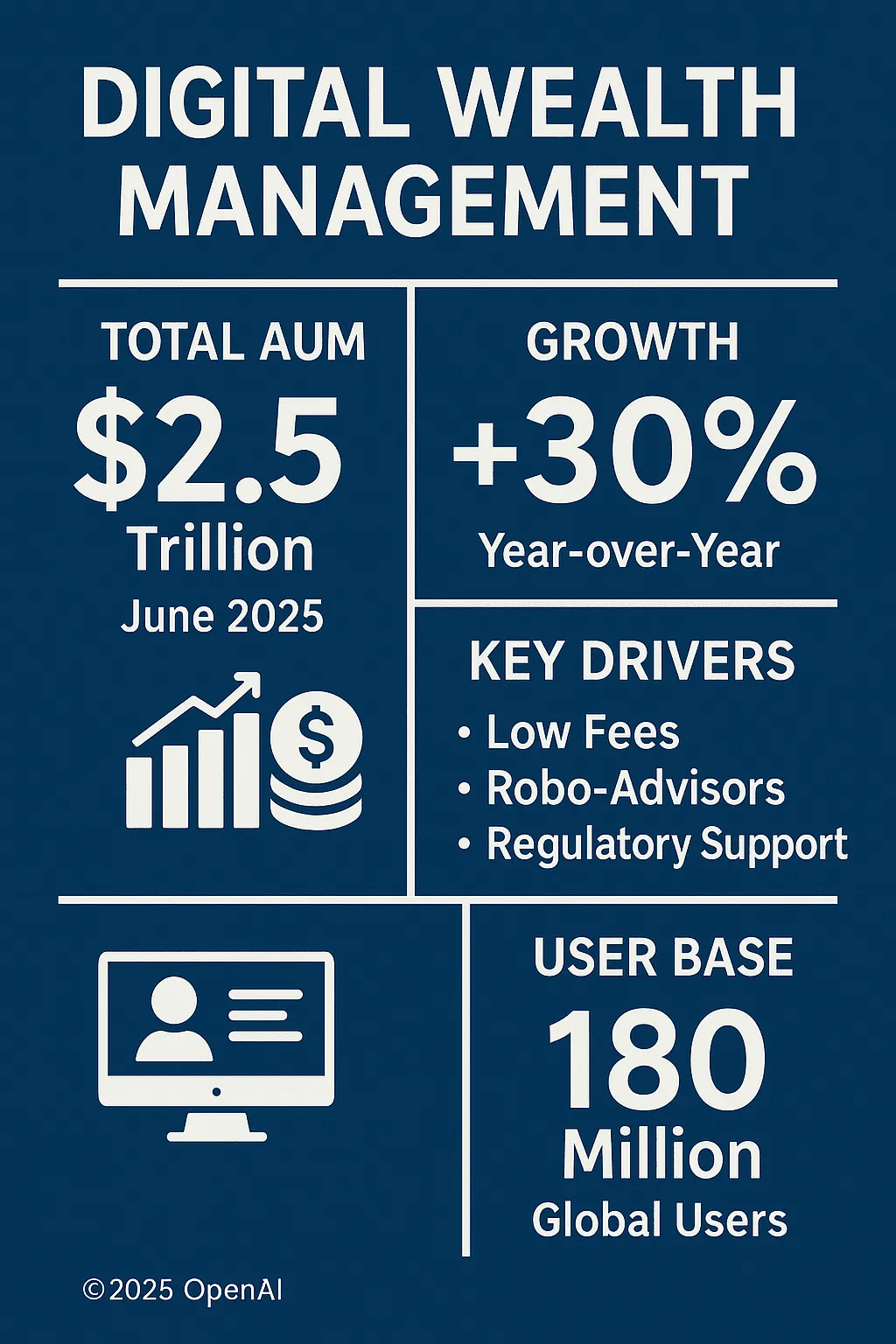
As of June 2025, the global digital wealth management AUM will reach US$2.52 trillion, of which the North American market accounts for 40%, Europe and the Middle East (EMEA) accounts for 35%, and Asia Pacific (APAC) accounts for 25%.
In the first half of 2025, the new AUM was approximately US$580 billion, a year-on-year increase of 30%, of which institutional and high-net-worth clients contributed 60% and retail users contributed 40%.
Growth drivers
Low fees and convenient experience : The average handling fee of digital platforms is 40% lower than that of traditional consultants. The mobile account opening and asset allocation process can be completed in seconds, which firmly attracts the younger generation and the middle class.
The rise of smart investment advisors : asset allocation and rebalancing models based on machine learning achieve automation in the three dimensions of market value management, risk control warning and tax optimization, allowing users' average return rate to exceed that of traditional funds by 1.5 percentage points.
Regulatory support : Regulatory agencies in many European and American countries have successively issued "Digital Wealth Management Compliance Guidelines" by the end of 2024, clarifying the platform's technical and process requirements in KYC, anti-money laundering (AML) and customer suitability assessment, reducing compliance costs and enhancing trust.
2. User Structure and Innovative Services
User Profile
The total number of digital wealth users worldwide is approximately 180 million, with 40 million new users in the first half of 2025; in terms of age distribution, 52% are aged 25-40, 30% are aged 40-60, and 18% are aged 60 and above.
The middle- to high-end customer group, with an average holding size of US$50,000 to US$500,000, prefers theme-based investments (such as new energy, artificial intelligence, ESG) and target-date funds.
Diversified products and services
In addition to traditional stock and bond portfolios, platforms have launched private fund solutions, crypto asset allocation and structured notes.
In terms of value-added services, digital consultants provide one-on-one customized consulting, tax planning and family trust docking, realizing "one-stop" wealth inheritance and cross-border asset allocation.
3. Technical architecture and security compliance
Core technology platform
Mainstream platforms use microservices architecture and cloud-native deployment, supporting second-level scaling and high availability and fault tolerance;
The data layer introduces graph database (Graph DB) and real-time stream processing (Stream Processing) to improve the efficiency of customer portrait analysis and risk control warning.
Security and Compliance
Biometrics and multi-factor authentication (MFA) have become standard for account opening and important transactions;
Blockchain distributed ledgers are used to snapshot customer assets and keep transaction records, ensuring that data cannot be tampered with;
The platform must pass ISO 27001 and SOC 2 Type II security certifications, and conduct regular penetration testing and compliance audits.
4. Industry Competition and M&A Trends
Top players and emerging platforms
Digital platforms under traditional banks (such as JPMorgan YouInvest and UBS eWealth) account for 30% of AUM; emerging FinTech companies (such as Wealthify and Nutmeg) have captured 20% of the market with flexible pricing and innovative products.
Mergers and Acquisitions and Strategic Cooperation
In the first half of 2025, there were 12 industry mergers and acquisitions worldwide, with a total transaction value of over US$23 billion, including major banks' acquisition of independent investment advisory startups, as well as strategic investments by FinTech platforms and insurance giants.
At the cross-border cooperation level, the platform has reached joint marketing and data interconnection with banks, third-party payment and social media giants, and explored a new "social + investment advisory" model.
V. Future Outlook and Investment Strategy
Digitalization and personalization
As AI’s natural language understanding and large-scale model capabilities improve, voice investment consulting and contextual advice will become a new trend;
Differentiated strategies such as ESG, carbon neutrality, and sustainable themes will be further subdivided to enrich the platform's product matrix.
Stricter regulation and international coordination
Global regulation will focus on data sovereignty, cross-border services and algorithm transparency, and platforms need to accelerate investment in compliance technology;
International organizations are expected to launch "Universal Standards for Digital Wealth Management" in 2026 to promote the legality and compliance of cross-border services.
Investor Education and Risk Management
The platform will deepen investor education content and improve the financial literacy of non-professional users through interactive teaching and simulated accounts;
Risk hedging tools (such as equity protection ETFs and risk-balanced portfolios) will be integrated into daily investment advisory advice to help clients stabilize their returns.
By William Thompson