BrokerHiveX
1. Market size and overall performance
Global AUM & Inflows
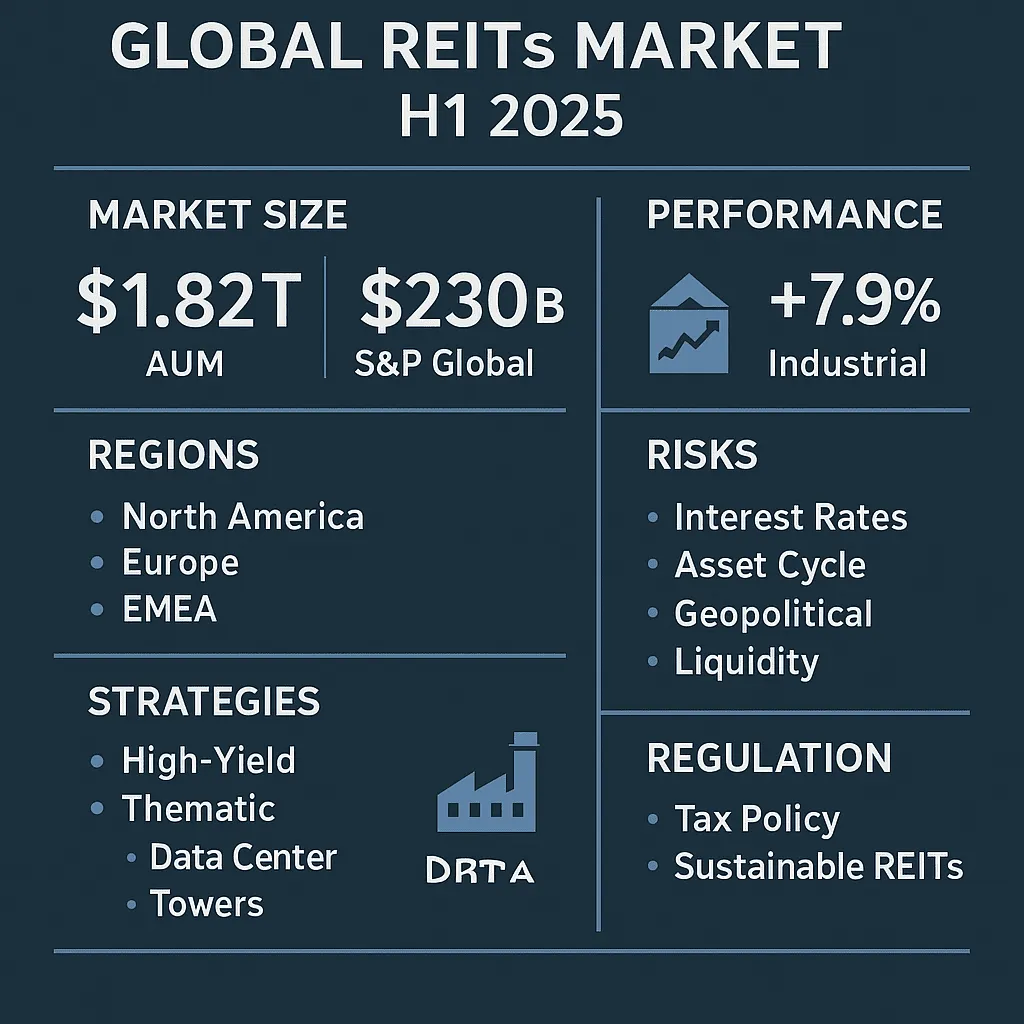
As of June 2025, the total assets under management of global REITs reached US$1.82 trillion, with a net inflow of new funds of US$230 billion in the first half of 2025, a year-on-year increase of 15%.
Institutional investment accounts for 65%, while retail investment through ETFs and cross-border platforms accounts for 35%.
Revenue Performance
The S&P Global REITs Index (S&P Global REITs Index) rose 7.4% in the first half of the year; among them, REITs in the EU region had the highest increase, reaching 9.1%, while the North American and Asia-Pacific markets rose 6.3% and 5.8% respectively.
By type: Industrial REITs led the gains with a 7.9% increase, driven by the expansion of e-commerce and logistics; Commercial (Office) and Retail (Retail) REITs rose by 5.2% and 6.0% respectively.
II. Regional differentiation and thematic opportunities
North American Market
US REITs account for 40% of the global market value, with a net inflow of US$90 billion in H1, with core sectors being residential and industrial. In May 2025, the US 10-year Treasury yield fell back to 3.6%, providing a good financing environment for highly leveraged REITs.
Canadian REITs benefit from government infrastructure investment, with infrastructure REITs (such as roads and pipelines) rising 8.5% in the first half of the year.
Europe and the Middle East (EMEA)
The European REITs market accounts for 30% of the total, with Germany and France performing outstandingly. German logistics park REITs rose 11% this year, and French office building REITs also rose 7% due to concentrated CBD development.
UK REITs have grown steadily after Brexit, rising 5.5% in the first half of the year, with a rebound in demand for office space in central London supporting the sector's performance.
Asia Pacific Market
The Asia-Pacific region accounts for 30% of AUM, and REITs in Hong Kong, China and Japan have been increased by institutions. Japanese residential REITs have increased by 6.8%, and Hong Kong retail REITs have increased by 4.9%.
Core urban REITs in Australia and Singapore posted solid growth, up 6.2% and 5.7% respectively, benefiting from concentrated population and business activity.
III. Main investment strategies
Leverage Yield Play
Against the backdrop of falling interest rates, some REITs have increased leverage to 50%-60% to expand dividend distribution, with a target annualized dividend rate of 8%-9%.
Recommended targets: large logistics and data center REITs, such as Prologis and Equinix.
Thematic Allocation
Data center, communication tower and healthcare REITs have become star tracks due to their stable cash flow and growth potential.
In the first half of 2025, data center REITs increased by an average of 10.2%, while communication tower REITs increased by 9.4%.
Currency-Hedged REITs
REITs products that hedge against fluctuations in the USD/Euro and USD/JPY exchange rates are suitable for emerging market investors who are under greater pressure from currency depreciation.
Typical ETF: hedged global REITs ETF (such as “Xtrackers Global REITs Hedged”).
4. Risk Factors and Hedging Methods
Interest rate risk
Although interest rates are generally stable in the first half of 2025, short-term interest rates may rise again if inflation rebounds in the second half of the year. It is recommended to use floating rate debt instruments (such as floating rate preferred stocks) for hedging.
Asset cycle risk
Commercial office buildings and retail properties face the risk of oversupply in the future, which can be diversified by reducing holdings of related REITs and increasing holdings of medical and residential REITs.
Geopolitical risks
Real estate development in the Asia-Pacific region is greatly affected by geography and regulation. We recommend allocating REITs in mature markets in the United States and Europe and hedging against emerging market risks.
Liquidity Risk
Some small-cap REITs have insufficient liquidity. You can give priority to targets with a market value of more than US$5 billion and sufficient daily trading volume, or allocate highly liquid ETFs.
V. Regulatory policies and future prospects
Taxation and Compliance
Many countries have adjusted their REITs dividend policies and tax incentives. In April 2025, Japan simplified the REITs income tax declaration procedures, and some EU member states raised the REITs dividend exemption ceiling.
Green and Sustainable REITs
ESG has become an industry consensus, “green building REITs” are traded at a premium, and most funds have launched carbon footprint reports and energy-saving standard certifications.
In the first half of 2025, green REITs’ inflows accounted for 40% of new funds, outperforming the benchmark by 2.5%.
Technology Empowerment
Blockchain asset tokenization is attempting to be implemented in some markets to achieve fragmented trading of REITs shares and an all-weather market.
The AI big data platform is used for property valuation and rental forecasting to improve management efficiency and decision-making accuracy.
By Daniel Roberts