BrokerHiveXBrokerHiveXBrokerHiveX
Summary:Although the US GENIUS Act prohibits yield-generating stablecoins, industry insiders believe that this will not stop institutional investors from pursuing returns, but may instead drive trillions of dollars into the tokenized real-world asset (RWA) market. #GENIUSAct#Stablecoins#TokenizedAssets#InstitutionalInvestment#RWA
The landmark GENIUS Act in the United States was originally seen as a key initiative to promote the regulatory compliance of stablecoins. A core provision of the bill is a complete ban on yield-bearing stablecoins, meaning that holders cannot earn interest on digital dollar balances (Source: White House document).
Will Beeson, former Standard Chartered Bank executive and current founder and CEO of Uniform Labs, told Cointelegraph that the ban will force institutions to seek new sources of revenue. Rather than allowing assets to sit idle and depreciate, capital will quickly flow to compliant, liquid, and yielding asset classes.
Beeson emphasized: “The next stage is not to hold idle stablecoins, but to achieve programmatic risk-free returns and freely switch between cash and high-quality assets.”
He revealed that Uniform Labs is building Multiliquid, an institutional liquidity layer for tokenized markets that enables real-time, programmable conversions between tokenized assets (such as US Treasuries and money market funds) and stablecoins (Source: Glassy Nakamoto).
While partners have not yet been announced, the company has engaged with several leading institutions, fintech firms, and stablecoin issuers, and plans to launch its product later this year.
Solomon Tesfaye of Aptos Labs agrees with this view, believing that the GENIUS Act will promote the development of both stablecoins and tokenized assets.
Sandra Waliczek, a member of the World Economic Forum's Blockchain and Digital Assets Department, pointed out that tokenization is not limited to private credit and government bonds. It can also divide high-threshold assets such as real estate, private equity, commodities, and corporate bonds into smaller investment units, allowing ordinary investors to participate (Source: RWA.xyz).
Currently, the global tokenization market is worth approximately $26 billion, but it is expected to experience explosive growth driven by institutional funding.
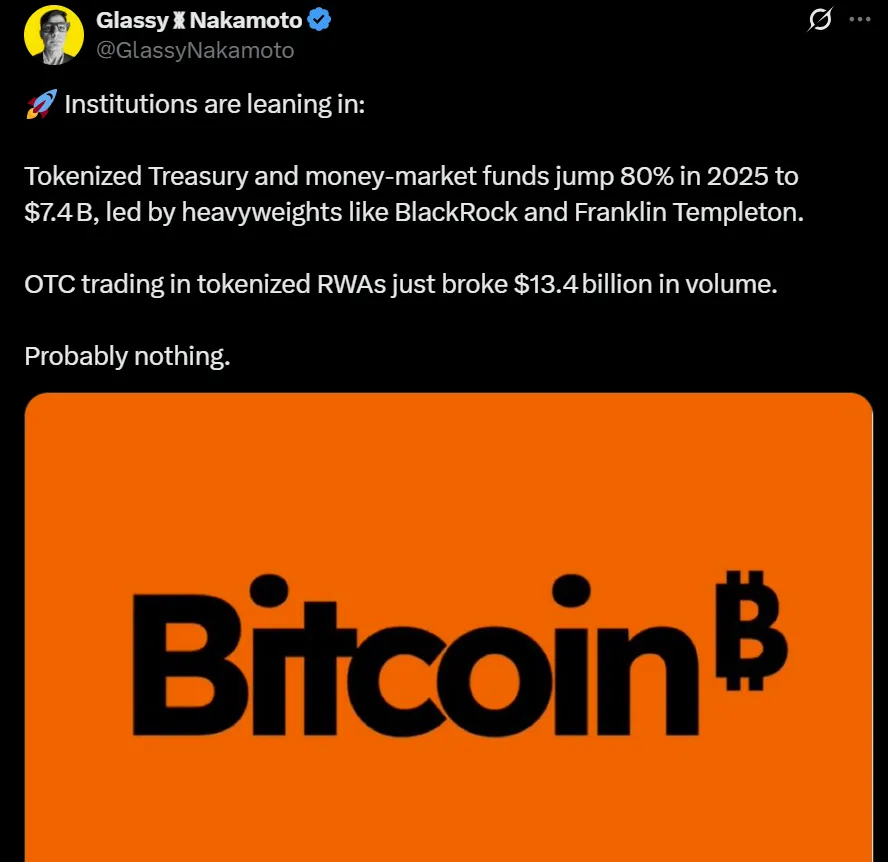
Tokenized Treasury bonds and money market funds will see significant growth by 2025. Source: Glassy Nakamoto
For investors, the GENIUS Act may reshape the logic of digital asset investment:
Short term: The decline in stablecoin returns will prompt institutions to explore tokenized assets, and the demand for RWA products will increase.
Medium term: Low-risk tokenized products such as government bonds and money market funds may benefit first.
Long term: The tokenization of traditional high-threshold assets such as real estate and private equity will bring structural opportunities.
However, the RWA market is still in its early stages of development, and investors need to pay attention to the regulatory environment, technical compliance and liquidity risks, and allocate asset proportions prudently.
Want to be the first to grasp global market trends and investment opportunities? Follow us on BrokerHiveX for the latest in-depth analysis and real-time information!
BrokerHivex is a financial media platform that displays information from the public internet or user-uploaded content. BrokerHivex does not support any trading platform or instrument. We are not responsible for any trading disputes or losses arising from the use of this information. Please note that the information displayed on the platform may be delayed, and users should independently verify its accuracy.