BrokerHiveXBrokerHiveXBrokerHiveX
Summary:The People's Bank of China and the central banks of the ten ASEAN member states have launched a regional local currency settlement system, promoting direct clearing between the RMB and ASEAN currencies. This article examines the mechanism's design, market impact, and evolving global monetary landscape.
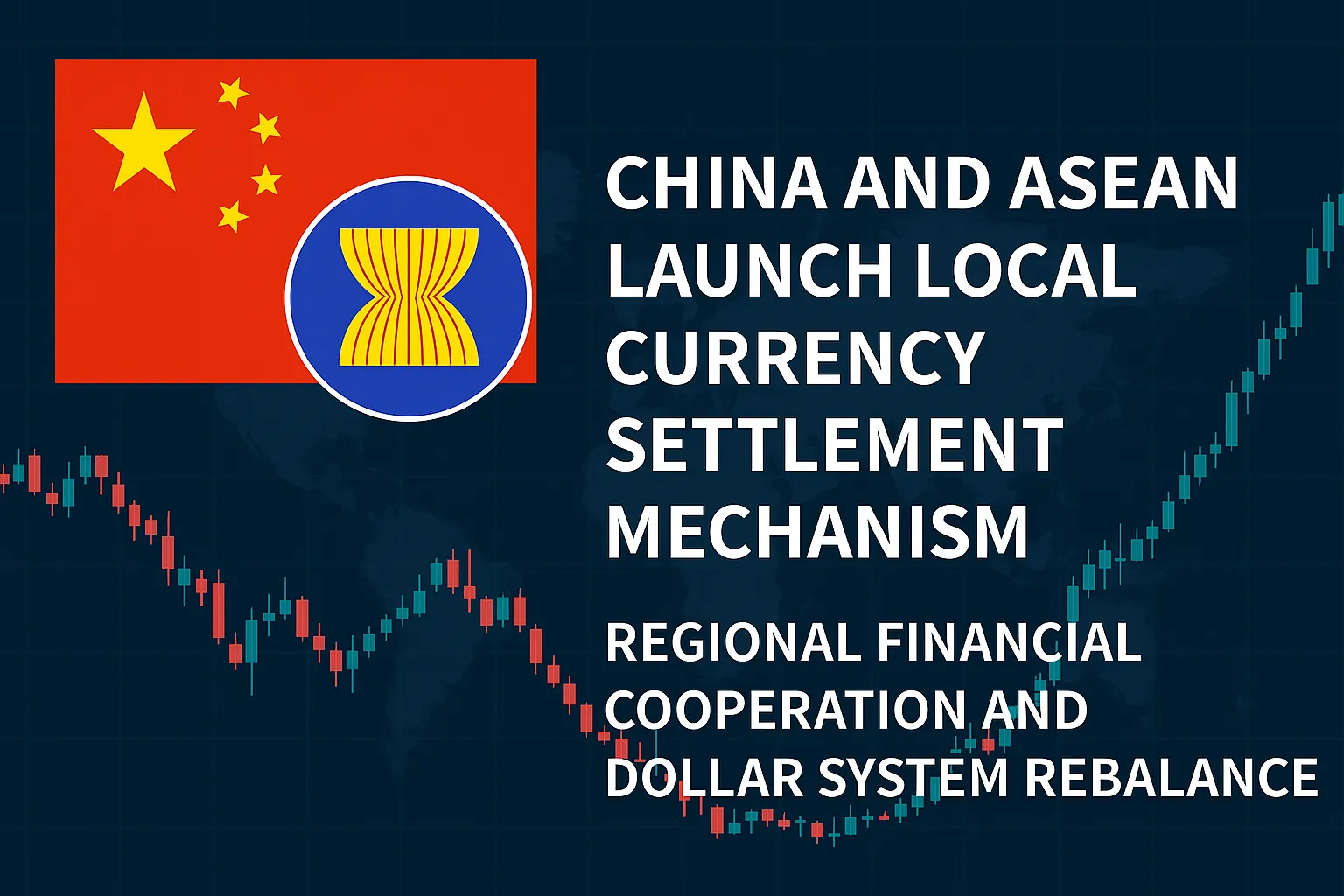
In October 2025, the People's Bank of China (PBOC) and the central banks of the ten ASEAN countries jointly announced that
The Regional Local Currency Settlement Mechanism (R-LCS) was officially launched.
The mechanism aims to reduce the reliance on the US dollar in regional trade settlements.
Promote direct swap and clearing of currencies such as the RMB (CNY), Indonesian Rupiah (IDR), Thai Baht (THB), and Malaysian Ringgit (MYR).
PBOC Deputy Governor Pan Gongsheng said:
"This is not about de-dollarization, but diversification. Asia needs a more balanced and sustainable financial order."
This move marks the entry of Asian financial integration into the substantive stage of "post-dollarization".
Traditional trade settlements are highly dependent on the US dollar, exposing companies in the region to exchange rate fluctuations and liquidity risks.
The goals of the new mechanism include:
🏦 Reduce foreign exchange hedging costs : Cross-border settlements denominated in local currency reduce the impact of US dollar fluctuations;
🌏 Enhance financial sovereignty : Increase the independence of Asian currencies in the international trading system;
🤝Improve regional financial connectivity : support cross-border payment and bond market integration.
According to data from the China Foreign Exchange Trading Center,
As of the third quarter of 2025, 36% of the trade volume between ASEAN countries and China has been settled in local currency .
This is a significant increase from 16% in 2023.
| Settlement currency | Proportion | Main countries/regions of use | Changes from 2023 to 2025 |
|---|---|---|---|
| Chinese Yuan (CNY) | 36% | China, Thailand, Indonesia, Malaysia | ↑ +20% |
| US dollar (USD) | 47% | Regional Multinational Enterprises and Energy Settlements | ↓ -15% |
| Euro (EUR) | 8% | Singapore, Vietnam, Philippines | Stablize |
| Local currency (IDR, MYR, THB) | 9% | Intraregional trade SMEs | ↑ +5% |
Source: ASEAN Secretariat, PBOC, Q3 2025 report
The regional local currency settlement system is jointly operated by the People's Bank of China Clearing Corporation and the ASEAN Payments Network (APN) .
The core technologies include:
1️⃣ Unify cross-border payment interface (API) standards ;
2️⃣Real -time foreign exchange rate matching system (FX Matching System) ;
3️⃣Traceable distributed ledger (DLT) clearing platform ;
4️⃣Central Bank Digital Currency (CBDC) interconnection module .
Currently, 12 major commercial banks and 8 central bank digital currency pilot nodes have participated in the trial operation.
The average settlement speed has been reduced to less than 30 seconds .
This mechanism will have a profound impact on the Asian trade finance ecosystem:
Strengthen the status of the local currency and reduce dependence on the US dollar for foreign reserves;
Support regional financial stability and coordination of capital flows;
Promote the unification of cross-border anti-money laundering and compliance frameworks.
Exporting companies can directly use local currency for settlement, reducing exchange losses;
Banks can provide more local currency trade financing and letter of credit services;
Fintech companies can enter the cross-border clearing and foreign exchange matching markets.
“The R-LCS system will become an alternative and supplement to the Asian version of SWIFT.” — Asian Development Bank Institute (ADBI) report
This regional monetary cooperation is not only an economic event, but also has geopolitical significance.
According to the International Monetary Fund (IMF):
In the first half of 2025, the proportion of US dollars in global foreign exchange reserves fell to 57.2% .
The lowest level in 20 years.
At the same time, the proportion of RMB reserves rose to 5.8% .
ASEAN currencies (IDR, THB, MYR) entered the ranks of major reserve currencies for the first time.
“The US dollar remains central, but the rise of regional currency networks will change the landscape of liquidity centers.” — Kristalina Georgieva, IMF Economic Counselor
While the outlook is positive, experts warn of three potential risks:
1. Exchange rate fluctuation risk : liquidity among regional currencies is still unbalanced;
2️⃣ Differences in compliance standards : AML/KYC regulations in different countries are not yet fully mutually recognized;
3️⃣Technical compatibility issues : Payment systems in some countries still use traditional architecture.
The Asian Development Bank suggests that in the future, a unified regional clearing regulatory sandbox should be established.
To ensure the transparency and security of cross-border digital payments.
The launch of the “Regional Local Currency Settlement Mechanism” is not only an innovation in financial technology,
It is also a sign of the transformation of the Asian monetary system from "dependence on the US dollar" to "diversified balance".
This mechanism lays the foundation for Asia's financial landscape over the next decade:
“Capital will no longer flow in one direction, and monetary power is being redistributed.”
BrokerHivex is a financial media platform that displays information from the public internet or user-uploaded content. BrokerHivex does not support any trading platform or instrument. We are not responsible for any trading disputes or losses arising from the use of this information. Please note that the information displayed on the platform may be delayed, and users should independently verify its accuracy.