BrokerHiveXBrokerHiveXBrokerHiveX
Summary:The U.S. Securities and Exchange Commission (SEC) has officially released its latest guidance on crypto asset regulation, updating its "Securities Determination Standard" and adding DeFi tokens, stablecoins, and yield tokens to the potential regulatory scope. This article analyzes the core of the new regulations, their market impact, compliance challenges, and international comparisons.
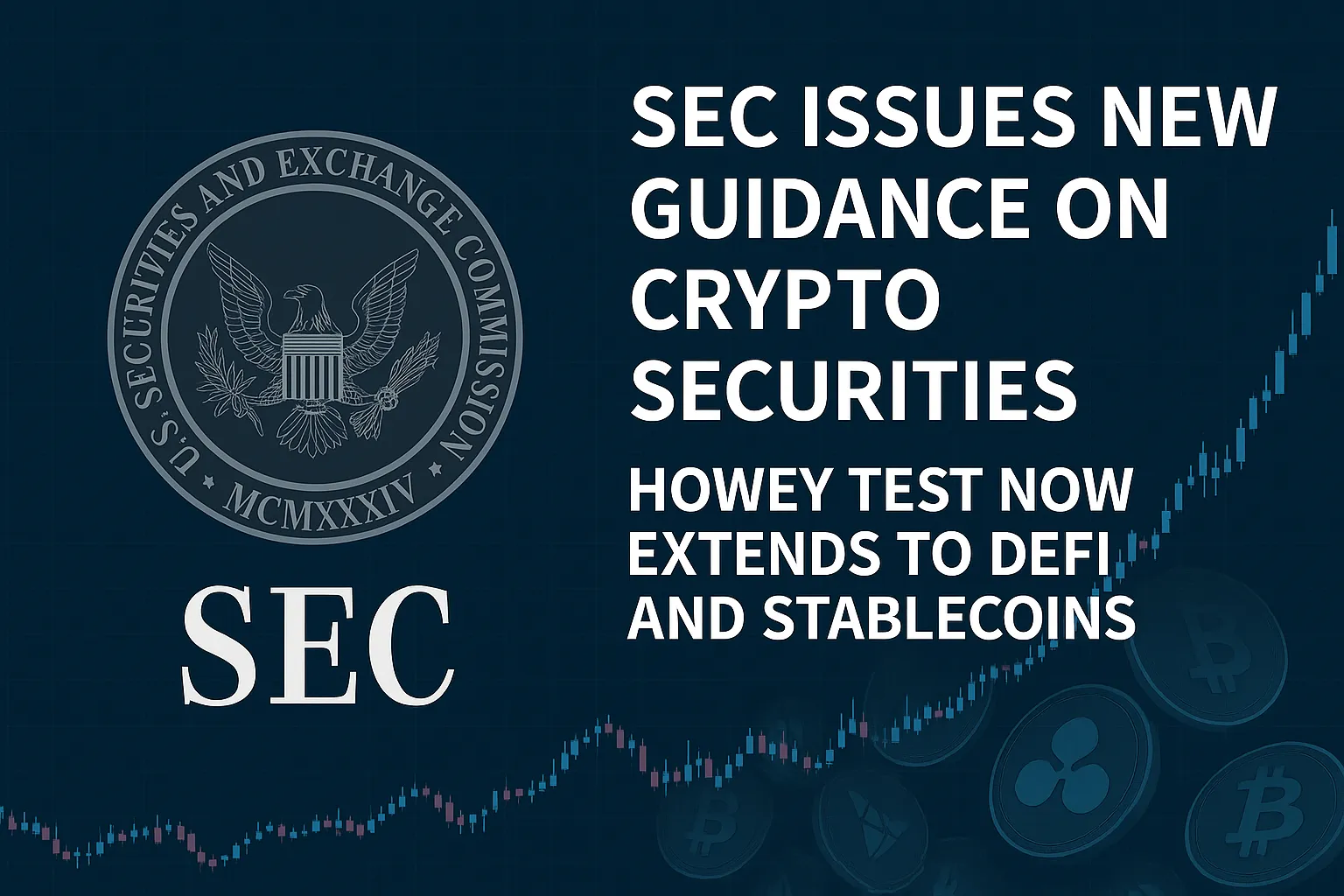
In October 2025, the U.S. Securities and Exchange Commission (SEC) officially released a report called
The guidance document for the Digital Asset Securities Framework 2025 ,
New interpretations and expansion standards are proposed for whether crypto assets constitute securities.
The document clearly states:
“Any cryptoasset where investors expect to earn an economic return through the efforts of others should be considered a security.”
This move is seen as a significant extension of the classic Howey Test .
Especially for DeFi protocol tokens, stablecoins and yield-based staking assets (Yield Token) .
In the new version of the document, the SEC still retains the traditional four standards of the Howey Test, but adds supplementary explanations.
| Judgment criteria | Original definition | New Supplementary Notes (2025 Edition) |
|---|---|---|
| ① Investment behavior | Investing funds in a project or enterprise | Including digital asset purchase, staking, liquidity provision and other behaviors |
| ② Joint venture | Investors and issuers have common interests | Collective mechanisms such as DAOs and liquidity pools are considered “common enterprises” |
| ③ Profit expectations | Investors expect to profit from the efforts of others | Including income-based staking, reward distribution, and liquidity mining income |
| ④ Others’ efforts | Asset value is driven by the issuer or developer | Even if a decentralized project has a "core team", it still meets this requirement. |
The SEC emphasized that decentralization is no longer an exemption condition .
As long as there is "key management, revenue commitment or technical control",
may be deemed securities.
The document specifically mentions three categories of key regulatory targets:
1. Yield-bearing Stablecoins
If stablecoins generate interest income through algorithms or staking mechanisms, they will be classified as securities.
2️⃣ DeFi Liquidity Tokens
If users can obtain profit sharing through LP tokens, it constitutes an investment contract.
3️⃣ Staking Products
If the platform centrally manages user pledges and distributes returns, it may constitute a "collective investment plan."
SEC Director Gary Gensler stated:
“The goal of regulation is not to prevent innovation, but to ensure that investors receive the same protections as in traditional markets.”
Major US exchanges (Coinbase, Kraken, Gemini)
After the guidance was issued, some DeFi token trading pairs were temporarily delisted, including:
UNI (Uniswap)
AAVE (Aave)
CRV (Curve)
MKR (MakerDAO)
Short-term volatility in the crypto market:
BTC fell 2.1% to $63,500 at one point;
ETH fell 3.4% to $2,480;
The overall market value of the DeFi sector shrank by 5.2%.
The release of this guidance document once again triggered discussions on the "dual management" of US regulation.
| Regulatory agencies | Areas of responsibility | Latest position (2025) |
|---|---|---|
| SEC | Investment assets, securities issuance and market supervision | DeFi, DAO, staking, and income-generating stablecoins are included in the scope |
| CFTC | Commodity derivatives and futures regulation | Some derivatives of Bitcoin, Ethereum, and stablecoins are still regulated by the CFTC |
| FinCEN | Anti-money laundering and capital flow supervision | Mandatory registration of trading platforms as MSBs (Money Services Businesses) |
Academics believe that this guidance provides the SEC with greater power of interpretation in the field of DeFi regulation.
| area | Crypto Regulatory Framework | Core Features | Differences from the SEC's new rules |
|---|---|---|---|
| European Union (MiCA) | Markets in Crypto-Assets Regulation | Clearly define the hierarchical management of stablecoins and tokens | The EU allows algorithmic stablecoins to be registered as EMTs (Electronic Money Tokens) |
| United Kingdom (FCA) | Digital Assets Regime 2025 | Emphasis on investor protection and advertising compliance | Not forcing all tokens to be classified as securities |
| Singapore (MAS) | PS Act + DPT Framework | Emphasis on KYC and AML supervision | Maintaining technology neutrality towards decentralized protocols |
| Hong Kong (SFC) | Virtual Assets Guidelines 2024 | Trading platforms require licenses to operate | Allow some DeFi projects to register in the sandbox |
The US approach is closer to " definition first, enforcement later ".
This means that the project party must prove that it is not a security.
1️⃣Project parties face increased compliance pressure
Newly issued tokens are required to undergo a “self-assessment”
If financing or token incentives are provided through SAFT, SEC registration or exemption application must be submitted
2️⃣Exchanges need to reclassify listed assets
Coinbase has said it will review the legal status of about 80 tokens
Non-compliant tokens may be moved into the “grey market”
3️⃣Investor education and legal transparency
Investors need to understand the governance and profit mechanisms behind tokens
The law firm recommends that the project adopt a "practical statement + public white paper update" mechanism
The SEC’s new guidance means:
The crypto industry is entering an institutionalized regulatory cycle ;
Compliance costs are rising, but market trust is also increasing;
DeFi and stablecoins may be included in a unified regulatory sandbox in the future.
Morgan Stanley's blockchain research department believes:
“By 2026, 70% of the world’s mainstream tokens will be tested for securities attributes.”
BrokerHivex is a financial media platform that displays information from the public internet or user-uploaded content. BrokerHivex does not support any trading platform or instrument. We are not responsible for any trading disputes or losses arising from the use of this information. Please note that the information displayed on the platform may be delayed, and users should independently verify its accuracy.