BrokerHiveXBrokerHiveXBrokerHiveX
Summary:Eurozone finance ministers are discussing how to accelerate the launch of euro-denominated stablecoins to strengthen the euro's international standing in the digital currency era. This article analyzes the policy motivations, market landscape, regulatory framework, and potential impact, revealing Europe's new strategy in the race for digital sovereignty.
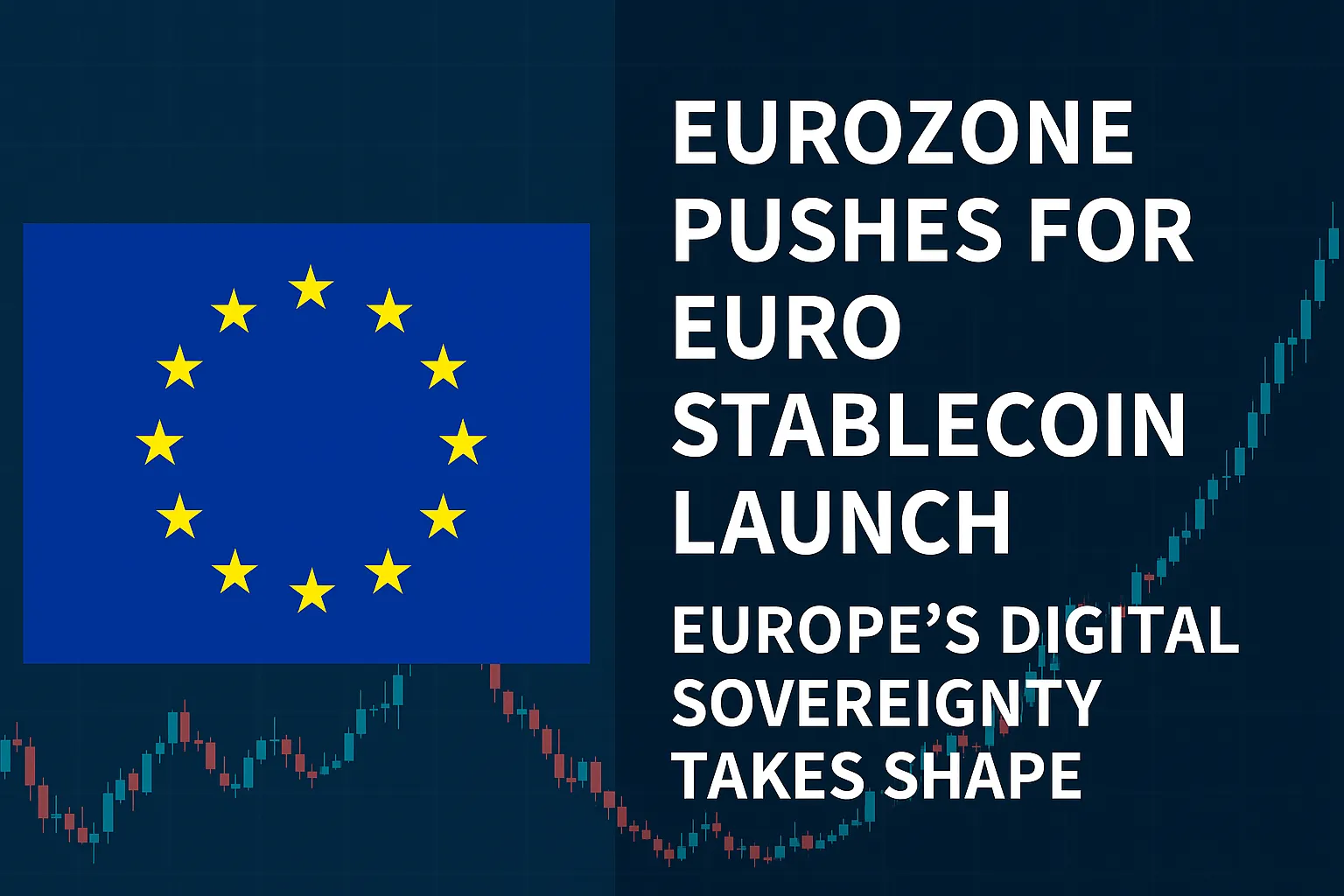
In October 2025, the Eurogroup Meeting of Finance Ministers of the Eurozone formally discussed for the first time the issuance and promotion plan of the Euro-denominated stablecoin .
The conference topics focus on:
How to promote the use of euro stablecoins in payments, trade and capital markets within the region;
How to reduce dependence on US dollar stablecoins (USDT, USDC);
How to establish a unified regulatory and technical framework.
According to Reuters ( reuters.com ),
Eurozone officials believe that the euro's presence in the digital economy is "clearly insufficient".
Currently, Euro-related assets account for less than 1.5% of global stablecoin trading volume.
The US dollar-related stablecoins account for more than 90% .
Eurozone Finance Minister Paschal Donohoe said after the meeting:
“The euro must remain competitive in the digital economy or its monetary sovereignty will be eroded.”
There are three core motivations behind this policy:
1️⃣ Strengthen the international status of the euro
Currently, cross-border payments are still dominated by the US dollar, and the share of euro settlement is declining year by year;
The launch of a euro stablecoin could increase its usability in the digital asset market.
2️⃣ Fighting against the US dollar stablecoin monopoly
Tether (USDT) and Circle (USDC) almost monopolize the global crypto payment system;
The euro stablecoin is seen as key to "balancing power."
3️⃣Technological sovereignty and payment security
The European Central Bank (ECB) hopes to gain control over data and payment infrastructure;
Reduce dependence on U.S. fintech and settlement systems.
| Stablecoin categories | Market capitalization (billions of US dollars) | Global proportion | Dominant regions |
|---|---|---|---|
| USDT (Tether) | 115 | 54% | Americas, Asia |
| USDC (Circle) | 65 | 30% | North America, Europe |
| DAI (MakerDAO) | 6.2 | 3% | DeFi Ecosystem |
| EURe / EUROC / Monerium | 2.3 | 1.5% | European Union, Iceland |
| Other regional currencies (GBP, JPY, etc.) | 3.5 | 2% | Multi-country distribution |
Source: CoinMetrics, ECB Stablecoin Study, October 2025
The market capitalization of euro-related stablecoins is extremely low, even less than the circulation of some emerging currency tokens in Asia.
The EU’s crypto asset regulatory law MiCA (Markets in Crypto-Assets Regulation) will be fully effective in 2025.
The regulation requires stablecoin issuers to obtain dual authorization from the European Central Bank (ECB) and local regulators .
Eurozone finance officials proposed:
Euro stablecoins are jointly issued by banks and fintech companies ;
All funds are deposited in an account with the European Central Bank or a regulated bank ;
Prohibit anonymous holding or transfer (to ensure compliance and AML controls);
Allows parallel operation with the Digital Euro system .
Fabio Panetta, a member of the ECB’s Executive Board, said:
“Private stablecoins and central bank digital currencies can coexist, but this must be done within a safe and regulatory framework.”
Banks have a positive attitude : BNP Paribas and Deutsche Bank have expressed their willingness to participate in the Euro Stablecoin Pilot Project.
The crypto industry is cautious : some DeFi developers are worried that the regulatory threshold is too high and will affect innovation;
Market level : The trading volume of the Euro stablecoin projects EUROC and Monerium EUR increased by more than 40% after the announcement.
Coinbase's head of Europe said:
“If the euro stablecoin receives official support, the European digital asset market will usher in institutional prosperity.”
The EU plans to adopt a "dual track" structure:
Main track (central bank channel) : provides clearing and settlement support for financial institutions and banks;
Sidetrack (Open API) : Allows regulated fintech firms to develop payment services based on the euro stablecoin.
This model will enable the euro stablecoin to access mainstream chains (such as Ethereum, Polygon, Avalanche) and local clearing systems (TARGET2, SEPA).
| area | Leading Projects | Policy Objectives | Features |
|---|---|---|---|
| USA | USDC, PayPal USD | Private sector-led, tolerant regulation | Market-oriented, loose compliance |
| European Union | EUROC, EURe, Monerium | Government guidance, bank-led | Strong supervision and high compliance |
| Asia | JPYC, XSGD, HKD-T | Digitalization of regional currencies | Leading technology and flexible policies |
Europe hopes to establish a new standard for "institutionalized stablecoins" and attract international settlement flows back to the Euro system.
1️⃣Insufficient market liquidity : initial usage may be limited;
2. Regulatory complexity : Coordinated regulatory enforcement across 27 countries is difficult;
3️⃣ Competitive pressure : The US dollar stablecoin ecosystem has formed economies of scale;
4️⃣Technical security : Cross-chain interoperability still needs to be improved.
A Deutsche Bank research report states:
“The success or failure of the euro stablecoin does not lie in the speed of issuance, but in whether it can build trust.”
The launch of the euro stablecoin will become a core piece of the European digital financial system.
It is both an extension of technological innovation and a manifestation of economic sovereignty.
In the future global digital currency competition,
Whether the euro can reshape its international influence depends on the balance between regulatory uniformity and market acceptance.
“In the digital age, currency requires not only credibility but also trustworthiness.”
BrokerHivex is a financial media platform that displays information from the public internet or user-uploaded content. BrokerHivex does not support any trading platform or instrument. We are not responsible for any trading disputes or losses arising from the use of this information. Please note that the information displayed on the platform may be delayed, and users should independently verify its accuracy.