BrokerHiveXBrokerHiveXBrokerHiveX
Summary:The U.S. Securities and Exchange Commission (SEC) has again delayed its decision on a spot Ethereum (ETH) ETF, triggering significant market volatility. This has impacted investor confidence in the regulatory compliance process for crypto assets, with institutional strategies and regulatory trends becoming a key focus. This article provides an in-depth analysis of the reasons behind this delay, the market reaction, its long-term impact, and investor strategies.
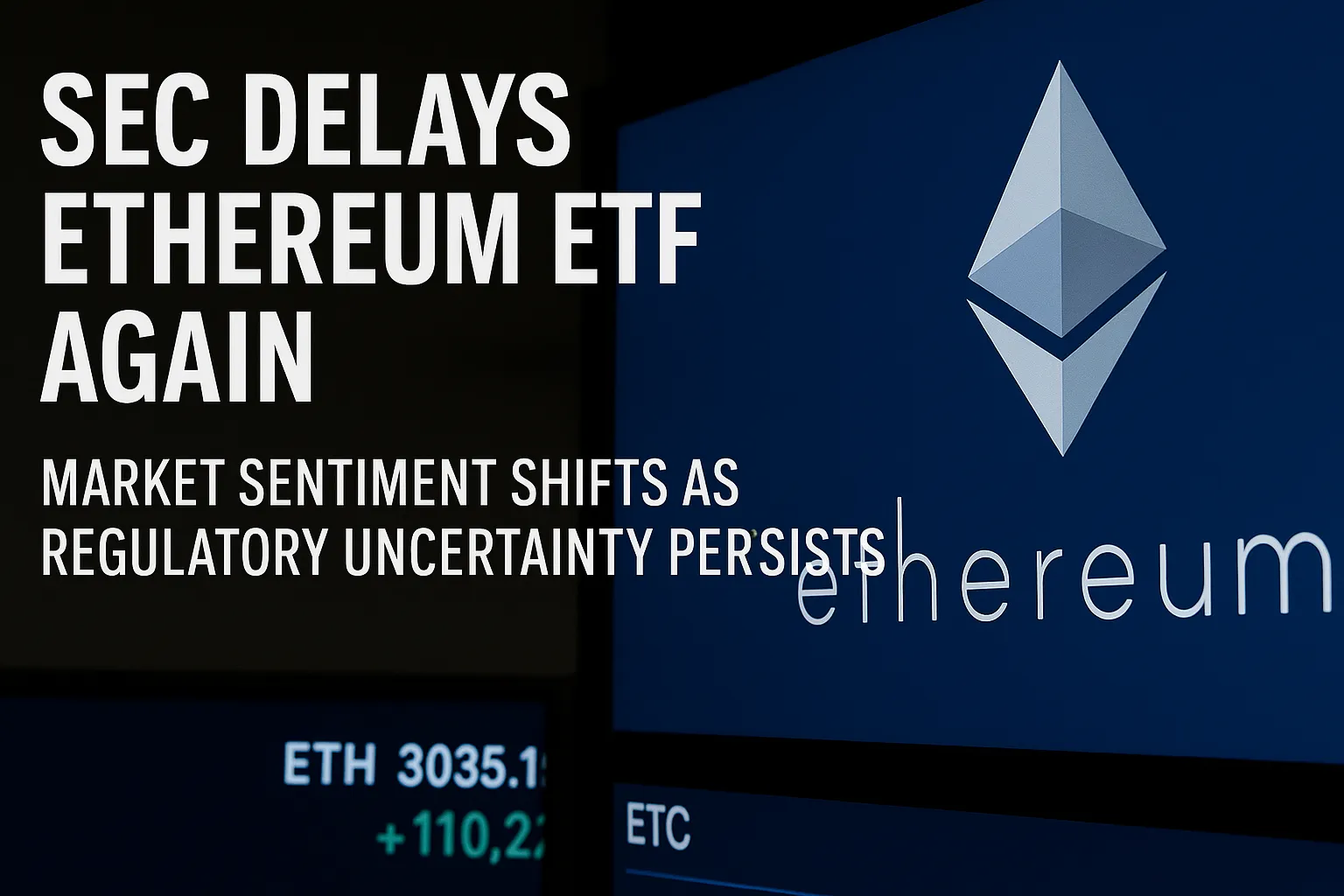
In October 2025, the U.S. Securities and Exchange Commission (SEC) announced that it would postpone the final approval decision on spot Ethereum ETF applications submitted by multiple institutions including BlackRock, Fidelity, ARK Invest, etc. The new deadline was postponed to January 15, 2026 .
This is the fourth time that the Ethereum ETF decision has been postponed since 2024. The reason given by the SEC is still that "more time is needed to evaluate market manipulation risks and investor protection frameworks."
After the news was announced, the crypto market reacted quickly:
📉 Ethereum Price (ETH/USD) : Down 7.4% in 24 hours, from $3,270 to $3,030
Grayscale Ethereum Trust (ETHE) : Down over 9%, premium turns to discount
📉 ETH options market : Put options holdings hit a new high since 2025
At the same time, the price of Bitcoin was also affected by the sentiment transmission, falling from US$69,000 to US$66,500.
| assets | Price before postponement | Price after postponement | 24h price fluctuation |
|---|---|---|---|
| ETH/USD | $3,270 | $3,030 | -7.4% |
| BTC/USD | $69,000 | $66,500 | -3.6% |
| ETHE | $25.1 | $22.8 | -9.1% |
🔗 CoinMarketCap ETH real-time data
The SEC has consistently emphasized that the crypto market lacks a mature spot price monitoring mechanism and anti-manipulation infrastructure , and approving ETFs at this stage may not fully protect investors.
Unlike Bitcoin, Ethereum involves complex scenarios such as staking income, DeFi applications, and smart contract platforms . There is still controversy within the SEC as to whether it is a "security."
With the 2026 US presidential election approaching, the bill on crypto regulation is still under debate within Congress. The SEC may choose a "maintaining stability" strategy and leave the decision to the next administration.
🔗 CNBC: The political considerations behind the SEC's postponement of the ETH ETF
Despite the delay in approval, several Wall Street giants have not withdrawn their applications, but have instead chosen a "long-term holding" strategy:
| mechanism | ETF Products | state | Strategy |
|---|---|---|---|
| BlackRock | iShares Ethereum Trust | Waiting for approval | Not withdrawn, keep the application |
| Fidelity | Wise Origin Ethereum ETF | Waiting for approval | Enhanced compliance documentation |
| ARK Invest | ARK 21Shares Ethereum ETF | Waiting for approval | Reduce fee structure to attract institutions |
Analysts pointed out that this reflects the institutions' firm confidence in the long-term value of Ethereum, and the postponement is more like "delay rather than rejection."
The SEC's frequent postponements also mean that it is carefully studying the compliance conditions of spot products. Once approved in the future, the ETF's structure and risk control mechanism will be more perfect.
Some institutional investors may postpone entering the ETH spot market, and the liquidity of the crypto market may be suppressed in the short term.
The CFTC and the SEC have different opinions on the regulatory oversight of Ethereum, and there may be an "overlapping supervision" situation in the future.
Against the backdrop of rising uncertainty, ETH volatility is expected to increase by at least 20%-30% in Q4.
| Investor Type | Recommended strategies | Risk Warning |
|---|---|---|
| long-term investors | Maintain core holdings and use callbacks to increase positions in batches | Pay attention to regulatory policy developments |
| Short-term traders | Capitalize on volatility opportunities with options or leverage | Increased volatility requires strict stop-loss |
| Institutional investors | Continue to pay attention to SEC approval signals and allocate structured products in advance | Be aware of tax and compliance requirements |
The SEC’s further postponement is not a “rejection” but a necessary stage in the evolution of regulation.
Just as it took nearly 10 years for the Bitcoin ETF to go from proposal to approval, the implementation of the Ethereum ETF also requires the maturity of regulators, market infrastructure, and institutional demand.
During this transition period, short-term market sentiment may fluctuate dramatically, but in the long run, Ethereum's ecological development, institutional layout and technological innovation will continue to drive it to become an important part of global digital assets.
BrokerHivex is a financial media platform that displays information from the public internet or user-uploaded content. BrokerHivex does not support any trading platform or instrument. We are not responsible for any trading disputes or losses arising from the use of this information. Please note that the information displayed on the platform may be delayed, and users should independently verify its accuracy.