BrokerHiveXBrokerHiveXBrokerHiveX
Summary:Saudi-India payment corridor, cross-border payments, de-dollarization, rupee settlement, oil settlement system, SWIFT replacement, global financial landscape, Middle East capital flows, energy finance system
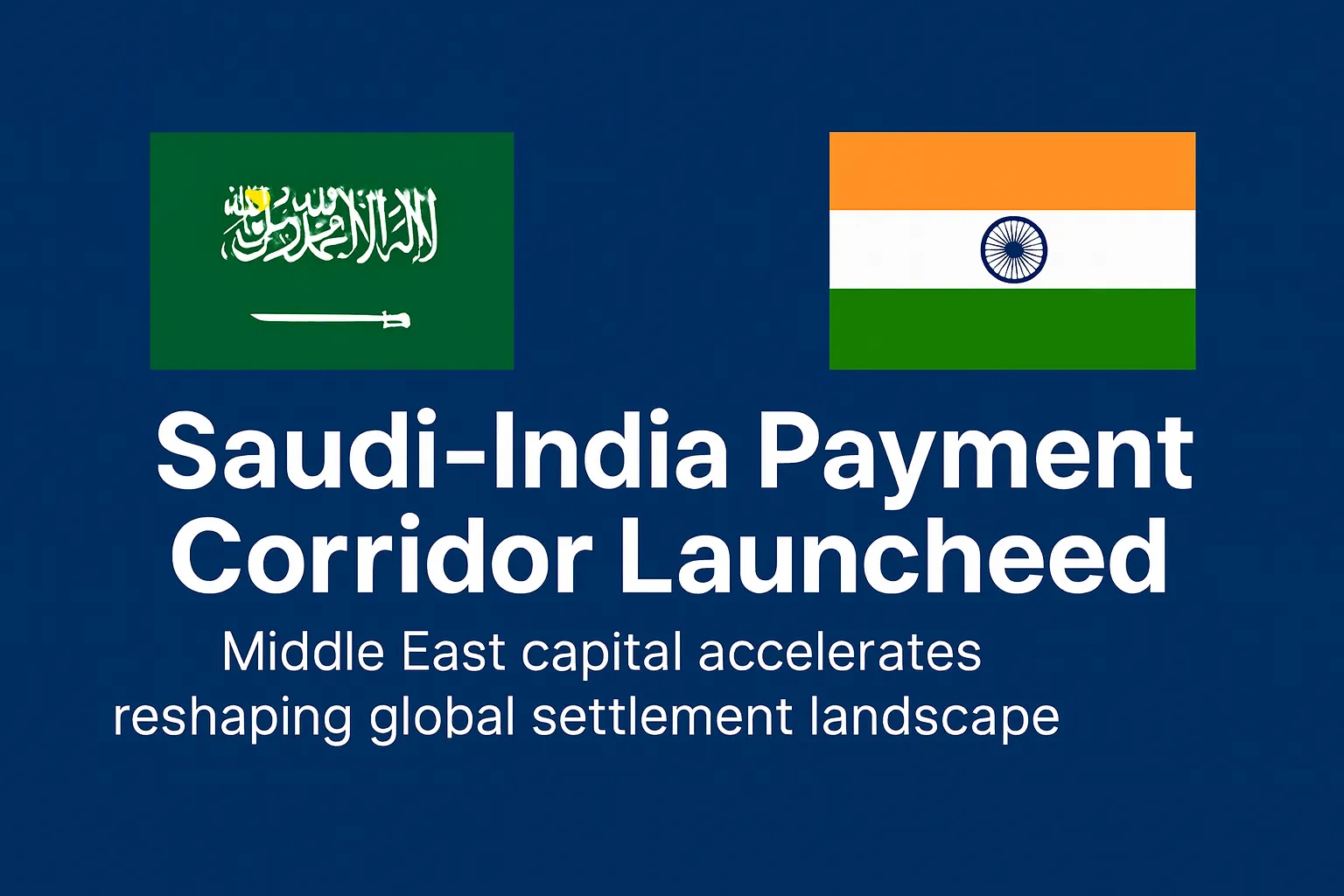
On October 5, 2025, the Saudi Arabian Central Bank (SAMA) and the National Payments Corporation of India (NPCI) jointly announced the official launch of the Saudi-India Payment Corridor, which allows the two countries to directly use their own currencies for settlement in multiple fields such as energy, manufacturing, technology and trade, marking the first time that the rupee and riyal have achieved the institutionalization of bilateral commodity settlement .
This news quickly ignited global financial markets. Multiple international media outlets noted that this was not only a significant milestone in bilateral relations between the two countries, but also a substantial challenge to the dollar-dominated SWIFT cross-border payments system. The chief economist of the Bank for International Settlements (BIS) stated in a report: "If the Cross-Border RMB Payment System (CIPS) is an 'Eastern model' for de-dollarization, then the Saudi-India Payment Corridor represents a 'structural breakthrough' in South-South cooperation."
The establishment of this channel is not accidental. Over the past three years, geopolitics and the global payment structure have been profoundly reshaped :
The US's "weaponization" of the SWIFT system has accelerated the search for alternatives
India's digital payment infrastructure (UPI) globalization strategy has achieved a breakthrough
Middle Eastern countries promote "de-dollarization" and financial sovereignty strategies
For the first time, total trade between the Global South countries has surpassed bilateral trade between the G7 and the EU.
“The payment system is becoming the new main battlefield of geopolitical competition,” a report from the London School of Economics and Political Science’s Center for Financial Research stated. “Whoever controls the payment infrastructure will dominate the flow of global capital.”
The "Saudi Arabia-India Payment Corridor" is not a simple inter-bank cooperation project, but a multi-level system that integrates central bank settlement, commercial bank clearing, payment technology and foreign exchange hedging mechanisms . Its complex design and sophisticated architecture are the first of its kind in the world.
The core of the system is the "Riyal-Rupee Bridge", which directly connects the clearing centers of the two central banks to achieve the following functions:
📊Direct exchange settlement : Both parties can settle directly in riyals or rupees without the need for USD transfer.
🔁Real -time foreign exchange hedging : The system automatically locks in the real-time exchange rate during settlement to reduce the risk of fluctuations.
🔐Liquidation is traceable : blockchain ledger records are used to improve transparency and regulatory efficiency.
🏦Dual central bank reserve support : The central banks of the two countries each provide US$5 billion in local currency as a clearing reserve pool.
The first sectors to be connected to the payment corridor are energy and crude oil trade. According to official announcements, starting in the fourth quarter of 2025, over 60% of Saudi Arabia's crude oil exports to India will be settled directly in local currency , with an estimated value exceeding $18 billion.
This means that the dollar's share of settlement in India-Saudi Arabia energy trade will drop rapidly from 95% to below 35% .
The system is not only compatible with the SWIFT ISO20022 message standard, but is also interconnected with India's UPI interface and Saudi Arabia's SADAD clearing system, allowing small and medium-sized enterprises to access cross-border settlements through digital wallets or bank APIs, greatly lowering the threshold for cross-border payments.
The impact of this project is not limited to the trade relations between Saudi Arabia and India. More importantly, it has a structural impact on the global dollar settlement system .
Crude oil trade has long been a pillar of US dollar hegemony. Since the establishment of the "petrodollar" system in the 1970s, nearly all Middle Eastern oil exports have been priced and settled in US dollars. However, local currency settlements between Saudi Arabia and India defy this underlying logic.
🌍 Dual challenges from pricing to settlement : While some oil prices are denominated in euros or yuan, final settlement is often completed in US dollars. This is the first time that local currency payment corridors have achieved dual de-dollarization of "pricing + settlement."
📉Structural decline in demand for the US dollar : The IMF model estimates that if this type of settlement mechanism is extended to Saudi Arabia's oil exports to China and ASEAN, the demand for the US dollar will decrease by more than US$300 billion annually.
SWIFT, the "nervous system" of cross-border payments, was used as a tool for sanctions following the Russia-Ukraine conflict, sparking global outrage. The actions of India and Saudi Arabia provide a replicable model for "de-SWIFTing."
🛡️Reshaping financial sovereignty : Developing countries are beginning to seek independent payment infrastructure to avoid being controlled by others in geopolitical conflicts.
🧭The rise of multipolar payment networks : In addition to the Saudi-India corridor, China's CIPS, Russia's SPFS, and the UAE-China Payment Bridge are all expanding rapidly.
Behind the "Saudi Arabia-India Payment Corridor" is a fundamental shift in the strategic logic of Middle Eastern capital.
Over the past decade, Middle Eastern oil funds have primarily flowed into European and US bonds and dollar-denominated assets. However, since 2022, geopolitical conflicts, high US dollar interest rates, and uncertainty in the Western regulatory environment have led to a "southward flow" of funds.
🪙 By 2024, Saudi Arabia's Public Investment Fund (PIF) will increase its direct investment in Asia by 42% year-on-year
🏗️ In 2025, Saudi Arabia-India bilateral direct investment projects exceeded US$37 billion, the highest in history
Saudi Finance Minister Mohammed al-Jadaan stated at the press conference: "Payment infrastructure is not a technical issue, but the foundation of financial sovereignty."
This sentence reveals the core of the Middle East strategy: by controlling trade and capital flows through the payment system, we can control the flow of global resources .
This payment corridor complements the previous China-Russia, local currency settlement and RMB crude oil futures markets, marking the prototype of a "de-dollarization closed loop" in the energy financial system:
Upstream: Crude oil settlement in local currency
Midstream: Multipolarization of cross-border payment systems
Downstream: Sovereign Wealth Fund Multi-Currency Portfolios
The formation of this closed loop means that cracks are beginning to appear in the energy-finance-capital chain dominated by the US dollar.
The Saudi-India Payment Corridor is not an isolated incident, but another crucial piece in the restructuring of the global financial landscape. Its impact extends far beyond bilateral trade, profoundly reshaping global capital flows, the structure of reserve currencies, and the ecosystem of payment systems .
Over the past decade, discussions on de-dollarization have largely remained at the "discourse level" or "symbolic transactions." However, with the implementation of the India-Saudi payment channel, the reality of the global financial system has changed:
📉The share of the US dollar in global foreign exchange reserves has dropped from 71% in 2000 to about 57% in 2025.
🪙For the first time, the trade volume settled in non-US dollar currencies exceeded 20% of the global total.
🌐The number of regional payment alliances will increase from 5 in 2020 to 19 in 2025, covering nearly 40% of global GDP.
The essence of this trend is that the US dollar remains the world's most important reserve currency, but it is no longer the "only option." A multi-currency, regionalized, and decentralized payment structure is gradually taking shape.
The rise of “payment corridors” has provided the infrastructure conditions for regional currencies such as the Indian rupee and the Saudi riyal to become reserve currencies. This means that the future reserve currency landscape may present a “three-tier structure”:
🥇USD : Its status as a core reserve currency remains, but its influence has declined.
🥈Renminbi and Euro : As the world's second-tier reserve currencies, they undertake regional trade settlement functions.
🥉Regional currencies (rupee, riyal, rand, etc.) : Achieve reserve status within specific trade corridors and bilateral systems.
The International Monetary Fund (IMF) pointed out in its latest "Monetary and Payment Systems Report" that by 2030, about 15%-20% of global foreign exchange reserves will consist of regional currencies , and such payment corridors are the "infrastructure prelude" to this trend.
Payment systems have never been as "geostrategically significant" as they are today. This is not only related to settlement efficiency, but also to financial sanctions, capital controls, monetary sovereignty and national security.
“Over the next decade, payment infrastructure will become the fifth dimension of strategic competition between nations .” - said Martinez, Head of Payments Innovation at the ECB.
For investors and financial institutions, the launch of the "Saudi Arabia-India Payment Corridor" is not only a macro event, but also means a series of structural adjustments to asset pricing logic, risk assessment models and investment strategies .
As the scale of local currency settlement expands, the demand and trading volume of rupees and riyals in the international market will increase significantly:
📊 The rupee's share in Asia-Africa trade settlements is expected to increase from 3.8% to 7.2%.
📊 The riyal's share of energy-related foreign exchange transactions is expected to rise from 1.5% to 4.5%.
This means that the liquidity and trading depth of the two currencies will increase, which may bring implicit appreciation pressure in the long run and gradually get rid of excessive dependence on the US dollar exchange rate policy.
One profound impact on the energy market is that price discovery mechanisms may be redefined . When oil is no longer priced entirely in US dollars, the risk pricing logic of futures, swaps, and derivatives markets will also adjust:
⚖️ Increased volatility in USD-denominated oil prices as pricing and settlement currencies are no longer fully aligned
📉 The non-USD oil derivatives market is expected to grow rapidly, providing new arbitrage opportunities for hedge funds and large traders.
💼 Energy companies' demand for foreign exchange risk management has increased dramatically, driving innovation in the derivatives market.
The “geo-localization” of payment systems will bring about huge demands for infrastructure construction:
🏦 Banks, clearing houses, and payment companies need to develop multi-currency clearing platforms
💻 Demand for blockchain settlement, smart contract payments, and cross-border digital identity verification technologies is surging
🪙 Cross-border interconnection of payment APIs and digital wallets has become a new focus of competition
McKinsey predicts that global payment infrastructure investment will exceed US$2.7 trillion by 2030, of which more than 40% will flow into emerging markets.
Experts from various international organizations believe that the Saudi-India Payment Corridor is as significant as the collapse of the Bretton Woods system. It is not just a technological collaboration, but also a prelude to a redistribution of power in the global financial order .
🧠Goldman Sachs : "This mechanism is not a replacement for the dollar, but a balancer for the global payment system. The dollar will continue to dominate, but it will no longer have an absolute monopoly."
📉 UBS : "The next stage of de-dollarization will not be RMBization, but multi-currency settlement. The Saudi-India payments corridor is a typical example of this process."
🧭 IMF Special Advisor Elisa Green : "In the next 5-7 years, similar payment corridors will form a network effect around the world. The countries of the Global South will no longer be 'price takers' of the US dollar system, but will become one of the 'rule makers'."
The Saudi-India Payment Corridor is just the beginning. Industry experts predict that within the next decade, three major payment alliances will emerge globally:
Asian Payments Alliance (China, India, ASEAN, Gulf countries)
EU Payment Block (Eurozone + UK + Nordic)
Inter-American Payment System (traditional system centered on the US dollar)
These three alliances, with both competition and complementarity, will jointly shape a "multi-center payment landscape." Within this landscape, capital flows will become more complex, the effectiveness of financial sanctions will be weakened, and the struggle for monetary sovereignty will become the forefront of global economic competition.
Q1: Does this payment corridor mean the end of the US dollar hegemony?
A: It is not the end, but it does mark the beginning of the marginalization of the US dollar hegemony. The US dollar will still be the dominant reserve currency, but its dominance will gradually weaken.
Q2: Can ordinary investors profit from this change?
A: Yes. Focus on foreign exchange trading related to the rupee and riyal, energy derivatives markets, and technology companies in the payment infrastructure sector.
Q3: Will other countries replicate this model?
A: Yes. The India-Saudi Arabia Payment Corridor provides a viable model for other countries in the Global South. Similar projects are likely to be launched in Indonesia, Brazil, South Africa, and other countries in the future.
Q4: Is this mechanism safe and reliable?
A: Due to the use of central bank reserve support and blockchain ledger transparency mechanism, the system has high security and traceability, but it is still necessary to guard against political risks and sanctions risks.
The significance of the Saudi-India Payment Corridor goes far beyond the opening of a financial channel. It represents a profound structural transformation: from dollar dominance to multi-currency coexistence, from a single payment hub to a regional alliance, and from passive adaptation to proactive reshaping.
Future financial competition will no longer be a battle over interest rates, bonds, or capital markets. Instead, whoever controls the power of payment infrastructure will determine the direction of global capital . The Saudi-India Payment Corridor is the starting point for this new round of financial power redistribution.
BrokerHivex is a financial media platform that displays information from the public internet or user-uploaded content. BrokerHivex does not support any trading platform or instrument. We are not responsible for any trading disputes or losses arising from the use of this information. Please note that the information displayed on the platform may be delayed, and users should independently verify its accuracy.