 BrokerHiveXBrokerHiveXBrokerHiveX
Summary:In October 2025, the three major financial centers of Tokyo, Singapore, and Sydney announced the establishment of the Asia-Pacific Time Zone Alliance (APTA). This initiative aims to interconnect order books and achieve market access, creating the world's first "24-hour, non-stop" trading ecosystem. This initiative is seen as a direct challenge to the dual-core financial system of London and New York, and will profoundly impact the structure of foreign exchange, derivatives, bonds, and other capital markets. This article analyzes the far-reaching significance of this alliance from multiple perspectives, including its mechanisms, capital flows, technological transformation, global competitive landscape, and investment opportunities.
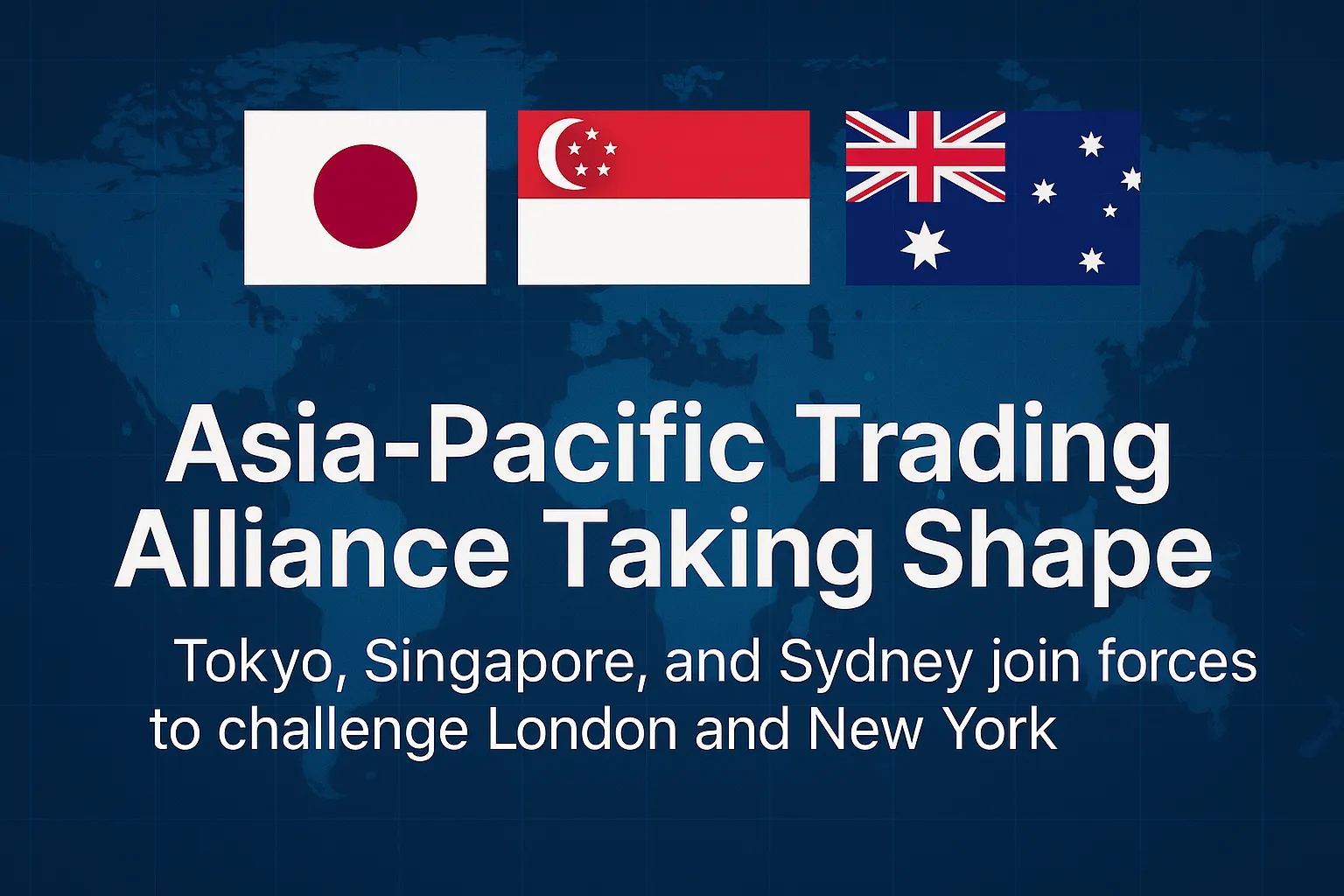
On October 3, 2025, the Tokyo Stock Exchange (JPX), the Singapore Exchange (SGX) and the Australian Securities Exchange (ASX) jointly issued an announcement in Singapore, announcing the official establishment of the Asia-Pacific Trading Alliance (APTA), aiming to create the world's first "continuous 24-hour uninterrupted" trading network through order book interconnection, common clearing, and shared trading hours.
The news quickly made headlines in global financial media. Bloomberg commented, "This is the most significant geographical restructuring of the global financial market in 50 years." The Financial Times bluntly stated, "APTA's goal is not simply cooperation, but a 'systemic challenge' to London and New York."
Behind the establishment of the alliance is a long-brewing geopolitical financial logic: global capital is evolving from a "Western dual-core" to a "multipolar network."
London and New York have dominated global trading for over a century, but the trading volume of the Asian market has accounted for more than 40% of the global total for five consecutive years.
Over the past three years, the combined liquidity of Tokyo, Hong Kong, Singapore and Sydney has approached 85% of the London market.
The growth of digital assets, derivatives and emerging market bonds has made the Asian time zone the new main battlefield for "price discovery".
Tokyo Exchange CEO Ichiro Yamamoto said at the press conference: "In the past, we were the 'baton' of the global market, but now we want to become the 'main stage'."
APTA is not just a loose cooperation mechanism, but a deeply integrated market infrastructure reconstruction plan , with three core modules:
The alliance achieves interconnection and interoperability between order books in Tokyo, Singapore, and Sydney through a unified matching protocol and data interface:
📊Unified depth display : Investors can see the order books and trading volumes of three exchanges on any exchange.
🔄Inter -exchange matching : Orders from Sydney can be directly executed against orders placed in Tokyo without the need for a middleman.
🏦 Common clearing house : APTA Clearing Co. will be responsible for the clearing of transactions in the three locations.
This means that the trading depth that was previously scattered across different time zones and markets will be integrated into a global "super order book" for the first time, providing an unprecedented liquidity environment for high-frequency trading, market makers and algorithmic funds.
There is an obvious “time zone fault” in the traditional global market:
Asian market closes → 2-3 hours of “liquidity vacuum” before European market opens
There is also a time gap between European closing and US stock opening
APTA achieved "seamless global market connectivity" for the first time through overlapping trading hours and technology bridging:
| Time Zone | Original opening | After APTA synchronization |
|---|---|---|
| Tokyo | 09:00–15:00 JST | 08:00–16:00 JST |
| Singapore | 09:00–17:00 SGT | 09:00–19:00 SGT |
| Sydney | 10:00–16:00 AEST | 06:00–16:00 AEST |
In this way, the entire Asia-Pacific trading network can operate continuously for 22 hours and be almost seamlessly connected with the trading hours in Europe and North America.
Assets initially covered by APTA include:
📈 Forex spot and futures
📉 Stock index and interest rate futures
🪙 Digital Asset and Stablecoin Contracts
💵 Sovereign bonds and emerging market bonds
In the future, it will also expand to the carbon credit, renewable energy certificate and green bond markets to provide a unified trading infrastructure for ESG investments.
The emergence of APTA is viewed by the global financial community as the first systematic challenge to the traditional "dual-core" market. Its potential impact is reflected in multiple aspects:
The foreign exchange market is the most liquid market in the world, but it has long been monopolized by London (38%) and New York (18%).
After the establishment of APTA, the transaction share of the Asia-Pacific market is expected to exceed 35% in 2026, forming a new pattern of "three-way division of the world".
📊 Trading depth for Asian currency pairs (USD/JPY, AUD/USD, SGD/USD) is expected to increase by 40%
📈 High-frequency trading volume in the Asian time zone is expected to double, attracting more than 1,000 emerging quantitative funds to enter the market
🪙 The "erosion effect" of digital currencies and stablecoins on the foreign exchange market will be amplified first in the Asia-Pacific time zone
The derivatives market, especially interest rate and stock index futures, has long relied on US and European platforms such as CME and ICE for price discovery. APTA will enable global liquidity center competition in Asia for the first time:
Singapore SGX's interest rate swap products have reached a 28% market share in the Asia-Pacific region, and are expected to challenge CME's regional dominance.
Tokyo's Nikkei 225 futures and Sydney's ASX200 index futures will be directly connected to European products
"Cross-time zone arbitrage strategy" will become a new hot spot in quantitative funds
As the depth and efficiency of Asia's trading networks increase significantly, international capital allocation patterns will also change:
🌏 Asia Pacific will attract more global sovereign funds and pension funds to increase their asset allocation ratio from 25% to 35%
💼 Family offices and hedge funds will partially relocate their trading headquarters to Singapore and Tokyo
🏦 International investment banks' market making and proprietary trading departments will reallocate global human resources
The emergence of APTA is not only a geographical restructuring, but also a reflection of technological competition.
The "TimeWarp Engine" matching system adopted by the alliance is a low-latency matching engine jointly developed by the three locations. Its matching speed is about 35% faster than the current CME Globex, and the latency is controlled within 8.3 microseconds .
The system has a built-in AI routing algorithm that can automatically identify the best prices and liquidity sources among the three locations, splitting and allocating orders to the optimal market for execution, significantly reducing the risk of slippage.
APTA launched the world's first "unified margin account" mechanism, allowing investors to conduct multi-asset transactions across three markets with the same capital pool, significantly improving capital utilization efficiency.
This structural change presents unprecedented new opportunities for investors:
As price differences and time disparities shrink, the complexity of arbitrage strategies increases significantly. Advanced quantitative funds will use AI strategies to conduct millisecond-level arbitrage between the three locations.
Global asset management companies are planning to launch ETFs, options and index products based on the "APTA trading basket" to provide institutional investors with new allocation tools.
As the Asian market deepens, traditional pricing models will be re-evaluated, and the financing costs and currency hedging structures of multinational companies will be recalculated.
Morgan Stanley : "APTA is not just a market linkage, it's a redrawing of the financial landscape. We may be witnessing the beginning of the 'post-London-New York era'."
📉 Citigroup : "As trading depth and clearing efficiency increase, global capital will be more evenly distributed across the three major time zones."
🧭The Institute of Finance, University of Tokyo : "The financial center of the future will not be a single city, but a 'distributed network' composed of technology, time zones, and infrastructure."
The establishment of the "Asia-Pacific Trading Time Zone Alliance" marks the entry of the global financial system into the "era of multipolar competition."
🌍 The hegemony of the Western market is no longer unshakable
🏦 Asia will change from a “taker” to a “price maker”
📈 The complexity and innovation of the market structure will increase significantly
Experts predict that by 2030, the global market will no longer be a dual-core "London-New York" market, but a three-legged structure of "New York-London-Asia-Pacific", and Asia-Pacific's status as a liquidity hub will become a must-pass place for global capital allocation.
The "Asia-Pacific Trading Time Zone Alliance" is not just a market cooperation, but a deep game about discourse power, pricing power and capital flows .
Its significance lies not only in the extension of trading hours and the interconnection of order books, but also in the reshaping of the "timeline" of global financial centers.
In the future, market fluctuations may no longer begin when New York opens or end when London closes, but will quietly surge at the moment when Tokyo morning, Singapore noon and Sydney dusk meet.
BrokerHivex is a financial media platform that displays information from the public internet or user-uploaded content. BrokerHivex does not support any trading platform or instrument. We are not responsible for any trading disputes or losses arising from the use of this information. Please note that the information displayed on the platform may be delayed, and users should independently verify its accuracy.

 Su***ey