BrokerHiveXBrokerHiveXBrokerHiveX
Summary:By 2025, the investment logic of global sovereign wealth funds is undergoing a structural shift. Against the backdrop of declining US Treasury yields, rising risk in US dollar-denominated assets, and accelerating de-dollarization, sovereign wealth funds from the Middle East to East Asia are making large-scale adjustments to their holdings, increasing their holdings of gold, RMB bonds, digital currencies, and physical assets. This article delves into this "quiet capital revolution," revealing its underlying geoeconomic drivers, investment logic, market impact, and future trends.
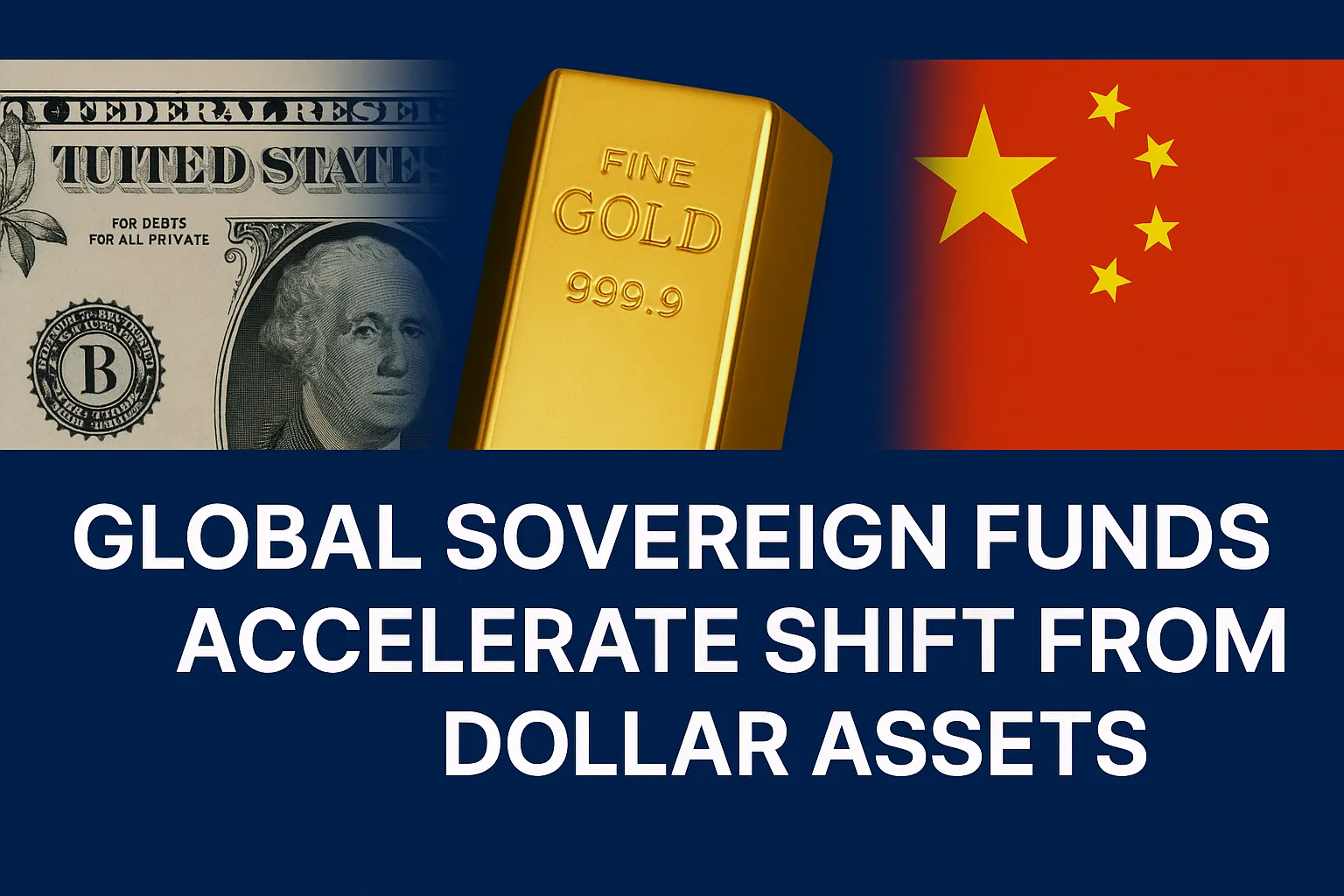
At the pinnacle of the capital market, sovereign wealth funds (SWFs) have long been considered a "silent yet most influential" force. As of Q3 2025, the total assets managed by 95 sovereign wealth funds worldwide exceeded US$13.7 trillion , representing over 12% of global GDP. The investment directions of these funds often determine the long-term flow of global capital.
Over the past three decades, US dollar assets (US Treasury bonds, US stocks, and US dollar-denominated commodity futures) have been the core allocation of sovereign wealth funds, accounting for 60%-70% of their holdings. However, in the past two years, this structure has shown a significant loosening:
📉 The proportion of US Treasuries in sovereign fund portfolios will drop from 43% in 2021 to 31% in 2025.
📈 The allocation ratio of gold and physical assets increased from 8% to 15%.
📊 The proportion of RMB assets and non-US dollar bonds increased from less than 4% to 12%.
This trend isn't a short-term strategy adjustment, but rather a structural asset rebalancing . The Norwegian Government Pension Fund (GPFG) stated in its latest quarterly report: "US dollar assets are no longer the only option for risk hedging."
The de-dollarization of sovereign capital is driven by complex geopolitical and financial logic. A comprehensive analysis reveals at least three forces driving this historic shift:
Since 2022, the United States has expanded sanctions against Russia, Iran, Venezuela, and other countries, and the weaponization of the US dollar payment system has become increasingly apparent. Central banks and sovereign wealth funds from more than 20 countries have publicly expressed concerns about the "declining political neutrality" of the US dollar system.
A senior executive at a Middle Eastern sovereign fund told the Financial Times: “When reserve assets can be frozen due to policy changes, they are no longer ‘safe assets’.”
Long-term U.S. Treasury yields have fluctuated amid rising inflation and a widening fiscal deficit. The U.S. Congressional Budget Office projects that federal debt will reach 128% of GDP by 2030, weakening sovereign wealth funds' confidence in long-term dollar-denominated debt assets.
📉 The real yield on 10-year US Treasury bonds has fallen from 1.9% in 2022 to 0.7% in 2025.
📊 Many funds including those from Japan, Saudi Arabia, and Abu Dhabi have begun turning to emerging market sovereign and corporate bonds.
As the share of the RMB, euro, and digital currencies in cross-border settlements increases, the dollar's currency dominance is no longer secure . Sovereign wealth funds must adjust their asset structures in advance to cope with the future multi-currency settlement environment.
Middle Eastern sovereign wealth funds are at the vanguard of this round of structural adjustments. As one of the world's largest pools of capital, their investment strategy is shifting from a "dollar-oriented" approach to a "geopolitical focus."
📉 The proportion of US debt has dropped from 39% to 25%.
📈 Investment in infrastructure projects in China, India and Indonesia increased by 65% year-on-year.
🏦 Established a $10 billion "Emerging Market Local Currency Bond Fund".
The ADIA investment strategy report states: "The global reserve system is evolving towards a 'multi-anchor currency' model, with local currency bonds and real assets being the core configurations for the next decade."
The PIF is collaborating with the People's Bank of China on a financial product called "RMB-denominated crude oil settlement" and plans to convert 15% of its foreign exchange reserves into non-US dollar assets. Saudi Arabia has also significantly increased its gold reserves, with total holdings exceeding 450 tons, a record high.
The QIA has established the world's first "Sovereign Digital Currency Strategic Fund," focusing on investing in CBDC interoperability platforms and stablecoin payment infrastructure. The fund's head stated, "The next generation of payment systems will not be centered around the US dollar, but will be based on multiple assets and multiple chains."
The allocation logic of Asian sovereign capital has also undergone fundamental changes. In particular, RMB assets are becoming the new favorite of sovereign funds and central bank reserves.
📈 China's government bond yields have stabilized at 2.6%-2.9%, higher than US Treasury bonds during the same period.
📊 The balance of Chinese bonds held by foreign capital reached 4.3 trillion yuan, a record high.
🏦 The RMB's weight in the IMF SDR was raised from 10.9% to 14.8%.
In its latest quarterly report, the Government of Singapore Investment Corporation (GIC) pointed out that “the risk-adjusted yield of RMB bonds is significantly better than that of US Treasuries, making them the most cost-effective sovereign asset in the global capital market.”
Financial centers such as Hong Kong, Singapore, and Shanghai are becoming hubs for de-dollarization of capital. The number of RMB clearing banks is projected to increase from 14 in 2020 to 35 in 2025, and the transaction volume of the CIPS cross-border payment system is projected to increase by 58% year-on-year.
The structural shift of sovereign funds is not only changing their own investment portfolios, but is also reshaping the entire global financial market landscape:
The Bank for International Settlements predicts that overseas demand for U.S. Treasuries may fall by 15%-20% in the next five years, which will push up U.S. fiscal financing costs and intensify doubts about the credit of the U.S. dollar.
As the reserve structure diversifies, the gold price is expected to exceed US$2,800 per ounce, and RMB assets and commodities will also become part of the "new reserve triangle".
New York and London remain the main capital hubs, but the strategic positions of Singapore, Hong Kong, Riyadh, and Shanghai are rapidly rising. In the future, global capital may present a "three-pole structure":
| area | Features | Dominant force |
|---|---|---|
| US and Europe | Traditional US dollar asset center | US Treasury bonds, US stocks, and US dollar bonds |
| Asia | Emerging Markets and RMB Asset Center | RMB bonds, Asian real assets |
| middle East | Energy Capital and Physical Reserves Center | Gold and sovereign fund investments |
The shift in sovereign wealth funds' allocations is not a short-term tactic, but a prelude to a transformation of the global capital order. In the next 5 to 10 years, we will see:
🌏The reserve currency structure has changed from "dollar dominance" to a diversified structure of "dollar + RMB + gold"
🏦Global capital hub evolves from "European and American dual core" to "three-pole competition"
🪙Investment logic shifts from "profit-oriented" to a three-dimensional structure of "security + geography + strategy"
The chief strategist of UBS Wealth Management concluded: "When sovereign funds begin to take action, it means that the reconstruction of the world's capital order has begun. The era of the US dollar will not end overnight, but its 'irreplaceability' is disappearing."
Sovereign wealth funds are always slow to act, but once they start, they signal irreversible changes in underlying structures. The dominance of US dollar assets is being eroded by time, while the rise of gold, the renminbi, digital assets, and local currency bonds marks the beginning of a new order.
The future capital market will no longer be a "sea of dollars," but a global network of multipolar convergence and balanced power. Sovereign wealth funds are the "invisible hand" driving this quiet revolution.
BrokerHivex is a financial media platform that displays information from the public internet or user-uploaded content. BrokerHivex does not support any trading platform or instrument. We are not responsible for any trading disputes or losses arising from the use of this information. Please note that the information displayed on the platform may be delayed, and users should independently verify its accuracy.