BrokerHiveXBrokerHiveXBrokerHiveX
Summary:In 2025, the global energy trade settlement landscape is undergoing its most dramatic structural reorganization in 50 years. From the Middle East to Asia, from Russia to Africa, numerous countries and regions are beginning to circumvent the dollar-dominated "petrodollar system" and form three major energy settlement alliances based on the renminbi, ruble, and riyal. This "settlement currency war" is not only affecting the global energy market pricing system but is also profoundly altering the structure of international reserves, capital flows, and the geopolitical landscape.
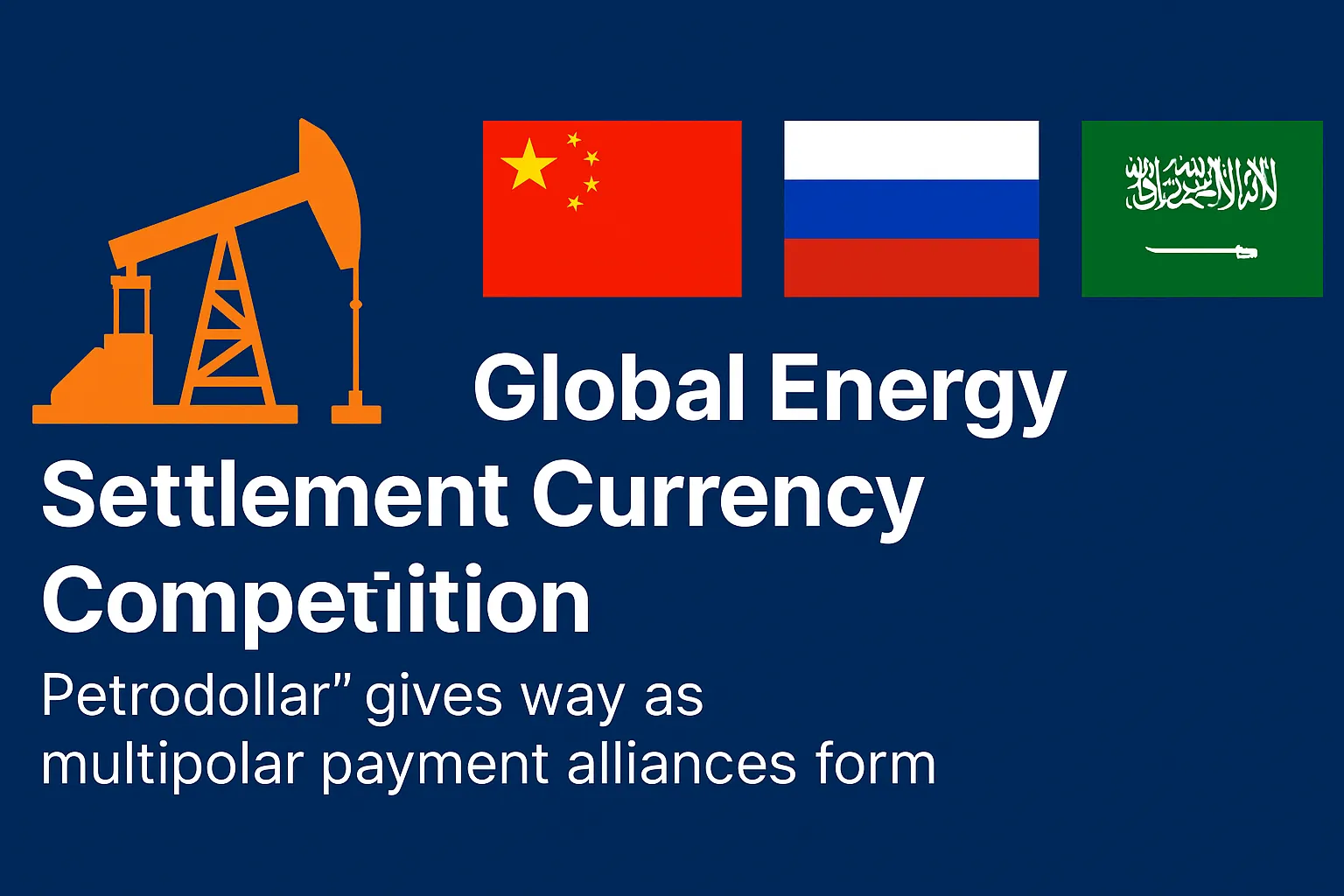
After the collapse of the Bretton Woods system in 1973, the United States and Saudi Arabia reached the "Petrodollar Agreement," stipulating that global crude oil prices and settlements would be denominated in US dollars. This arrangement became the cornerstone of US dollar hegemony. In the following fifty years:
📈 More than 80% of global oil and gas trade is denominated in US dollars
🏦 The US dollar has become the core currency for foreign exchange reserves and international settlements
🌎 Oil demand feeds back into the U.S. Treasury market and financial assets, supporting the “dollar circulation system”
However, this landscape is facing unprecedented challenges. Geopolitical friction, sanctions risks, the weaponization of the SWIFT system, rising energy demand in emerging markets, and technological advances in multi-currency payment systems are all eroding the dollar’s natural monopoly in the energy sector.
In the global energy market in 2025, three new forces have emerged and are changing the rules of the game for half a century.
The most representative de-dollarization settlement alliance is the "RMB Crude Oil Settlement Zone" built with China as the core and in cooperation with Middle Eastern energy exporters.
In 2025, China signed long-term crude oil supply agreements with Saudi Arabia, the United Arab Emirates and Qatar, which were denominated in RMB and settled through the Shanghai Petroleum Futures Market for the first time.
In the 20-year crude oil contract signed by China National Petroleum Corporation (CNPC) and Saudi Aramco, 70% of the settlement is in RMB .
Trading volume of RMB crude oil futures (SC contracts) on the Shanghai Futures Exchange increased by 180% year-on-year.
The RMB's share in global crude oil settlement has risen from 2.6% in 2020 to 18.5% in 2025.
"Petro-yuan" is not only used for settlement, but also becomes a new asset class for central bank reserves.
CIPS (Cross-Border Payment System) runs in parallel with SWIFT and clears 85% of energy transactions.
For Middle Eastern countries, it can reduce their dependence on the US dollar and enhance their monetary sovereignty.
For China, it will help the internationalization of the RMB, energy security and financial strategic initiative.
The "Ruble Energy Settlement Zone" led by Russia and the Eurasian Economic Union countries represents the second path: achieving "de-dollarization" of energy trade through local currency swaps and bilateral agreements .
Large energy companies such as Gazprom and Lukoil have signed natural gas and oil contracts with China, India, Türkiye, Iran and other countries settled in rubles or local currencies.
The Russian Central Bank has launched an "Energy Exchange Platform" that allows buyers to directly exchange their local currency for rubles to pay for energy.
More than 60% of the contracts in India-Russia crude oil trade are settled in rupees and rubles.
The ruble's share of global natural gas settlements rises from 1.5% in 2021 to 9% in 2025.
Local currency swap settlements enabled Russia to avoid sanctions losses exceeding $60 billion.
Energy trade between Russia, China and India increased by 42% year-on-year.
For sanctioning countries, it is a strategic weapon to avoid risks in the US dollar system.
It has strengthened the energy and financial ties among Russia, China and India, forming the "Eurasian Energy Corridor".
The third model is led by the Gulf Cooperation Council (GCC), which uses local currencies such as riyals and dirhams and a multi-currency mixed settlement system to promote "diversified settlement" in energy trade.
Saudi Arabia and India signed the "Oil-Rupee-Ryal Trilateral Settlement Agreement", allowing the two countries to make direct payments without using the US dollar.
The UAE, Oman and other countries have launched the "Energy Digital Settlement Bridge" (Energy Bridge), which supports the simultaneous use of USDC, EURC, CNY and AED.
Qatar and South Korea signed a 15-year liquefied natural gas contract, with payment in a mixture of euros and Korean won.
Gulf currency settlements accounted for 23% of GCC’s total energy exports, a record high.
The multi-currency settlement mechanism reduces exchange rate risks and liquidity costs for energy exporters.
The use of Middle Eastern currencies in regional energy clearing systems has increased by 220%.
Enhance the currency status of Middle Eastern countries and build "energy and financial sovereignty".
Diversify dollar risks and strengthen strategic ties with major Asian buyers.
These three clearing alliances do not exist in isolation, but rather represent three structural shocks to the “petrodollar system”:
In the past, the US dollar served as both the unit of account and the medium of settlement. Today, while currencies like the renminbi, ruble, and riyal haven't completely replaced the dollar's pricing function, they are rapidly eroding its market share in the settlement process.
📉 Data shows:
In 2020, the US dollar accounted for 88.2% of global energy settlements.
Decline to 69.5% in 2025
The IMF predicts that the GDP growth rate may fall below 55% by 2030.
Energy derivatives, futures, insurance, and swap markets are forming a new financial ecosystem around the new settlement currency.
For example, the derivatives trading volume in the RMB crude oil futures market increased by 210% year-on-year, and has become the "third price reference" besides Brent and WTI.
As the demand for US dollars in energy settlements decreases, the US "petrodollar cycle" is experiencing a breakdown:
Passive demand for US Treasury purchases declines
The global distribution of US dollar liquidity tends to be dispersed
U.S. financial influence on energy exporters weakens
Competition in energy settlement is no longer just an economic issue, but also an extension of geopolitics and the core of diplomatic games .
China has tied its energy cooperation under the Belt and Road Initiative to RMB settlement, Middle Eastern countries have strengthened their dependence on the Asian market through local currency settlement, and Russia has used ruble settlement to consolidate its "sanction immunity" system.
These three types of "currency diplomacy" are shaping a new global energy relationship chain.
Due to settlement diversification, the United States' financial influence on the Middle East has declined, and Saudi Arabia and the UAE have become more "strategically autonomous" in their foreign policy, even distancing themselves from Washington on some issues.
The issue of settlement currency has become a core agenda item in decision-making at platforms such as OPEC+, the BRICS Energy Council, and the Shanghai Cooperation Organization (SCO) Energy Forum. Currency is no longer just a means of payment, but a strategic bargaining chip.
Looking ahead to the next 5 to 10 years, the global energy settlement system will most likely evolve into a multi-polar coexistence pattern:
| camp | Dominant currency | Member States | Main settlement areas |
|---|---|---|---|
| US dollar camp | USD | United States, European Union, Japan | North American and European energy trade |
| RMB camp | CNY | China, Gulf States, Africa | Crude oil, coal, rare earths |
| Local Currency - Mixed Camp | RUB / AED / INR | Russia, India, Central Asia, Middle East | Natural gas, liquefied gas, raw materials |
In this landscape, the US dollar will continue to play an important role, but it will no longer be "irreplaceable." The financial infrastructure of the energy market will shift from "unipolar domination" to "multipolarity."
This structural shift has brought a new framework of thinking to global investors:
📊Energy futures pricing models will be restructured, and the risk premiums of RMB and ruble-denominated products will be reassessed
🏦 Reserve currency allocation will become more diversified, with the proportion of gold and energy-linked assets increasing
🌐Investment in cross-border payment infrastructure will become a key trend in emerging market fintech.
The "petrodollar" has been the cornerstone of the global monetary order for the past 50 years, but against the backdrop of geopolitical multipolarization, technological changes and the restructuring of the global energy landscape, it is undergoing a "midlife crisis."
Settlement currency is no longer just a detail of financial operations; it is the intersection of sovereignty, diplomacy, capital, and security . In the future energy world, whoever controls the standard for settlement currency will hold the geostrategic initiative.
BrokerHivex is a financial media platform that displays information from the public internet or user-uploaded content. BrokerHivex does not support any trading platform or instrument. We are not responsible for any trading disputes or losses arising from the use of this information. Please note that the information displayed on the platform may be delayed, and users should independently verify its accuracy.