 BrokerHiveXBrokerHiveXBrokerHiveX
Summary:A recent Standard Chartered report indicates that the rapid expansion of stablecoins in payments and stored-value sectors could lead to a loss of up to $1 trillion in deposits from emerging market banking systems over the next three years. This article delves into the mechanisms and underlying factors of the impact of stablecoins on the global banking industry, as well as the regulatory responses of various countries.
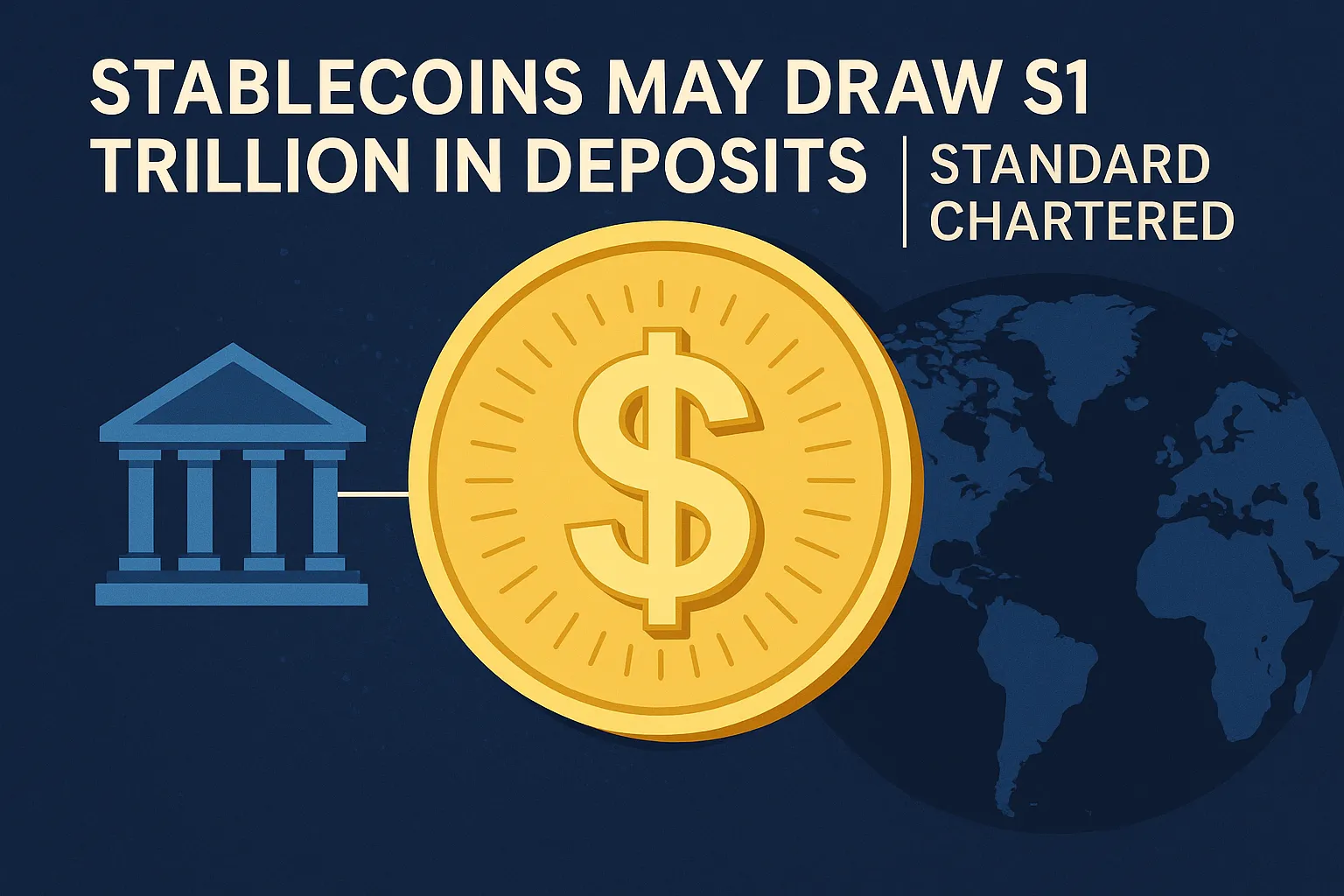
After several rounds of volatility in the cryptocurrency market, stablecoins are becoming a new variable in the global financial system. Standard Chartered Bank predicted in its latest research report released on October 7:
“If the current growth trend continues, stablecoins could siphon off up to $1 trillion in deposits from emerging market banks over the next three years , with profound implications for the traditional financial system.”
The report notes that the core appeal of stablecoins lies in the convenience and accessibility of a "digital dollar." In regions experiencing high inflation, volatile exchange rates, and inefficient financial systems, businesses and individuals are more willing to convert their assets into dollar-pegged stablecoins (such as USDT, USDC, and FDUSD) rather than deposit them in local banks.
This trend is particularly evident in Latin America, Africa, the Middle East, and Southeast Asia. Data platform Chainalysis shows that global stablecoin trading volume has exceeded US$5.7 trillion since 2025, of which 65% comes from emerging market countries .
The reason why stablecoins can "steal" the business of traditional banks is essentially because they solve the three long-standing pain points of the banking system :
🔄 Faster and cheaper transfers
Cross-border settlement of stablecoins is almost real-time, and the handling fee is as low as 1/10 of traditional wire transfers, greatly reducing payment costs for businesses and individuals.
🏦Dollarized stored value, strong resistance to inflation
For residents in emerging markets where the local currency has depreciated severely, converting assets into stablecoins pegged to the US dollar is equivalent to having a "digital dollar account", and the sense of security of stored value is much higher than that of local banks.
🌍No need to open an account, extremely low threshold
Anyone can use stablecoins with just a smartphone and a digital wallet, without the need for cumbersome KYC reviews and account management processes, which is extremely attractive to people without bank accounts.
This trend of "disintermediation" has led to stablecoin platforms gradually replacing the functions of traditional banks in areas such as cross-border remittances, savings, and payments.
The Standard Chartered report emphasizes that deposit outflows are not only a problem for banks’ profitability, but also have the potential to trigger systemic risks . Once large-scale capital is transferred from the banking system to the on-chain stablecoin ecosystem, it will bring about three major chain reactions:
📉Bank liquidity has declined and lending capacity has been limited : A decrease in deposits means that the scale of funds available for banks to lend has shrunk, directly affecting the financing costs of the real economy.
🏦Small and medium-sized banks face survival crisis : Small banks in emerging markets that rely heavily on demand deposits may find it difficult to maintain a balanced balance sheet due to the loss of depositors.
🪙 Monetary policy transmission is hindered : If a large amount of funds remain in on-chain assets, the central bank’s traditional tools for regulating interest rates and money supply may become ineffective.
The International Monetary Fund (IMF) also warned in a recent research report: "The cross-border expansion of stablecoins may undermine national monetary sovereignty and bring unprecedented challenges to capital account management."
As the threat of stablecoins to the banking system expands, major central banks and regulators around the world have taken action:
🇺🇸United States : The Treasury Department and Congress are advancing the Stablecoin Regulation Act, which requires all issuers of dollar-pegged stablecoins to hold 100% reserves and undergo bank-level audits.
🇪🇺EU : MiCA (Regulatory Framework for Markets in Crypto Assets) clearly states that the issuance of stablecoins requires the permission of the ECB and sets a daily trading volume cap.
🇨🇳China : Although it has banned cryptocurrency transactions within its borders, it has begun promoting RMB-pegged stablecoins (such as AxCNH) in overseas markets to hedge against the expansion of the "digital dollar."
🌍Central banks in emerging markets : Some countries are accelerating the development of CBDC (central bank digital currency), trying to compete for dominance in digital payments with "official digital currency."
Stablecoins are not only a technological innovation, but also a new front in the competition for monetary hegemony .
Although the warning of a “$1 trillion deposit outflow” sounds alarmist, industry experts believe that it also provides an opportunity for traditional banks to transform.
John Bates, a global fintech analyst, said: "If banks can integrate stablecoin technology into their own systems or launch regulated digital currency accounts, they have the opportunity to regain the initiative."
In the future, the boundaries between traditional finance and on-chain finance will become increasingly blurred. Stablecoins will not replace banks, but they will force them to evolve —from passive depository institutions to "bridges" for the circulation of digital assets.
The rise of stablecoins is not only changing the way people store value and make payments, but is also shaking the foundations of the global banking system. This not only brings about a quantitative shift in "deposit loss," but is also likely to trigger qualitative changes in monetary policy, capital flows, and financial sovereignty .
When $1 trillion in deposits may be transferred to the chain, the world's financial system has quietly entered the deep waters of the "digital dollar era".
BrokerHivex is a financial media platform that displays information from the public internet or user-uploaded content. BrokerHivex does not support any trading platform or instrument. We are not responsible for any trading disputes or losses arising from the use of this information. Please note that the information displayed on the platform may be delayed, and users should independently verify its accuracy.
 Su***ey