 BrokerHiveXBrokerHiveXBrokerHiveX
Summary:October 31, 2025 (Friday, Pacific Time) – Following the Federal Reserve's expected 25 basis point rate cut on Wednesday (October 29), Chairman Powell emphasized at the press conference that **"whether there will be further rate cuts in December is not a foregone conclusion"**, significantly cooling market bets on further easing. The following day, selling pressure on US Treasuries intensified, with the 10-year Treasury yield breaking through 4.11% intraday, reaching a high of approximately 4.12%, its highest level since mid-October, almost erasing the gains from the previous month's price increases (declining yields).
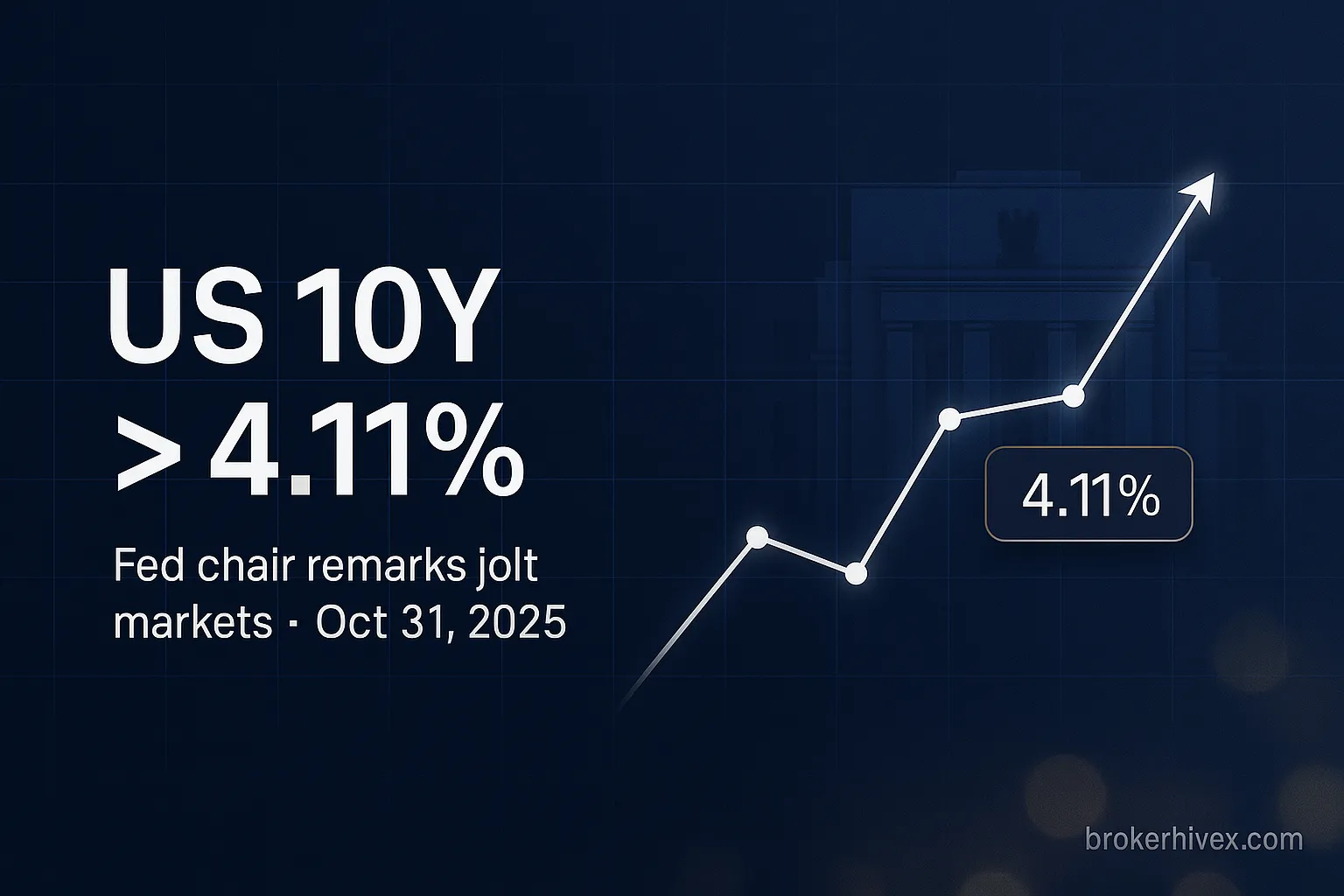
Benchmark 10-year yield : rose to approximately 4.11%–4.12% during the session (intraday high around 4.12%, daily range 4.083%–4.120%), a significant increase from the previous trading day. Intraday quotes and the daily range indicate that the yield broke through the key 4.11% technical level. ( barrons.com )
Closing Reference : The St. Louis Fed DGS10 showed an official closing yield of 4.08% on October 29th. Subsequent intraday gains reflected a repricing of Powell's remarks in the following day's trading. ( FRED )
Policy decision : The target range for the federal funds rate was lowered by 25 basis points to 3.75%–4.00% . Simultaneously, the FOMC announced that it will end balance sheet reduction (cease reducing securities holdings) on December 1st and released corresponding implementation instructions. ( federalreserve.gov )
Key signal : Powell emphasized after the meeting that "further rate cuts in December are not a foregone conclusion," and pointed out that with the government shutdown leading to a lack of some official data , decision-making will rely more on the balance of available information and risks. This statement directly undermined market expectations of "continuous rate cuts." ( Reuters )
US stocks and the dollar : Following Powell's remarks, the Dow Jones Industrial Average closed lower, the S&P 500 was flat, and the Nasdaq Composite rose slightly ; the stronger dollar highlighted the broad-spectrum impact of "repricing." ( Reuters )
Bond market prices : 10-year Treasury futures (TY) fell while spot bond yields rose, reflecting expectations of downgrades and a filling of the term premium. ( Reuters )
Technical/Psychological Level : The 4.10%-4.12% level saw multiple fluctuations in October. A breakout would mean the previous "low interest rate-easing trade" is being challenged, with the 10-year yield returning to the upper end of its early October range. ( barrons.com )
Expectations Shift : Previously, the market had bet a high probability of another rate cut this year . However, after Powell poured cold water on this, traders lowered their pricing for a December rate cut to "not certain." A Reuters pre-market analysis also indicated that only about a 70% probability had been priced in, significantly lower than before the meeting. ( Reuters )
Stopping quantitative tightening (QT) : The FOMC statement indicated that quantitative tightening will end on December 1st . Reuters added that with the termination of QT, reinvestment will resume to maintain ample reserves and interest rate transmission, and the balance sheet may be expanded again if necessary to ensure money market stability. ( federalreserve.gov )
Signal Interpretation : Ending balance sheet reduction is itself a form of "marginal easing," which should theoretically help lower long-term yields; however, the forward guidance that **"a rate cut in December is not guaranteed"** carries more weight in pricing, driving up yields in the short term. ( ft.com )
Short-term vs. Long-term : The significant decline in the two-year yield previously reflected bets on further interest rate cuts; however, the long-term yield is more sensitive to long-term inflation and supply-demand balance . With the policy path becoming "decerated," the repricing of the term premium in the 10-year and 30-year yields has been more dramatic. ( Reuters )
Debt Supply and Risk Compensation : Given the backdrop of fiscal deficits and refinancing pressures, there is no direct evidence that supply alone has driven this round of price increases. However, investors are reassessing the **downward elasticity of nominal interest rates**, increasing their compensation requirements for long-term holdings. (Industry Consensus Analysis)
Global bond market volatility : Since October, major global bond markets have experienced a rollercoaster ride, with the pricing spillover of US Treasuries onto European and Japanese bonds persisting and cross-market correlations remaining high. Reuters summarized it as "an unforgettable month for the bond market." ( Investing.com )
Data and the Impact of the Shutdown : The government shutdown reduces the availability of official data (employment, inflation components, etc.), and the Federal Reserve will rely more on "available information" and forward assessments. The limited data window before the December meeting will amplify the marginal impact of individual data points. ( Reuters )
Policy Communication : A flurry of speeches by FOMC officials, if continuing to emphasize a "wait-and-see" approach, could further constrain the probability of a December rate cut ; if inflation or employment unexpectedly deviates from their expected path, the probability distribution will be quickly repriced. ( Reuters )
Funding and Supply : The Treasury's refinancing and quarterly refinancing statements, year-end liquidity conditions (use of repurchase agreements, changes in excess reserves), and the reinvestment path after the cessation of balance sheet reduction will all affect the yield curve shape and term premium. ( Reuters )
Interest rate sensitive assets : Mortgage and corporate bond spreads are highly sensitive to changes in the 10-year maturity. If yields stabilize above 4.0%–4.2%, the downside potential for medium- to long-term borrowing costs is limited, and the "second-order effect" of credit spreads needs to be observed. ( Reuters )
Stock Valuation : Under the framework of **"slower pace of interest rate cuts + higher discount rates"**, earnings will play a more significant role in supporting valuations for US stocks; tech leaders are relatively resilient but volatility may increase. ( Reuters )
US Dollar and Commodities : The US dollar is sensitive to interest rate differentials and risk appetite . If the market continues to lower the probability of a December rate cut, the dollar will likely strengthen in the short term, pulling on gold and other risk assets. ( Reuters )
BrokerHivex is a financial media platform that displays information from the public internet or user-uploaded content. BrokerHivex does not support any trading platform or instrument. We are not responsible for any trading disputes or losses arising from the use of this information. Please note that the information displayed on the platform may be delayed, and users should independently verify its accuracy.


 Ro***le
 Su***ey