 BrokerHiveXBrokerHiveXBrokerHiveX
Summary:Meta announced a $27 billion investment to build global AI data centers, marking the tech giant's official entry into the "computing infrastructure" field. This strategy has attracted strong attention from Wall Street and is seen as the core of a new wave of capital investment following cloud computing.
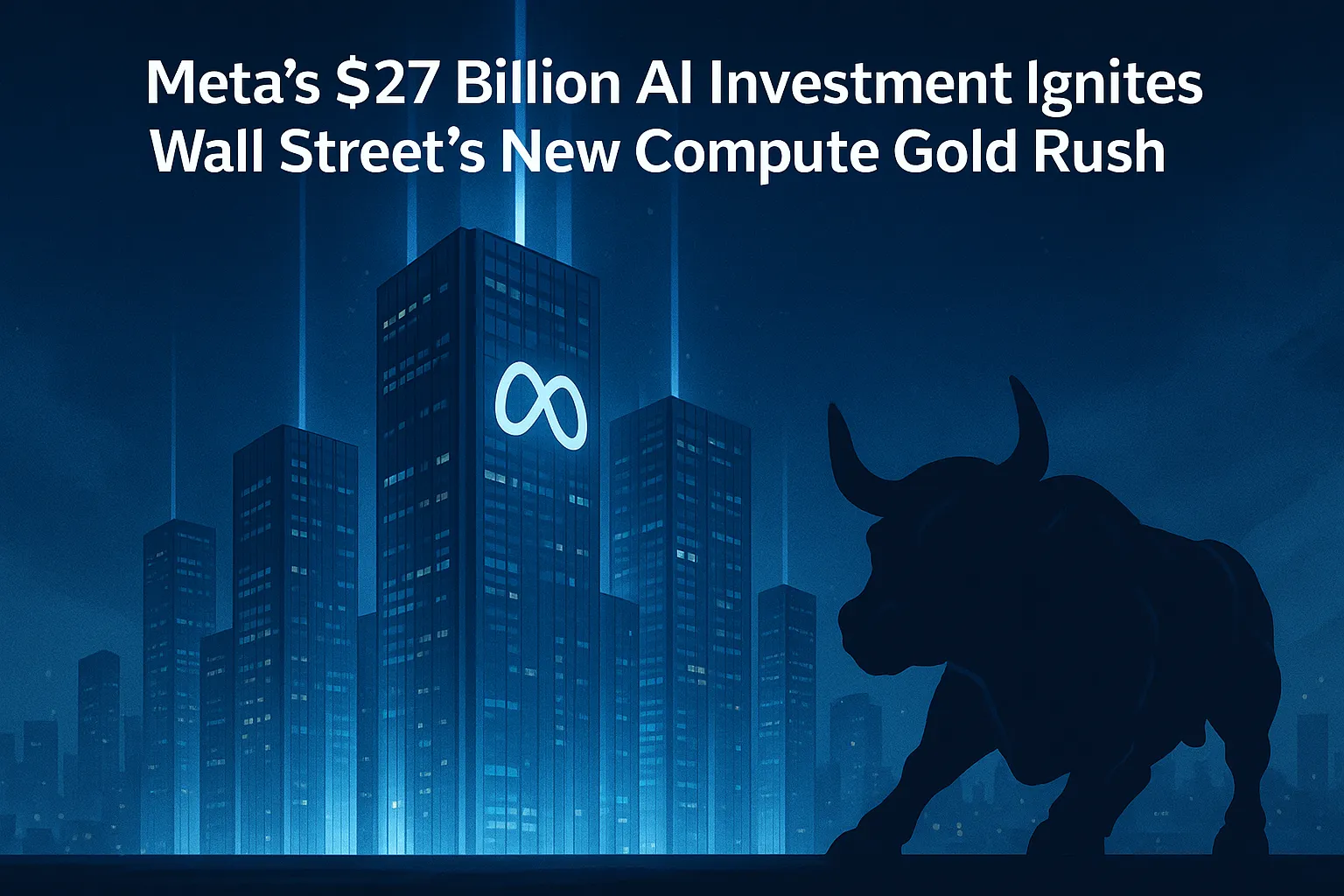
In Silicon Valley, every convergence of capital and technology has the potential to reshape the global economic landscape. In late October 2025, Meta Platforms (formerly Facebook) announced a $27 billion investment over the next few years to build next-generation artificial intelligence computing infrastructure. This figure is equivalent to one-third of the company's annual net profit, representing a fundamental transformation from a "social media empire" to an "AI infrastructure provider."
This investment will be used to expand data centers in the United States, Sweden, Ireland, and Singapore, and to introduce high-performance chip clusters and liquid cooling systems designed specifically for AI tasks. Meta also plans to develop its own AI training platform, "Artemis," to support internal models and external commercial services.
Meta CEO Mark Zuckerberg wrote in an internal memo:
"In the next decade, artificial intelligence will not only be a product feature, but also the core of the infrastructure. We are paving the way for this core."
This move immediately triggered a strong reaction from Wall Street. Meta's stock price rose 4.6% within a week of the announcement, and several investment institutions raised their target prices for the company, believing that the plan could make Meta the "Amazon Web Services (AWS) of the AI era."
Over the past decade, the capital market has shifted from "traffic dividends" to "cloud computing dividends." And now, computing power itself is being capitalized .
Analysts point out that the training scale of AI models is growing exponentially. OpenAI's GPT-5, Anthropic's Claude 4, and Google's Gemini Ultra all require the support of tens of thousands of GPUs. Computing power equals productivity; computing power is the new currency.
Meta's massive investments have made "AI infrastructure" the third major battleground for technology capital, following semiconductors and cloud computing. Morgan Stanley, in its latest report, points out:
“Computing infrastructure may become the most valuable hard asset class for investment between 2025 and 2030.”
With surging demand for high-performance computing, data center REITs (Real Estate Investment Trusts) have become a new favorite. Shares of US-based Digital Realty and Equinix have risen 32% and 41% respectively this year.
Meanwhile, chip giant NVIDIA's market capitalization has surpassed $3.2 trillion, exceeding Apple's and becoming one of the world's most valuable technology companies.
Meta's investments have also fueled volatility in the energy market. The massive power consumption of AI data centers has benefited several clean energy companies. For example, NextEra Energy has seen a surge in long-term power contracts, leading to record highs in the stock prices of some nuclear power plants and wind farms.
Meta's transformation had been brewing since the Metaverse debacle in 2022. After experiencing losses at Reality Labs, Zuckerberg realized that instead of betting on the future of virtual space, it was better to bet on the "soil of AI".
There are three main underlying principles behind this strategy:
Vertical integration of computing resources : Building our own AI data centers reduces reliance on AWS and Google Cloud.
This creates an internal flywheel effect : computing power feeds back into advertising algorithms, content distribution, and AI assistant services.
External commercialization potential : In the future, it may be possible to open up "AI Compute Leasing" to enterprises, becoming a new source of revenue.
Industry insiders have likened it to "Tesla's Gigafactory in the AI era." Just as Tesla controls the battery supply chain, Meta is attempting to control the AI energy and hardware chain.
Despite the high market sentiment, the challenges are obvious.
Energy consumption is staggering : each large AI data center consumes the equivalent of 300,000 households' worth of electricity annually, and Meta's plan to add six more centers means a surge in electricity demand.
Carbon emission pressure : EU and California regulators are already studying a carbon tax scheme for AI computing centers. Meta may face additional costs if it cannot guarantee a supply of green energy.
Long capital recovery period : The investment recovery period for AI infrastructure is about 8–12 years, which is far longer than the average cycle of Internet business.
Technology iteration risk : GPU technology updates extremely quickly, and the new generation of Blackwell chips may replace the old architecture in the short term, resulting in asset depreciation.
Analysts warn: "AI infrastructure is not a high-profit industry, but a capital-intensive one. It burns through cash quickly, returns are slow, and the margin for error is extremely low."
Meta's move quickly triggered a global chain reaction.
Microsoft announced an additional $10 billion to build AI data centers in the UK and Australia.
Amazon AWS will expand its European computing campuses and launch the “Compute Credit Bonds” financing model.
Saudi Arabia and the UAE sovereign wealth funds are accelerating investment in chip manufacturing and cooling technologies to create an "AI corridor" in the Middle East.
In Asia, Japan's SoftBank Group and South Korea's SK Hynix are also considering collaborating with Meta to build a transnational AI computing alliance to reduce their dependence on chips and energy.
The global competition for AI infrastructure has become a new geoeconomic arena following 5G and semiconductors.
For investors, Meta's $27 billion bet is not only a technological move, but also a signal for the financial markets.
With high inflation and stabilizing interest rates, Wall Street is looking for new high-growth sectors. AI infrastructure, which combines "technological growth potential" with "infrastructure stability," has become a choice for both safe-haven and speculative investments.
Investment bank Goldman Sachs predicts that the global AI data center market will reach $1.2 trillion by 2030, with an average annual growth rate of over 20%.
In the next decade, computing power may become a "strategic asset" after oil and gold.
From the internet era to the mobile era, infrastructure upgrades often give rise to new dominant players. Meta's $27 billion investment is not just a business decision, but a battle for technological sovereignty and the power of capital .
Whoever possesses computing power possesses the ability to define the future.
In this new era, data centers are the mines, GPUs are the drill bits, and AI is the gold.
As Wall Street reinvests in computing power, the next round of global wealth migration may have already begun.
BrokerHivex is a financial media platform that displays information from the public internet or user-uploaded content. BrokerHivex does not support any trading platform or instrument. We are not responsible for any trading disputes or losses arising from the use of this information. Please note that the information displayed on the platform may be delayed, and users should independently verify its accuracy.
 Ro***le
 Su***ey