 BrokerHiveXBrokerHiveXBrokerHiveX
Summary:As the market gradually recovers, Ethereum on-chain activity has significantly increased, with total value locked in DeFi rebounding to a yearly high, and Layer 2 networks experiencing a surge in both funding and users. Ethereum is re-establishing its position as the "core infrastructure" of the blockchain ecosystem, becoming a key engine for the new round of digital asset growth.
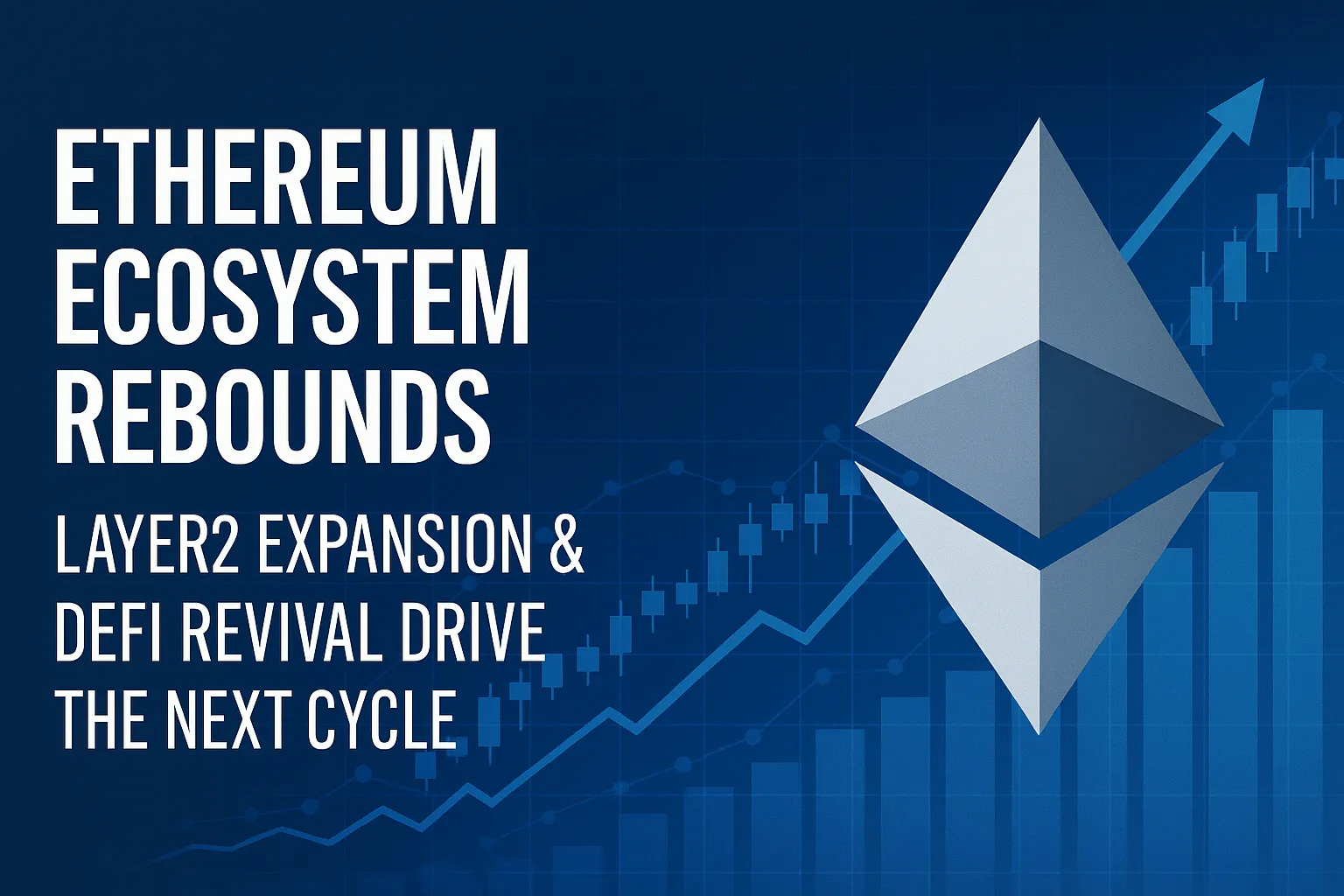
Since entering the fourth quarter, the number of transactions and gas consumption on the Ethereum network have continued to rise. The total value locked (TVL) of several major DeFi protocols has increased by more than 30% year-on-year, indicating that on-chain fund activity is returning to the second-highest level since the peak in 2021.
Trading volume on decentralized exchanges (DEXs) has increased significantly, with stablecoins and liquidity staking (LSD) being the main drivers. Specifically, the staking ratio for ETH has exceeded 24%, indicating rising investor confidence in long-term returns and cybersecurity.
This recovery is not simply a price rebound, but rather an endogenous repair of on-chain applications and ecosystem structure .
Layer 2 networks (including Arbitrum, Optimism, Base, Blast, etc.) are experiencing a simultaneous explosion in user numbers and locked-in value. Low gas costs, high-speed trading, and liquidity aggregation capabilities have made Layer 2 a new battleground for capital and developers.
Over the past six months, multiple projects have completed financing and ecosystem incentive programs, with the total locked-in value breaking historical records.
Arbitrum continues to maintain its dominant position, holding over 40% of the Layer 2 market share;
Base leverages its collaborative ecosystem with mainstream trading platforms to become the fastest-growing network of emerging users;
Optimism is accelerating the deployment of its "Superchain" strategy to promote the compatibility of cross-chain assets and smart contracts.
Analysts believe that Ethereum's scaling landscape is shifting from "single-chain competition" to "multi-layer collaboration," and this layered structure is expected to support the next cycle of high-intensity application explosion.
The core logic of decentralized finance is quietly changing. Early "farm-style" products that relied on incentives and high returns are giving way to structured, risk-stratified, and institutionalized products.
The new protocol provides users with a combination of functions that are closer to traditional finance through automated market making, decentralized clearing, and a cross-chain credit system.
Meanwhile, the growth and liquidity rebalancing mechanisms of stablecoins enable the DeFi ecosystem to have greater sustainability.
Institutional investors are entering this space, deploying resources through on-chain liquidity pools, RWA (Real-World Assets), and tokenized bonds to inject a more sustainable source of funding into DeFi.
Ethereum is evolving from a single smart contract platform into the underlying settlement layer of the global digital economy .
Its powerful network effect, cross-chain compatibility, and security mechanisms make it a core node connecting stablecoins, tokenized assets, and Web3 applications.
Meanwhile, EIP-4844 (a proposal for data fragmentation and cost compression) is underway, which will significantly reduce the settlement costs of Layer 2 and provide technical support for the application layer boom.
The developer community generally believes that the future network structure of Ethereum will resemble a "modular internet"—the bottom layer provides secure settlement, the middle layer provides scalable throughput, and the top layer enables financial and social innovation.
From a technical perspective : data compression, cross-chain compatibility, privacy computing, and account abstraction (AA) will collectively drive improvements in user experience.
From a funding perspective : stablecoin growth, institutional funding entry, and Layer 2 incentive programs create a positive cycle.
Application dimension : New scenarios such as on-chain derivatives, structured returns, and cross-border payments will bring real demand.
In the short term, the market will still face volatility and valuation corrections, but the long-term trend is clear—the Ethereum ecosystem is becoming the infrastructure of the global digital financial system.
Ethereum's recovery is not just about price rebound, but also about the rebirth of its infrastructure capabilities.
From scaling to financialization, from decentralization to institutionalization, the Ethereum ecosystem is building the underlying power for the next wave of the global digital economy.
BrokerHivex is a financial media platform that displays information from the public internet or user-uploaded content. BrokerHivex does not support any trading platform or instrument. We are not responsible for any trading disputes or losses arising from the use of this information. Please note that the information displayed on the platform may be delayed, and users should independently verify its accuracy.
 Ro***le
 Su***ey