BrokerHiveXBrokerHiveXBrokerHiveX
Summary:In August 2025, the U.S. Bureau of Labor Statistics (BLS) significantly revised down its non-farm payroll data for May and June by a total of 258,000 jobs, sparking a strong reaction from the political community and leading President Trump to fire the Census Director. This was the largest downward revision since 1979, excluding the COVID-19 pandemic, and it dealt a blow to market confidence. The transparency and reliability of the statistical system have once again become a focus, and investors should pay attention to the potential impact of employment data revisions on policy and market volatility. #USEmploymentData#Non-farmRevisions#CensusDirectorFired#TrumpPolicies#EconomicDataRisks

On August 4, US President Trump officially replaced Erika McEntarfer, Director of the Bureau of Labor Statistics (BLS), due to revisions to the non-farm payroll data. The BLS announced the same day that it had revised downward its forecast for job gains in May and June 2025 by a combined 258,000 [Source: Reuters, August 4, 2025]. This represents the largest combined two-month downward revision since 1979 (excluding the impact of the pandemic) and is significantly higher than the median for the past decade.
This data has raised questions in the market about the true extent of the employment situation in the United States and has also exacerbated concerns about the credibility of government statistics.
The BLS explained that preliminary non-farm payroll data, released on the first Friday of each month, is typically revised in the following months based on additional business feedback and seasonal adjustments. However, over the past 12 months, eight of these revisions have been downward revisions [Source: BLS Historical Report]. The June data was revised downward by 133,000 jobs, the largest monthly revision since April 2021; and the third revision to May's data also saw a downward adjustment of 125,000 jobs, a record for a non-pandemic year since 1983.
This shows that the current data collection mechanism is facing the accumulation of systematic errors in a rapidly changing employment environment.
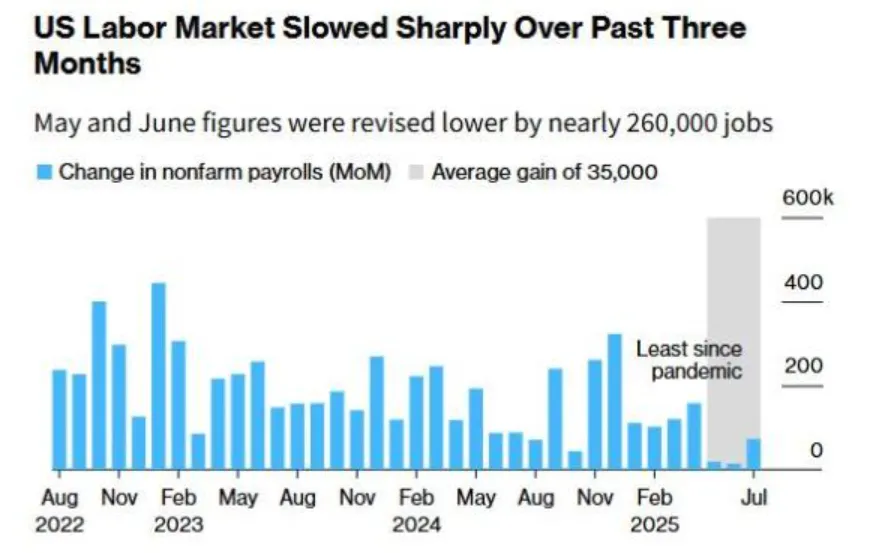
In July, the United States added only 73,000 new jobs, far below expectations.
Employment data is a crucial basis for the Federal Reserve's policymaking, and its reliability is crucial. This round of revisions comes at a time when US interest rate policy is highly sensitive, raising concerns among investors that the Fed is basing policy on flawed employment assumptions, potentially leading to a lag or overshoot in monetary policy.
In addition, large data revisions may also trigger market fluctuations, especially affecting the US dollar exchange rate, bond yields and industries closely related to employment (such as consumption and retail).
The turmoil in the employment data exposes potential systemic errors in the US statistical system and highlights signs of internal pressure and political interference at the government level. For investors, this significant revision in non-farm payroll data could undermine market confidence in the short term, especially for traders who rely on macroeconomic indicators for short-term judgment.
In the current environment, investors should remain cautious in interpreting official data, especially focusing on the consistency between revised data trends and policy guidance. At the same time, it is recommended to refer to alternative employment indicators (such as Indeed hiring trends and the ADP employment report) as a source of cross-validation to enhance understanding of the true state of the market.
Considering the uncertainty in the path of monetary policy, investors are advised to maintain a moderately defensive stance in asset allocation, avoid blindly increasing positions in risky assets during short-term fluctuations, and continue to pay attention to the signals released by the Federal Reserve's next two FOMC meetings, and flexibly adjust strategies to respond to possible market shifts.
Data is not only a barometer of the market, but can also be a source of confusion. Want to obtain timely and authoritative global economic data analysis?
Want to be the first to grasp global market trends and investment opportunities? Follow us on BrokerHiveX for the latest in-depth analysis and real-time information!
BrokerHivex is a financial media platform that displays information from the public internet or user-uploaded content. BrokerHivex does not support any trading platform or instrument. We are not responsible for any trading disputes or losses arising from the use of this information. Please note that the information displayed on the platform may be delayed, and users should independently verify its accuracy.